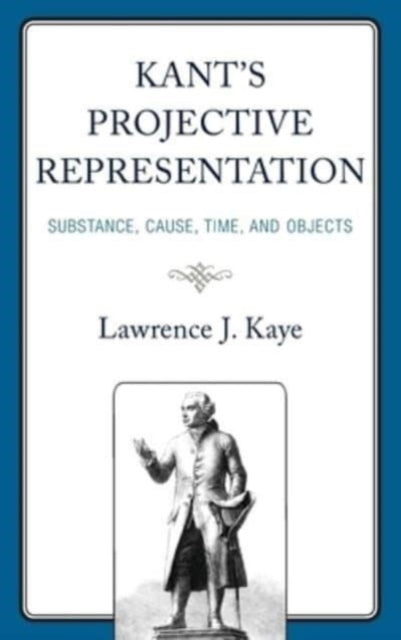
Lawrence J. Kaye
Kant's Projective Representation: Substance, Cause, Time, and Objects
Kant's Projective Representation: Substance, Cause, Time, and Objects
💎 Earn 398 Points (£3.98) on this item.
We can order this item for you. Delivery usually takes about 4 to 6 weeks.
This item is not held in our immediate stock. We will order it for you after checkout.
Estimated delivery: About 4 to 6 weeks
- Condition: Brand new
- UK Delivery times: Usually arrives within 2 - 3 working days
- UK Shipping: Fee starts at £3.89. Subject to product weight & dimension
Bulk ordering. Want 15 or more copies? Get a personalised quote and bigger discounts. Learn more about bulk orders.
Couldn't load pickup availability
- More about Kant's Projective Representation: Substance, Cause, Time, and Objects
Kants Projective Representation explores Kants account of mental representation, revealing the necessary unity of consciousness and the schematized categories that constitute representation. It reconciles realism and idealism by showing how we empirically represent a world that is external to consciousness but use purely mental constructions.
Format: Hardback
Length: 182 pages
Publication date: 15 December 2023
Publisher: Lexington Books
Kants Projective Representation: Substance, Cause, Time, and Objects is a comprehensive textual exploration of Kants account of mental representation, offering a fresh perspective on the fundamental doctrines of the Critique of Pure Reason. Lawrence J. Kaye contends that the analytic unity of concepts in the Transcendental Deduction establishes the necessary unity of consciousness, which is also the basis of representation. In the First Analogy, Kant asserts that our ability to represent sequences, simultaneity, and durations relies on the conceptually prior representation of persistence. Without persistence in empirical perceptions, we must represent persistence with identities across intuitions that project an external world of persistent matter. The other Analogies elucidate how we represent sequences through necessitated state transitions in objects and how we represent simultaneity through mutual influence. These pure unifications that constitute representation are the schematized (relational) categories—instances of the same types of unifying functions that underlie the concepts of substance, causation, and community. We know a priori that all perceptual experiences will project a world with this structure, which is synthetic a priori metaphysical knowledge. This interpretation also demonstrates how Kant reconciles realism and idealism: we empirically represent a world that is external to consciousness, but we do so by using unities that are purely mental constructions.
Dimension: 229 x 152 (mm)
ISBN-13: 9781793651556
UK and International shipping information
UK and International shipping information
We deliver throughout the United Kingdom and to 128 countries and territories worldwide, including the United States, Australia, Canada, Germany, Spain and France.