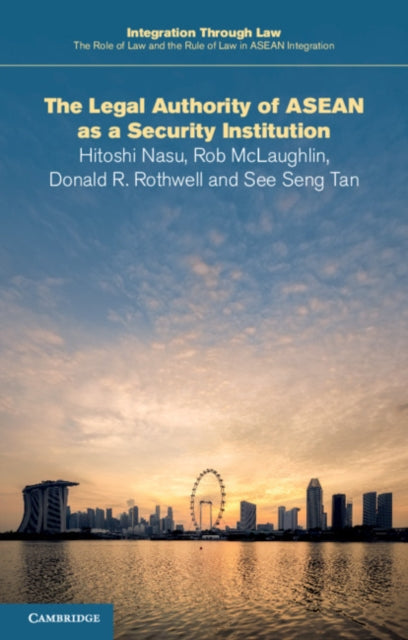

HitoshiNasu,Rob McLaughlin,Donald R.Rothwell,See SengTan
Legal Authority of ASEAN as a Security Institution
Legal Authority of ASEAN as a Security Institution
YOU SAVE £4.22
- Condition: Brand new
- UK Delivery times: Usually arrives within 2 - 3 working days
- UK Shipping: Fee starts at £3.89. Subject to product weight & dimension
Bulk ordering. Want 15 or more copies? Get a personalised quote and bigger discounts. Learn more about bulk orders.
Couldn't load pickup availability
- More about Legal Authority of ASEAN as a Security Institution
The Association of Southeast Asian Nations (ASEAN) has achieved deeper regional market integration to establish a socio-economic foundation for a regional community. Still, inter-state trust is not assured due to the maintenance of political regime stability against external interference. ASEAN has emerged as a distinct model of security institution, and the region's security landscape has diversified with non-traditional security issues. This book examines ASEAN's legal nature and form of authority to address diverse regional security issues, providing a fresh perspective on ASEAN's role as a security institution. It also reveals the normative role that ASEAN plays in facilitating the processes of norm development, localisation, and internalisation as it deals with contemporary security challenges.
Format: Paperback / softback
Length: 320 pages
Publication date: 25 April 2019
Publisher: Cambridge University Press
The Association of Southeast Asian Nations (ASEAN) has made significant strides in achieving deeper regional market integration, aiming to establish a socio-economic foundation for the development of a cohesive regional community. While inter-state trust within the ASEAN region has been established, there remains apprehension regarding the assurance of stability in the face of external interference. Nonetheless, ASEAN has demonstrated its ability to function as a unique security institution through its institutional practices.
In the contemporary security landscape of the region, a wide range of non-traditional security issues has emerged. This book delves into the legal nature and form of ASEAN's authority to address these diverse regional security challenges. By examining ASEAN's role beyond the surface of diplomacy and prevailing political circumstances, it offers a fresh perspective on the organization's role as a security institution. Through an interdisciplinary analysis, this book reveals the normative role that ASEAN plays in facilitating the processes of norm development, localization, and internalization as it navigates the contemporary security challenges confronting Southeast Asia.
The ASEAN region has experienced significant economic growth and development in recent years, driven by factors such as increased trade, investment, and tourism. However, this growth has also brought with it challenges, including environmental degradation, social inequality, and political instability. ASEAN has recognized the importance of addressing these issues and has taken steps to promote regional cooperation and integration.
One of the key achievements of ASEAN has been the establishment of the ASEAN Economic Community (AEC). The AEC is a regional free trade agreement that aims to promote economic growth, reduce trade barriers, and increase investment within the region. The AEC has also included provisions for cooperation in areas such as agriculture, tourism, and energy.
In addition to the AEC, ASEAN has also established several other regional institutions to promote cooperation and security. These include the ASEAN Regional Forum (ARF), which is a platform for dialogue and cooperation on security issues, and the ASEAN Defense Ministers Meeting Plus (ADMM+), which is a forum for defense cooperation and security policy coordination.
ASEAN has also played a role in promoting regional peace and stability through its efforts to address regional conflicts and disputes. For example, ASEAN has been involved in peacekeeping operations in the Philippines and Myanmar, and has worked to promote dialogue and reconciliation in conflict-affected areas such as the South China Sea and the East Asia region.
Despite these achievements, ASEAN faces several challenges in the future. One of the biggest challenges is the need to address the issue of regionalism and nationalism, which can sometimes hinder cooperation and integration. Another challenge is the need to address the issue of human rights and democracy, which are important for promoting regional stability and prosperity.
In conclusion, ASEAN has made significant strides in achieving deeper regional market integration and establishing a socio-economic foundation for the development of a regional community. While there are still challenges to be addressed, ASEAN has demonstrated its ability to function as a unique security institution and to promote regional peace and stability. With continued efforts and cooperation, ASEAN is well-positioned to continue playing a key role in shaping the future of Southeast Asia and the world.
Weight: 466g
Dimension: 141 x 215 x 16 (mm)
ISBN-13: 9781108705653
UK and International shipping information
UK and International shipping information
We deliver throughout the United Kingdom and to 128 countries and territories worldwide, including the United States, Australia, Canada, Germany, Spain and France.