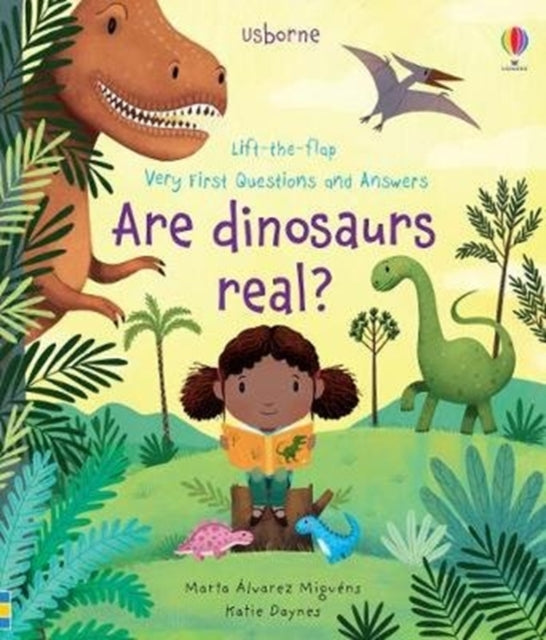
Katie Daynes,Katie Daynes
Lift-the-flap Very First Questions and Answers Are Dinosaurs Real?
Lift-the-flap Very First Questions and Answers Are Dinosaurs Real?
💎 Earn 28 Points (£0.28) on this item.
YOU SAVE £2.34
- Condition: Brand new
- UK Delivery times: Usually arrives within 2 - 3 working days
- UK Shipping: Fee starts at £3.89. Subject to product weight & dimension
Bulk ordering. Want 15 or more copies? Get a personalised quote and bigger discounts. Learn more about bulk orders.
Couldn't load pickup availability
- More about Lift-the-flap Very First Questions and Answers Are Dinosaurs Real?
This book is for young children to learn about dinosaurs and where they have gone.
Format: Board book
Length: 12 pages
Publication date: 04 March 2021
Publisher: Usborne Publishing Ltd
We see dinosaurs on TV and in books, but where have all the real ones gone? How big were they? Did they have feathers? What did they eat? And how do we know so much about them? This charming book allows young children to find out for themselves.
Dinosaurs are fascinating creatures that have captured the imagination of people for centuries. While we can see them on TV and in books, it's important to ask ourselves: where have all the real ones gone? These majestic animals once roamed the Earth, but over time, they disappeared.
One of the most intriguing questions about dinosaurs is their size. These creatures were enormous, some measuring up to 30 meters long and weighing several tons. Their size was a result of their evolution, as they needed to be able to survive in their environment.
Another question that many people have is whether dinosaurs had feathers. While some scientists believe that they did, others argue that they were covered in scales or other types of skin. Feathers would have provided insulation and helped dinosaurs to regulate their body temperature, which was important in their warm, tropical habitats.
What did dinosaurs eat? They were carnivores, which means that they primarily consumed meat. Their diet varied depending on the species, but they were likely to eat a variety of animals, including small mammals, birds, and reptiles. Some dinosaurs were even capable of eating plants, although this was less common.
One of the most remarkable things about dinosaurs is the amount of information that we have about them. Scientists have studied these creatures for thousands of years, and have uncovered a wealth of information that has helped us to understand their behavior, anatomy, and evolution. This information has been gathered through a variety of methods, including fossil excavation, scientific analysis, and observation.
Fossil excavation is one of the most important methods of studying dinosaurs. Scientists can examine the bones and teeth of these creatures to learn about their size, shape, and structure. This information can then be used to create detailed models of dinosaurs, which can help us to understand how they lived and interacted with their environment.
Scientific analysis is another important method of studying dinosaurs. Scientists can use a variety of techniques, including radiocarbon dating, to determine the age of fossils. This information can help us to understand the timeline of dinosaur evolution and to identify the species that were present at different times.
Observation is also an important method of studying dinosaurs. Scientists can observe the behavior of living animals, such as birds, to gain insights into the behavior of extinct dinosaurs. For example, birds are known to have feathers, which are similar to the feathers that some dinosaurs are believed to have had. By observing the behavior of birds, scientists can infer the behavior of extinct dinosaurs.
In conclusion, dinosaurs are fascinating creatures that have captured the imagination of people for centuries. While we can see them on TV and in books, it's important to ask ourselves: where have all the real ones gone? These majestic animals once roamed the Earth, but over time, they disappeared. By studying fossils, scientific analysis, and observation, we can learn more about these incredible creatures and gain a better understanding of their behavior, anatomy, and evolution.
Weight: 274g
Dimension: 167 x 196 x 17 (mm)
ISBN-13: 9781474979870
UK and International shipping information
UK and International shipping information
We deliver throughout the United Kingdom and to 128 countries and territories worldwide, including the United States, Australia, Canada, Germany, Spain and France.