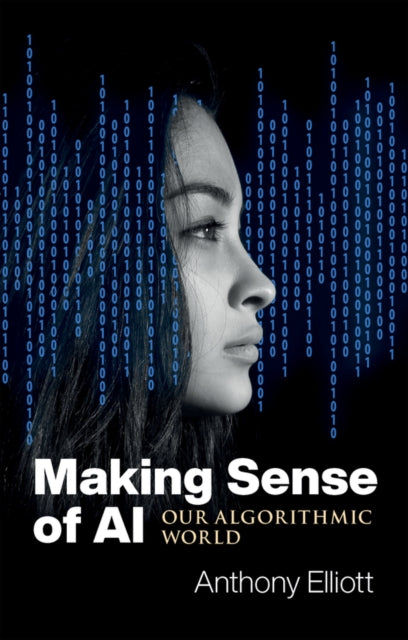
Anthony Elliott
Making Sense of AI: Our Algorithmic World
Making Sense of AI: Our Algorithmic World
YOU SAVE £2.32
- Condition: Brand new
- UK Delivery times: Usually arrives within 2 - 3 working days
- UK Shipping: Fee starts at £3.89. Subject to product weight & dimension
Bulk ordering. Want 15 or more copies? Get a personalised quote and bigger discounts. Learn more about bulk orders.
Couldn't load pickup availability
- More about Making Sense of AI: Our Algorithmic World
Artificial intelligence (AI) is a controversial topic with economic, political, social, and cultural consequences. Elliott's book "Making Sense of AI" provides a systematic account of how automated intelligent machines impact different spheres and aspects of public and private life, including the automation of workforces, surveillance capitalism, warfare and lethal autonomous weapons, the spread of racist robots, and the automation of social inequalities. It also considers the role of AI in confronting global risks and social futures, such as global pandemics and the search for energy security and combating climate change.
\n Format: Paperback / softback
\n Length: 220 pages
\n Publication date: 15 October 2021
\n Publisher: Polity Press
\n
The advent of industrial robots, self-driving cars, customer-service chatbots, and Google's algorithmic predictions has sparked a heated public debate surrounding artificial intelligence (AI). This technology has ignited intense controversy due to its far-reaching economic, political, social, and cultural consequences. In his book, "Making Sense of AI," Elliott delves into the intricate dynamics of how automated intelligent machines shape various aspects of public and private life.
Automation of Workforces:
One of the central themes of Elliott's book is the impact of AI on the workforce. He explores how the automation of repetitive and routine tasks has led to job displacement and economic inequality. While AI has the potential to increase productivity and efficiency, it also threatens the livelihoods of many workers who rely on manual labor. Elliott raises concerns about the potential for AI to exacerbate social tensions and create a divide between those who have access to technology and those who do not.
Surveillance Capitalism:
Another critical aspect of AI's impact is its role in surveillance capitalism. Elliott argues that AI-powered systems enable companies to collect vast amounts of personal data from individuals, which can then be used to target advertising and other commercial interests. This practice raises concerns about privacy, consent, and the erosion of individual autonomy. Elliott suggests that the increasing reliance on AI-driven marketing strategies may lead to the further commodification of human experiences and the reinforcement of existing social inequalities.
Warfare and Lethal Autonomous Weapons:
The development of AI has also raised profound ethical questions about warfare and the use of lethal autonomous weapons. Elliott explores how AI can be used to enhance military capabilities, such as targeting and surveillance, and how it can contribute to the escalation of conflicts. He raises concerns about the potential for AI to make war more unpredictable, unpredictable, and difficult to control, leading to unintended consequences and human casualties.
Spread of Racist Robots:
Another alarming consequence of AI is the spread of racist and discriminatory robots. Elliott argues that the use of AI algorithms to train these robots can perpetuate biases and reinforce existing social inequalities. He highlights the case of Amazon's facial recognition technology, which was found to be less accurate for people of color than for white individuals, perpetuating harmful stereotypes and perpetuating social tensions.
Automation of Social Inequalities:
AI has the potential to automate social inequalities and exacerbate existing disparities. Elliott explores how AI-powered systems can be used to automate hiring, lending, and other decision-making processes, which can lead to discrimination against marginalized groups. He suggests that the increasing reliance on AI-driven systems may perpetuate existing social hierarchies and reinforce existing power structures.
Confronting Global Risks and Social Futures:
Despite the challenges posed by AI, Elliott also recognizes its potential to address global risks and social futures. He discusses how smart algorithms can be used to predict and respond to global pandemics, such as COVID-19, and how they can help combat climate change. Elliott argues that AI can play a crucial role in developing sustainable solutions to complex social and environmental problems.
Making Sense of AI:
"Making Sense of AI" is a judiciously comprehensive account of artificial intelligence for those with little or no previous knowledge of the topic. Elliott provides a systematic exploration of how automated intelligent machines impact different spheres and aspects of public and private life. The book is organized into five chapters, each dedicated to a specific aspect of AI's impact.
The first chapter provides an introduction to the concept of AI and its historical development. Elliott explains the basic principles of AI, including machine learning, natural language processing, and robotics, and how they are being applied to various industries. He also discusses the ethical and social considerations surrounding AI, including the potential for unintended consequences and the need for responsible regulation.
The second chapter explores the impact of AI on the workforce. Elliott discusses how the automation of repetitive and routine tasks has led to job displacement and economic inequality. He also explores how AI can be used to enhance job skills and create new job opportunities. Elliott raises concerns about the potential for AI to exacerbate social tensions and create a divide between those who have access to technology and those who do not.
The third chapter examines the role of AI in surveillance capitalism. Elliott argues that AI-powered systems enable companies to collect vast amounts of personal data from individuals, which can then be used to target advertising and other commercial interests. He raises concerns about privacy, consent, and the erosion of individual autonomy. Elliott suggests that the increasing reliance on AI-driven marketing strategies may lead to the further commodification of human experiences and the reinforcement of existing social inequalities.
The fourth chapter explores the ethical and social implications of AI in warfare and the use of lethal autonomous weapons. Elliott argues that the development of AI has raised profound ethical questions about warfare and the use of lethal autonomous weapons. He explores how AI can be used to enhance military capabilities, such as targeting and surveillance, and how it can contribute to the escalation of conflicts. Elliott raises concerns about the potential for AI to make war more unpredictable, unpredictable, and difficult to control, leading to unintended consequences and human casualties.
The fifth chapter examines the spread of racist and discriminatory robots. Elliott argues that the use of AI algorithms to train these robots can perpetuate biases and reinforce existing social inequalities. He highlights the case of Amazon's facial recognition technology, which was found to be less accurate for people of color than for white individuals, perpetuating harmful stereotypes and perpetuating social tensions.
Conclusion:
The advent of industrial robots, self-driving cars, customer-service chatbots, and Google's algorithmic predictions has sparked a heated public debate surrounding artificial intelligence (AI). This technology has ignited intense controversy due to its far-reaching economic, political, social, and cultural consequences. In his book, "Making Sense of AI," Elliott delves into the intricate dynamics of how automated intelligent machines shape various aspects of public and private life.
Through his comprehensive analysis, Elliott demonstrates how AI has the potential to transform our world in both positive and negative ways. While it can enhance productivity, automate routine tasks, and improve decision-making processes, it also poses significant risks to the workforce, privacy, and social inequalities. Elliott's book provides valuable insights into the ethical and social considerations surrounding AI and offers practical solutions for addressing its challenges.
As we navigate the rapidly evolving landscape of AI, it is essential to approach this technology with caution, transparency, and responsibility. By engaging in informed discussions and implementing responsible regulations, we can ensure that AI benefits society as a whole and promotes the well-being of all individuals.
In conclusion, "Making Sense of AI" is a must-read for anyone interested in understanding the complex dynamics of artificial intelligence and its impact on our world. Elliott's book provides a comprehensive and insightful account of AI's past, present, and future, and offers valuable insights into the ethical and social considerations surrounding this rapidly evolving technology. By approaching AI with caution, transparency, and responsibility, we can ensure that it benefits society as a whole and promotes the well-being of all individuals.
\n Weight: 316g\n
Dimension: 138 x 217 x 22 (mm)\n
ISBN-13: 9781509548903\n \n
UK and International shipping information
UK and International shipping information
We deliver throughout the United Kingdom and to 128 countries and territories worldwide, including the United States, Australia, Canada, Germany, Spain and France.