Professor ManuelDeLanda
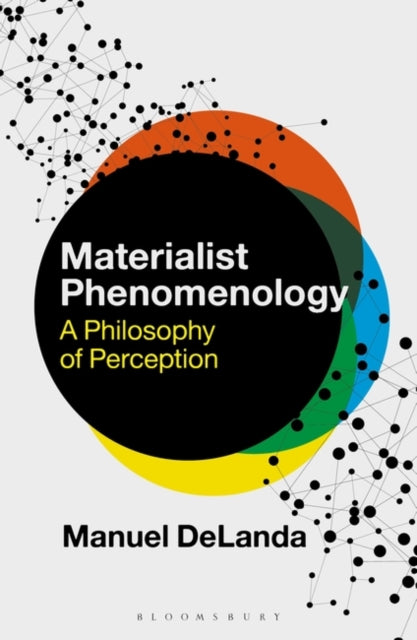
Materialist Phenomenology: A Philosophy of Perception
Materialist Phenomenology: A Philosophy of Perception
YOU SAVE £3.48
- Condition: Brand new
- UK Delivery times: Usually arrives within 2 - 3 working days
- UK Shipping: Fee starts at £3.89. Subject to product weight & dimension
Bulk ordering. Want 15 or more copies? Get a personalised quote and bigger discounts. Learn more about bulk orders.
Couldn't load pickup availability
- More about Materialist Phenomenology: A Philosophy of Perception
Bringing together phenomenology and materialism, Manuel DeLanda has created a new theory of visual perception that engages the scientific, philosophical, and mathematical fields to explore how vision shapes what matters in the 21st century.
\n Format: Paperback / softback
\n Length: 224 pages
\n Publication date: 21 October 2021
\n Publisher: Bloomsbury Publishing PLC
\n
In a groundbreaking synthesis, international theorist Manuel DeLanda has brought together phenomenology and materialism, two seemingly opposing perspectives, to create an entirely new theory of visual perception. By engaging the scientific disciplines of biology, ecological psychology, neuroscience, and robotics, as well as the philosophical ideas of the embodied mind and the mathematical frameworks of dynamic systems theory, DeLanda has crafted a comprehensive and interdisciplinary understanding of how vision shapes the world around us. This transdisciplinary and rigorous analysis delves into the intricate mechanisms through which vision influences our perception of objects, spaces, and ourselves, ultimately shaping the very fabric of what matters.
Through his innovative approach, DeLanda challenges traditional notions of visual perception and offers a fresh perspective on the role of vision in shaping our understanding of the world. He argues that vision is not merely a passive sense but a dynamic and active process that actively constructs our reality. By exploring the interplay between the biological mechanisms of vision, the cognitive processes of perception, and the technological advancements that have shaped our visual environment, DeLanda provides a rich tapestry of insights into how vision shapes our experiences and interactions with the world.
One of the key insights of DeLanda's theory is the notion of "object-oriented perception." According to this perspective, vision is not just about perceiving individual objects but about understanding the relationships and connections between objects. DeLanda argues that vision is not a standalone sense but is deeply intertwined with other senses, such as touch, hearing, and smell, and that these sensory modalities contribute to our understanding of the world in complex and interdependent ways.
Another important aspect of DeLanda's theory is the role of technology in shaping visual perception. He argues that the development of new visual technologies, such as virtual reality, augmented reality, and surveillance cameras, has fundamentally changed the way we perceive and interact with the world. These technologies not only alter our visual experiences but also shape our cognitive processes and social interactions, creating new opportunities and challenges for human perception and behavior.
In conclusion, Manuel DeLanda's theory of visual perception is a groundbreaking synthesis that brings together phenomenology, materialism, and a range of scientific and philosophical disciplines. By challenging traditional notions of visual perception and offering a fresh perspective on the role of vision in shaping our understanding of the world, DeLanda provides a valuable contribution to the field of visual studies and beyond. His transdisciplinary and rigorous analysis offers a rich tapestry of insights into how vision shapes our experiences and interactions with the world, and has the potential to inspire new ways of thinking about the relationship between the mind, body, and technology in the 21st century.
\n Weight: 257g\n
Dimension: 198 x 129 (mm)\n
ISBN-13: 9781350263956\n \n
UK and International shipping information
UK and International shipping information
We deliver throughout the United Kingdom and to 128 countries and territories worldwide, including the United States, Australia, Canada, Germany, Spain and France.