Matthieu Felt
Meanings of Antiquity: Myth Interpretation in Premodern Japan
Meanings of Antiquity: Myth Interpretation in Premodern Japan
YOU SAVE £13.44
- Condition: Brand new
- UK Delivery times: Usually arrives within 2 - 3 working days
- UK Shipping: Fee starts at £3.89. Subject to product weight & dimension
Bulk ordering. Want 15 or more copies? Get a personalised quote and bigger discounts. Learn more about bulk orders.
Couldn't load pickup availability
- More about Meanings of Antiquity: Myth Interpretation in Premodern Japan
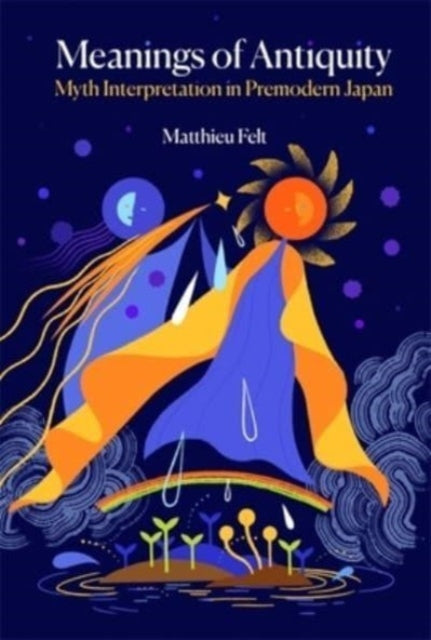
Between 800 and 1800 CE, the oldest Japanese myths recorded in the Kojiki and Nihon shoki changed in meaning and significance, leading to new adaptations of these myths. Matthieu Felt's book explores the geographical, cosmological, epistemological, and semiotic changes that led to these adaptations, demonstrating that the meanings of Japanese antiquity and of Japans most ancient texts are a work in progress.
Format: Hardback
Length: 376 pages
Publication date: 18 July 2023
Publisher: Harvard University Press
Meanings of Antiquity is a groundbreaking exploration into the evolution of the oldest Japanese myths, as recorded in the eighth-century texts Kojiki and Nihon shoki, between 800 and 1800 CE. For generations of Japanese scholars and students, these texts have served as a vital source of understanding their cultural identity and their place in the global order. As the worldviews depicted by these myths underwent significant transformations over the course of the millennium covered in this study, the myths themselves evolved in response. Japan transitioned from being the center of a proud empire to a humble millet seed at the periphery of the Buddhist world, from the last vestige of China's illustrious Zhou Dynasty to an archipelago situated on a spherical globe.
To unravel the intricate changes that shaped the meanings of Japanese antiquity, Matthieu Felt employs a comprehensive approach. He analyzes a wide range of historical records, poetry, fiction, religious writings, military epics, political treatises, and textual commentary. Through his meticulous analysis, Felt identifies the geographical, cosmological, epistemological, and semiotic shifts that gave rise to new adaptations of Japanese myths. What emerges is a compelling narrative that demonstrates that the meanings of Japanese antiquity and of Japans most ancient texts are not fixed entities but rather a dynamic and evolving collective effort of writers and thinkers over the past 1,300 years.
One of the key insights of Felt's study is that the meanings of Japanese antiquity are not solely rooted in historical events or cultural traditions but are also deeply intertwined with the evolution of Japanese language and literature. The study of ancient Japanese texts reveals a rich tapestry of linguistic and literary innovations that shaped the way of thinking and the expression of ideas. For example, the introduction of Chinese characters into the Japanese writing system in the sixth century CE led to the development of a new grammatical structure and a broader range of vocabulary. This in turn facilitated the evolution of Japanese myths, as writers and thinkers sought to adapt their stories to the new linguistic and cultural context.
Another important aspect of Felt's study is his recognition of the role of religion in shaping the meanings of Japanese antiquity. The study of ancient Japanese texts reveals a profound connection between religious beliefs and the evolution of mythological narratives. For example, the introduction of Buddhism to Japan in the sixth century CE led to the integration of Buddhist concepts and beliefs into Japanese myths. This integration not only enriched the meanings of the myths but also helped to establish Buddhism as a dominant religious force in Japan.
In conclusion, Meanings of Antiquity is a seminal exploration into the evolution of the oldest Japanese myths, as recorded in the eighth-century texts Kojiki and Nihon shoki, between 800 and 1800 CE. Through a comprehensive analysis of historical records, poetry, fiction, religious writings, military epics, political treatises, and textual commentary, Matthieu Felt identifies the geographical, cosmological, epistemological, and semiotic changes that led to new adaptations of Japanese myths. The study demonstrates that the meanings. meanings of Japanese antiquity and of Japans most ancient texts are not fixed entities but rather a dynamic and evolving collective effort of writers and thinkers over the past 1,300 years. Felt's insights into the role of language and literature, religion, and historical events shed light on the complex and multifaceted nature of Japanese cultural heritage and its enduring significance in the world.
Weight: 622g
Dimension: 159 x 237 x 31 (mm)
ISBN-13: 9780674293786
UK and International shipping information
UK and International shipping information
We deliver throughout the United Kingdom and to 128 countries and territories worldwide, including the United States, Australia, Canada, Germany, Spain and France.