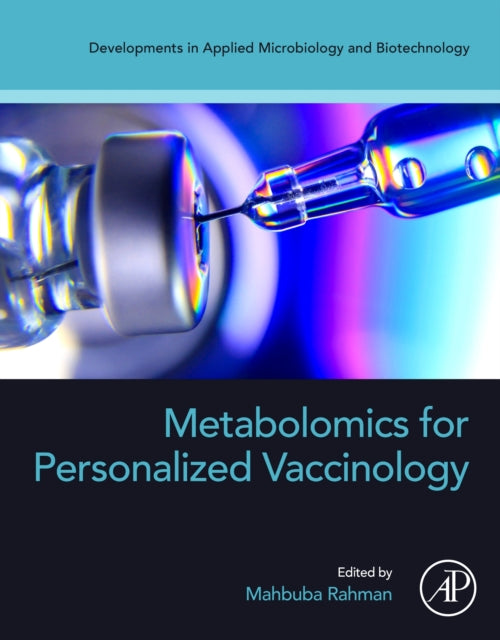
MahbubaRahman
Metabolomics for Personalized Vaccinology
Metabolomics for Personalized Vaccinology
YOU SAVE £19.43
- Condition: Brand new
- UK Delivery times: Usually arrives within 2 - 3 working days
- UK Shipping: Fee starts at £3.89. Subject to product weight & dimension
Bulk ordering. Want 15 or more copies? Get a personalised quote and bigger discounts. Learn more about bulk orders.
Couldn't load pickup availability
- More about Metabolomics for Personalized Vaccinology
Metabolomics for Personalized Vaccinology explores the development of personalized vaccines and how metabolomics can be used to understand the host's metabolic pathway and how vaccine administration alters it. It is suitable for researchers and postgraduate students interested in clinical and nonclinical studies.
Format: Paperback / softback
Length: 398 pages
Publication date: 22 July 2024
Publisher: Elsevier Science Publishing Co Inc
Metabolomics for Personalized Vaccinology is a comprehensive guide to the development of personalized vaccines, which requires a deep understanding of the patient's health status, particularly their immune system, and metabolomics, the closest indicator of the disease phenotype. The book provides an understanding of how metabolomics might be employed in personalized vaccinology and how the metabolic pathway of the host's system is altered by vaccine administration.
Metabolomics for Personalized Vaccinology is a valuable resource for researchers and postgraduate students who are interested in clinical and nonclinical studies where metabolites are used for the identification of disease and therapeutic targets. The book provides an overview of the progress of the field, despite being at its infancy.
The book is divided into several sections, each focusing on a different aspect of personalized vaccines. The first section provides an introduction to metabolomics and its role in personalized vaccinology. It discusses the different types of metabolites and their role in the immune system. The second section discusses the development of personalized vaccines, including the use of metabolomics to identify potential vaccine candidates. The third section discusses the use of metabolomics to monitor vaccine responses and identify adverse effects. The fourth section discusses the use of metabolomics to develop personalized vaccine formulations. The fifth section discusses the ethical and regulatory considerations of personalized vaccines.
One of the key challenges of personalized vaccines is the identification of potential vaccine candidates. Metabolomics can be used to identify metabolites that are associated with the disease phenotype. This can be done by analyzing the blood, urine, or tissue samples of patients with the disease. Metabolomics can also be used to identify metabolites that are associated with the immune response to the vaccine. This can be done by analyzing the blood, urine, or tissue samples of patients who have received the vaccine.
Once potential vaccine candidates have been identified, they can be tested in clinical trials. Metabolomics can be used to monitor the safety and efficacy of the vaccine during clinical trials. This can be done by analyzing the blood, urine, or tissue samples of patients who have received the vaccine. Metabolomics can also be used to identify adverse effects of the vaccine.
The use of metabolomics in personalized vaccinology has the potential to improve the safety and efficacy of vaccines. It can also help to reduce the cost of vaccine development. However, there are also some challenges associated with the use of metabolomics in personalized vaccinology. One of the challenges is the lack of standardization in the analysis of metabolomics data. This can make it difficult to compare the results of different studies.
Another challenge is the ethical and regulatory considerations of personalized vaccines. Personalized vaccines may be more expensive than traditional vaccines, and they may also be more targeted to specific populations. This can raise concerns about access to vaccines and the potential for discrimination.
To address these challenges, researchers are working to develop new technologies and methods for the analysis of metabolomics data. For example, machine learning algorithms can be used to analyze metabolomics data and identify potential vaccine candidates. This can help to reduce the time and cost of vaccine development.
In addition, researchers are working to develop new vaccines that are more targeted to specific populations. For example, vaccines that target specific cancer cells or viruses can be developed using metabolomics.
Despite the challenges associated with the use of metabolomics in personalized vaccinology, there is a growing interest in this field. Researchers are working to develop new vaccines that are more effective and safer than traditional vaccines. Metabolomics is a powerful tool that can be used to identify potential vaccine candidates and monitor vaccine responses.
In conclusion, Metabolomics for Personalized Vaccinology is a comprehensive guide to the development of personalized vaccines. It provides an understanding of how metabolomics might be employed in personalized vaccinology and how the metabolic pathway of the host's system is altered by vaccine administration. The book is divided into several sections, each focusing on a different aspect of personalized vaccines. The book is ideal for researchers and postgraduate students who are interested in clinical and nonclinical studies where metabolites are used for the identification of disease and therapeutic targets. While there are some challenges associated with the use of metabolomics in personalized vaccinology, there is a growing interest in this field, and researchers are working to develop new technologies and methods for the analysis of metabolomics data.
Weight: 808g
Dimension: 234 x 191 x 22 (mm)
ISBN-13: 9780443155260
UK and International shipping information
UK and International shipping information
We deliver throughout the United Kingdom and to 128 countries and territories worldwide, including the United States, Australia, Canada, Germany, Spain and France.