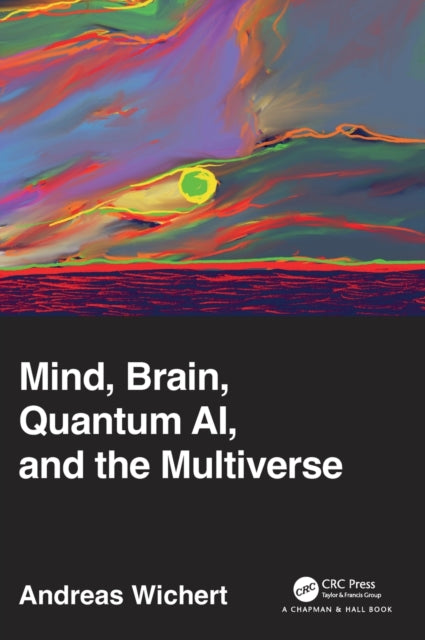
Andreas Wichert
Mind, Brain, Quantum AI, and the Multiverse
Mind, Brain, Quantum AI, and the Multiverse
We can order this item for you. Delivery usually takes about 4 to 6 weeks.
This item is not held in our immediate stock. We will order it for you after checkout.
Estimated delivery: About 4 to 6 weeks
YOU SAVE £7.39
- Condition: Brand new
- UK Delivery times: Usually arrives within 2 - 3 working days
- UK Shipping: Fee starts at £3.89. Subject to product weight & dimension
Bulk ordering. Want 15 or more copies? Get a personalised quote and bigger discounts. Learn more about bulk orders.
Couldn't load pickup availability
- More about Mind, Brain, Quantum AI, and the Multiverse
This book provides a comprehensive introduction to the main philosophical ideas concerning mind and freedom, as well as the basic principles of computer science, artificial intelligence, brain research, quantum physics, and quantum artificial intelligence. It is an essential compilation of knowledge for anyone interested in these fields.
Format: Hardback
Length: 180 pages
Publication date: 11 October 2022
Publisher: Taylor & Francis Ltd
The exploration of the intricate relationship between the mind and freedom is a central theme in philosophical discourse. Philosophers have grappled with questions such as what constitutes the nature of the mind, how it interacts with the body, and what freedoms it inherently possesses.
At the same time, the field of computer science has made significant strides in understanding the workings of the brain and developing artificial intelligence technologies that mimic human cognitive abilities. Brain research has shed light on the neural networks and processes that underlie cognition, while quantum physics has introduced new concepts and theories that challenge our understanding of the physical world.
In this comprehensive compilation, we delve into the philosophical implications of mind and freedom, explore the basic principles of computer science, artificial intelligence, brain research, and quantum physics. We examine how these fields intersect and shed light on the broader questions of consciousness, intelligence, and the nature of reality.
Philosophy:
The study of the mind and freedom has been a central focus of philosophical inquiry for centuries. Philosophers have sought to understand the nature of the mind, its relationship to the body, and the freedoms it inherently possesses.
One of the key questions in philosophy is whether the mind is a separate entity from the body or whether it is an integral part of it. Some philosophers argue that the mind is a distinct entity that exists independently of the body, while others argue that the mind is merely an emergent property of the brain.
Another important question in philosophy is whether the mind has free will. Some philosophers argue that we have the ability to make choices that are not determined by external factors, while others argue that our choices are ultimately determined by our biology, genetics, and environment.
Computer Science:
The field of computer science has made significant strides in understanding the workings of the brain and developing artificial intelligence technologies that mimic human cognitive abilities.
Neural networks, a fundamental concept in computer science, are modeled after the neural networks in the brain. These networks consist of interconnected neurons that transmit signals to each other. By studying the structure and function of neural networks, researchers have been able to develop algorithms that can recognize patterns, make decisions, and solve problems.
Artificial intelligence, a branch of computer science, aims to create machines that can perform tasks that traditionally require human intelligence. This includes tasks such as speech recognition, image recognition, and natural language processing. AI technologies have been used in a wide range of applications, from healthcare to finance to transportation.
Brain Research:
Brain research has shed light on the neural networks and processes that underlie cognition. By studying the brain using imaging techniques such as MRI and EEG, researchers have been able to identify the areas of the brain that are involved in different cognitive tasks.
One of the key findings in brain research is that the brain is highly plastic and adaptable. This means that the brain can change and adapt to new experiences and environments. This is important for learning and memory, as well as for developing new skills and abilities.
Quantum Physics:
Quantum physics has introduced new concepts and theories that challenge our understanding of the physical world. One of the key concepts in quantum physics is the uncertainty principle, which states that the more precisely we measure a physical quantity, the less precisely we can know its value.
Quantum physics has also introduced the concept of quantum entanglement, which occurs when two particles become intertwined in such a way that their states cannot be described independently of each other. This has implications for the nature of consciousness and the relationship between the mind and the body.
Conclusion:
The relationship between the mind and freedom is a complex and multifaceted issue that has been explored by philosophers and scientists for centuries. While computer science has made significant strides in understanding the workings of the brain and developing artificial intelligence technologies, brain research has shed light on the neural networks and processes that underlie cognition. Quantum physics has introduced new concepts and theories that challenge our understanding of the physical world.
In conclusion, the exploration of the mind and freedom is a continuous process that requires a multidisciplinary approach. By integrating knowledge from philosophy, computer science, brain research, and quantum physics, we can gain a deeper understanding of the nature of consciousness, intelligence, and the universe. This knowledge can have profound implications for our understanding of ourselves and our place in the world.
Weight: 516g
Dimension: 184 x 261 x 18 (mm)
ISBN-13: 9781032149608
UK and International shipping information
UK and International shipping information
We deliver throughout the United Kingdom and to 128 countries and territories worldwide, including the United States, Australia, Canada, Germany, Spain and France.