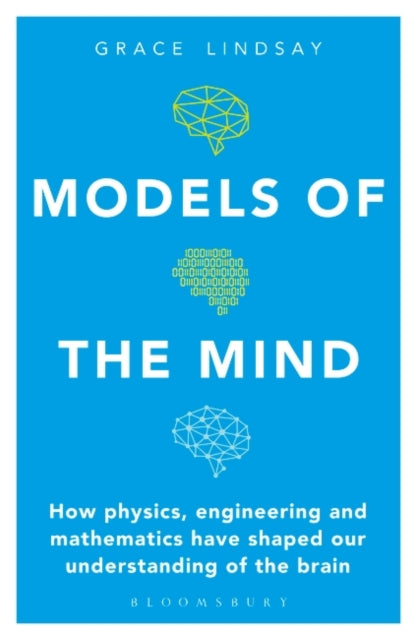
Grace Lindsay
Models of the Mind: How Physics, Engineering and Mathematics Have Shaped Our Understanding of the Brain
Models of the Mind: How Physics, Engineering and Mathematics Have Shaped Our Understanding of the Brain
💎 Earn 45 Points (£0.45) on this item.
YOU SAVE £3.80
- Condition: Brand new
- UK Delivery times: Usually arrives within 2 - 3 working days
- UK Shipping: Fee starts at £2.39. Subject to product weight & dimension
Bulk ordering. Want 15 or more copies? Get a personalised quote and bigger discounts. Learn more about bulk orders.
Couldn't load pickup availability
- More about Models of the Mind: How Physics, Engineering and Mathematics Have Shaped Our Understanding of the Brain
The human brain is made up of 85 billion neurons, which are connected by over 100 trillion synapses. Mathematics has been used to understand and describe many of the brain's processes, such as decision-making, sensory processing, quantifying memory, and more. Grace Lindsay's book "Models of the Mind" explains how mathematical models have allowed scientists to understand and describe these processes, and highlights the tensions that arise when the abstract world of mathematical modelling collides with the messy details of biology.
Format: Paperback / softback
Length: 400 pages
Publication date: 29 September 2022
Publisher: Bloomsbury Publishing PLC
The human brain is a remarkable organ composed of an astounding 85 billion neurons, intricately connected through over 100 trillion synapses. For over a century, a diverse group of researchers has embarked on a quest to find a language that can adequately capture the essence of these neurons' actions and communication, ultimately unraveling the mechanisms that give rise to thoughts, perceptions, and actions. The elusive language they sought was mathematics, a powerful tool that has enabled scientists to gain a deeper understanding of the brain's intricate processes.
In her book, "Models of the Mind," author and computational neuroscientist Grace Lindsay takes readers on a captivating journey into the world of mathematical models. Through this lens, she explains how these models have revolutionized our understanding of the brain, enabling researchers to unravel complex phenomena such as decision-making, sensory processing, memory quantification, and more. Lindsay introduces readers to the fundamental concepts of modern neuroscience, highlighting the tensions that arise when the abstract world of mathematical modelling intersects with the messy realities of biology.
Each chapter of "Models of the Mind" focuses on specific mathematical tools that have been applied in various areas of neuroscience. Starting from the simplest building block of the brain, the individual neuron, Lindsay progresses to explore circuits of interacting neurons, entire brain areas, and even the behaviors that brains command. Throughout the book, she delves into the history of the field, tracing the evolution of experiments conducted on frog legs in the late eighteenth century to the large models of artificial neural networks that form the foundation of modern artificial intelligence.
Lindsay emphasizes the immense value of using the elegant language of mathematics to describe the intricate machinery of the brain. By employing mathematical models, researchers can gain a clearer picture of how neurons interact and communicate, leading to a deeper comprehension of brain function and behavior. This interdisciplinary approach has opened up new avenues for research and treatment, paving the way for innovative therapies and interventions for neurological disorders.
In conclusion, the human brain is a complex and fascinating organ that has captivated the minds of researchers for centuries. Through the power of mathematics, we have gained a deeper understanding of its workings and the mechanisms that drive our thoughts, perceptions, and actions. "Models of the Mind" by Grace Lindsay is a valuable resource for anyone interested in exploring the world of mathematical models and their profound impact on neuroscience. By employing these models, researchers can unlock new insights into brain function and behavior, paving the way for innovative therapies and interventions that can improve the lives of individuals with neurological disorders.
Weight: 432g
Dimension: 135 x 216 x 32 (mm)
ISBN-13: 9781472966438
This item can be found in:
UK and International shipping information
UK and International shipping information
UK Delivery and returns information:
- Delivery within 2 - 3 days when ordering in the UK.
- Shipping fee for UK customers from £2.39. Fully tracked shipping service available.
- Returns policy: Return within 30 days of receipt for full refund.
International deliveries:
Shulph Ink now ships to Australia, Belgium, Canada, France, Germany, Ireland, Italy, India, Luxembourg Saudi Arabia, Singapore, Spain, Netherlands, New Zealand, United Arab Emirates, United States of America.
- Delivery times: within 5 - 10 days for international orders.
- Shipping fee: charges vary for overseas orders. Only tracked services are available for most international orders. Some countries have untracked shipping options.
- Customs charges: If ordering to addresses outside the United Kingdom, you may or may not incur additional customs and duties fees during local delivery.