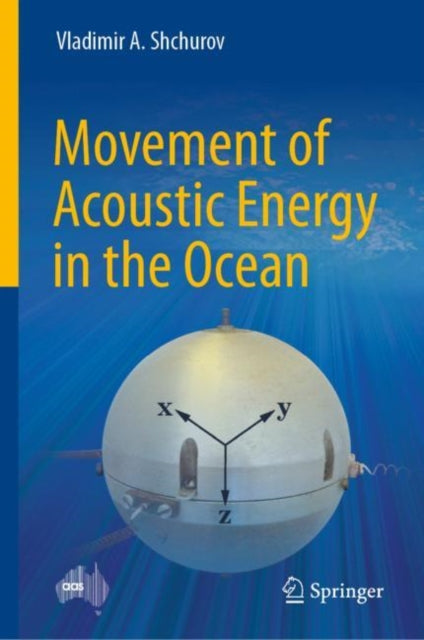
Vladimir A. Shchurov
Movement of Acoustic Energy in the Ocean
Movement of Acoustic Energy in the Ocean
We can order this item for you. Delivery usually takes about 4 to 6 weeks.
This item is not held in our immediate stock. We will order it for you after checkout.
Estimated delivery: About 4 to 6 weeks
YOU SAVE £22.22
- Condition: Brand new
- UK Delivery times: Usually arrives within 2 - 3 working days
- UK Shipping: Fee starts at £3.89. Subject to product weight & dimension
Bulk ordering. Want 15 or more copies? Get a personalised quote and bigger discounts. Learn more about bulk orders.
Couldn't load pickup availability
- More about Movement of Acoustic Energy in the Ocean
The vector-phase method is advantageous in underwater acoustic measurements, and this book showcases its applications in the deep open ocean and shallow sea through theoretical and experimental studies. It also discusses the development of advanced detection tools based on vector-phase sonar.
Format: Hardback
Length: 188 pages
Publication date: 26 May 2022
Publisher: Springer Verlag, Singapore
This comprehensive book delves into the realm of underwater acoustic measurements, emphasizing the merits of the vector-phase method. It presents extensive theoretical and experimental studies conducted in both the deep open ocean and shallow sea, utilizing vector-phase representations. By leveraging the physical phenomena unveiled and the compensation of counter streams of energy and vortices of the acoustic intensity vector, the book offers a detailed account of the transmission of acoustic energy in the real ocean. Furthermore, it explores the development of advanced detection tools based on vector-phase sonar, making it an invaluable resource for professionals and researchers engaged in diverse fields of applied underwater acoustics.
Introduction:
The vector-phase method has gained significant attention in underwater acoustic measurements due to its ability to provide accurate and reliable information about sound waves in complex environments. This book aims to showcase the advantages of this method and present comprehensive results derived from theoretical and experimental studies conducted in the deep open ocean and shallow sea.
Theoretical Studies:
In Chapter 1, the authors provide a theoretical framework for understanding the vector-phase method. They discuss the principles of phase retrieval, the compensation of counter streams of energy, and the description of processes involved in transmitting acoustic energy of a tonal signal in the real ocean. The theoretical discussions are supported by mathematical equations and diagrams, making the content accessible to readers with a background in acoustics.
Chapter 2 delves into the application of vector-phase representations in the deep open ocean. The authors analyze the effects of oceanic parameters, such as water depth, sound speed, and bottom topography, on the vector-phase representations. They demonstrate how vector-phase data can be used to identify and track underwater objects, such as fish schools and marine mammals. The chapter also highlights the potential of vector-phase sonar for oceanographic research, such as mapping the seafloor and studying ocean currents.
Chapter 3 explores the use of vector-phase representations in shallow sea environments. The authors discuss the challenges posed by shallow water, such as reverberation, clutter, and interference, and how vector-phase sonar can mitigate these effects. They present experimental studies conducted in shallow water areas, including coral reefs and estuaries, to evaluate the performance of vector-phase sonar in these environments. The chapter also discusses the potential applications of vector-phase sonar in marine navigation, such as fish finding and obstacle avoidance.
Experimental Studies:
Chapter 4 presents the results of experimental studies conducted in the deep open ocean and shallow sea. The authors describe the equipment used, the experimental procedures, and the data collected. They analyze the vector-phase representations obtained from the experimental data and discuss the advantages and limitations of the method. The chapter also highlights the potential applications of vector-phase sonar in various fields, such as marine biology, oceanography, and underwater communication.
Chapter 5 focuses on the development of advanced detection tools based on vector-phase sonar. The authors discuss the use of machine learning algorithms. The use of machine learning algorithms to enhance the performance of vector-phase sonar in detecting and classifying underwater objects. They present experimental studies conducted to evaluate the effectiveness of these advanced detection tools in real-world scenarios. The chapter also discusses the potential applications of these advanced detection tools in military and commercial applications.
Conclusion:
In conclusion, this book provides valuable insights into the advantages of the vector-phase method in underwater acoustic measurements. It presents comprehensive theoretical and experimental studies conducted in both the deep open ocean and shallow sea, utilizing vector-phase representations. By leveraging the physical phenomena unveiled and the compensation of counter streams of energy and vortices of the acoustic intensity vector, the book offers a detailed account of the transmission of acoustic energy in the real ocean. Furthermore, it explores the development of advanced detection tools based on vector-phase sonar, making it an invaluable resource for professionals and researchers engaged in diverse fields of applied underwater acoustics.
Weight: 477g
Dimension: 235 x 155 (mm)
ISBN-13: 9789811912993
Edition number: 1st ed. 2022
UK and International shipping information
UK and International shipping information
We deliver throughout the United Kingdom and to 128 countries and territories worldwide, including the United States, Australia, Canada, Germany, Spain and France.