Shulph Ink
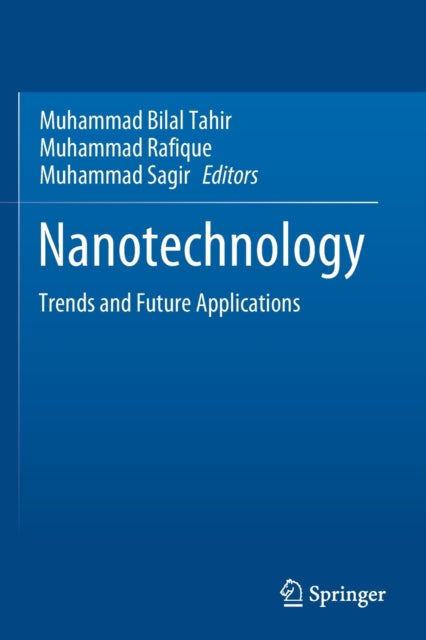
Nanotechnology: Trends and Future Applications
Nanotechnology: Trends and Future Applications
We can order this item for you. Delivery usually takes about 4 to 6 weeks.
This item is not held in our immediate stock. We will order it for you after checkout.
Estimated delivery: About 4 to 6 weeks
YOU SAVE £16.16
- Condition: Brand new
- UK Delivery times: Usually arrives within 2 - 3 working days
- UK Shipping: Fee starts at £3.89. Subject to product weight & dimension
Bulk ordering. Want 15 or more copies? Get a personalised quote and bigger discounts. Learn more about bulk orders.
Couldn't load pickup availability
- More about Nanotechnology: Trends and Future Applications
This book provides an introduction to nanomaterials, their types, and classifications, as well as methods for preparing and characterizing them. It is suitable for a wide readership, including students and professionals in nanotechnology, sustainable chemistry, energy conversion and storage, environmental protection, optoelectronics, sensors, and surface and interface science.
Format: Paperback / softback
Length: 142 pages
Publication date: 26 May 2022
Publisher: Springer Verlag, Singapore
This comprehensive book delves into the intricate world of nanomaterials, encompassing their fundamental characteristics, diverse types, and classifications based on various factors. It offers a comprehensive guide on the preparation and characterization of unique nanostructured materials, making it an invaluable resource for a wide range of readers. Comprising six chapters, this text appeals to both academia and industry professionals, as well as undergraduate and graduate students specializing in nanotechnology, nanomaterials, sustainable chemistry, energy conversion and storage, environmental protection, optoelectronics, sensors, and surface and interface science. Furthermore, it captivates readers with an interest in designing new materials with precisely controlled nanostructures.
Nanomaterials, as the name suggests, are materials that are characterized by their extremely small size, typically ranging from a few nanometers to a few micrometers. This size scale allows for unique physical and chemical properties that are not observed in larger materials. One of the key advantages of nanomaterials is their high surface area-to-volume ratio, which enables them to interact with their surroundings more effectively. This property leads to a wide range of applications in various fields, including electronics, energy, medicine, and environmental science.
Nanomaterials can be classified into different types based on their composition, structure, and properties. Some common types of nanomaterials include carbon nanotubes, graphene, silver nanoparticles, and gold nanoparticles. Carbon nanotubes are cylindrical structures made up of carbon atoms, which have a high strength-to-weight ratio and can be used for a variety of applications, such as electronics, energy storage, and composites. Graphene is a two-dimensional sheet of carbon atoms that is extremely thin and has exceptional electrical and thermal properties, making it a promising material for electronic devices, batteries, and sensors. Silver nanoparticles are small particles of silver that have antimicrobial properties and can be used in various applications, such as textiles, food packaging, and medical devices. Gold nanoparticles are small particles of gold that have a strong absorption of light at the visible and infrared wavelengths, making them useful for applications in photonics, medicine, and catalysis.
In addition to their classification based on composition and structure, nanomaterials can also be classified based on their properties. Some common properties of nanomaterials include superconductivity, magnetism, and photocatalytic activity. Superconductivity is the property of materials that allow them to conduct electricity with zero resistance at extremely low temperatures. This property is observed in certain materials, such as superconducting metals, and has potential applications in energy storage, transportation, and magnetic levitation. Magnetism is the property of materials that are attracted to magnetic fields. This property is observed in certain materials, such as iron and nickel, and has potential applications in electronics, energy storage, and magnetic materials. Photocatalytic activity is the property of materials that can catalyze the conversion of light into energy. This property is observed in certain materials, such as titanium dioxide and zinc oxide, and has potential applications in environmental remediation, energy generation, and catalysis.
Another important aspect of nanomaterials is their preparation and characterization. Preparation methods for nanomaterials include chemical vapor deposition, sol-gel synthesis, and lithography. Chemical vapor deposition is a method that involves the deposition of materials onto a substrate using a vapor of a precursor material. Sol-gel synthesis is a method that involves the reaction of a precursor material with a solvent to form a gel, which can then be converted into a solid material. Lithography is a method that involves the use of a mask to pattern a substrate, which can then be used to deposit materials onto the substrate. Characterization methods for nanomaterials include X-ray diffraction, scanning electron microscopy, and transmission electron microscopy. X-ray diffraction is a method that involves the diffraction of X-rays through a sample to determine its crystal structure. Scanning electron microscopy is a method that involves the use of a scanning electron beam to image a sample. Transmission electron microscopy is a method that involves the use of a high-energy electron beam to image a sample.
In conclusion, nanomaterials are a fascinating and rapidly evolving field that has the potential to revolutionize various industries. This comprehensive book provides a comprehensive overview of the basic and fundamental aspects of nanomaterials, their types, and classifications based on various factors. It offers a comprehensive guide on the preparation and characterization of unique nanostructured materials, making it an invaluable resource for a wide range of readers. Whether you are an academia, industry professional, undergraduate or graduate student, or simply someone with an interest in designing new materials with controlled nanostructures, this book will provide you with valuable insights and knowledge.
Weight: 238g
Dimension: 235 x 155 (mm)
ISBN-13: 9789811594397
Edition number: 1st ed. 2021
UK and International shipping information
UK and International shipping information
We deliver throughout the United Kingdom and to 128 countries and territories worldwide, including the United States, Australia, Canada, Germany, Spain and France.