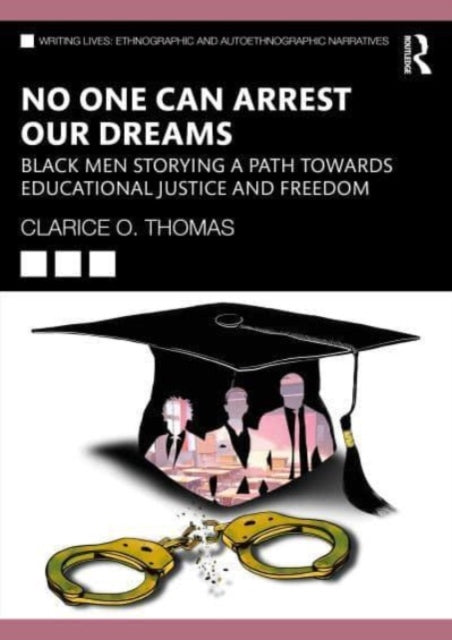
Clarice O. Thomas
No One Can Arrest Our Dreams: Black Men Storying a Path Toward Educational Justice and Freedom
No One Can Arrest Our Dreams: Black Men Storying a Path Toward Educational Justice and Freedom
💎 Earn 207 Points (£2.07) on this item.
We can order this item for you. Delivery usually takes about 4 to 6 weeks.
This item is not held in our immediate stock. We will order it for you after checkout.
Estimated delivery: About 4 to 6 weeks
YOU SAVE £2.47
- Condition: Brand new
- UK Delivery times: Usually arrives within 2 - 3 working days
- UK Shipping: Fee starts at £3.89. Subject to product weight & dimension
Bulk ordering. Want 15 or more copies? Get a personalised quote and bigger discounts. Learn more about bulk orders.
Couldn't load pickup availability
- More about No One Can Arrest Our Dreams: Black Men Storying a Path Toward Educational Justice and Freedom
This book explores the lives of three men, Robert, Raheem, and Warren, who experienced over-discipline in school, adverse teacher-student relationships, and violent community policing. It critically analyzes the school policies and practices that inflict educational harm upon students who experience criminalization, disengagement, and lack of connectedness and a sense of belonging. The narratives center the voices of these men and examine how criminalized experiences intersect with historical and social factors that create anti-Black practices in schools and communities. The book is a valuable pedagogical tool for those who work with Black, Latinx, low-income, and other minoritized youth, and can be used in courses around cultural diversity, equity and inclusion, social justice, and humanizing pedagogies. Community organizations can also use the narrative accounts to create spaces for transformative conversations to improve school and community policing practices.
Format: Paperback / softback
Length: 134 pages
Publication date: 13 February 2024
Publisher: Taylor & Francis Ltd
This book delves into the lives of three men, Robert, Raheem, and Warren, exploring their experiences of over-discipline in school, adverse teacher-student relationships, and violent community policing. It sheds light on the intersection of their involvement in the criminal justice system with these adverse experiences. After being incarcerated, the men found a path to restoration through the education system, which had previously played a role in their marginalization.
The book critically examines school policies and practices that perpetuate educational harm against students who face criminalization, disengagement, and a lack of connection and belonging. It centers the voices of these three men, who share their personal stories of how home environments, educational policies, and practices shape schools into environments where Black and other minoritized students are forced to survive. Through their narratives, the book explores how criminalized experiences, such as school removal and incarceration, intersect with historical and social factors that perpetuate anti-Black practices in schools and communities.
These narrative accounts serve as valuable pedagogical tools for those who work with Black, Latinx, low-income, and other minoritized youth. They provide a deeper understanding of how Black males perceive schools, neighborhoods, and the world. The book is particularly relevant for teachers and teacher educators in K-12 schools, colleges, and universities. Faculty in programs leading to elementary, middle, and secondary education certifications can incorporate the stories into courses covering cultural diversity, equity and inclusion, social justice, and humanizing pedagogies. Community organizations can also use the narrative accounts to facilitate transformative conversations that address the issues faced by marginalized communities.
In conclusion, this book offers a powerful exploration of the lives of three men and their experiences with over-discipline, adverse teacher-student relationships, and violent community policing. It sheds light on the structural factors that contribute to educational harm and provides valuable insights into the experiences of Black males in schools and communities. By engaging with the narratives presented in this book, educators, community organizations, and policymakers can work towards creating more inclusive and equitable educational environments for all students.
Weight: 264g
Dimension: 174 x 245 x 12 (mm)
ISBN-13: 9781032634913
UK and International shipping information
UK and International shipping information
We deliver throughout the United Kingdom and to 128 countries and territories worldwide, including the United States, Australia, Canada, Germany, Spain and France.