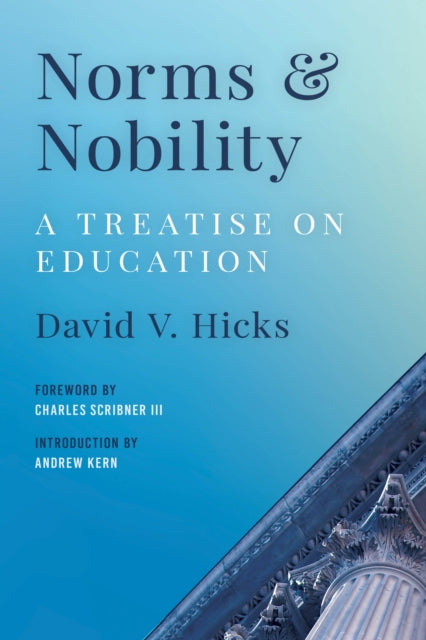
David V. Hicks
Norms and Nobility: A Treatise on Education
Norms and Nobility: A Treatise on Education
💎 Earn 84 Points (£0.84) on this item.
We can order this item for you. Delivery usually takes about 4 to 6 weeks.
This item is not held in our immediate stock. We will order it for you after checkout.
Estimated delivery: About 4 to 6 weeks
YOU SAVE £2.19
- Condition: Brand new
- UK Delivery times: Usually arrives within 2 - 3 working days
- UK Shipping: Fee starts at £3.89. Subject to product weight & dimension
Bulk ordering. Want 15 or more copies? Get a personalised quote and bigger discounts. Learn more about bulk orders.
Couldn't load pickup availability
- More about Norms and Nobility: A Treatise on Education
Norms and Nobility is a reissue of a classic text that argues for classical education as a viable and meaningful form of education for our increasingly technological society. It promotes a spirit of inquiry that develops style and conscience and can meet the needs of all students.
Format: Paperback / softback
Length: 216 pages
Publication date: 06 August 2024
Publisher: Rowman & Littlefield
Norms and Nobility: A Reissue of a Classic Text
Norms and Nobility is a provocative reappraisal of classical education that offers a workable program for contemporary school reform. David Hicks contends that the classical tradition promotes a spirit of inquiry that is concerned with the development of style and conscience, making it an effective and meaningful form of education. Dismissing notions that classical education is elitist and irrelevant, Hicks argues that the classical tradition can meet the needs of our increasingly technological society as well as serve as a feasible model for mass education.
The classical tradition is characterized by a focus on the development of style and conscience. This emphasis on style and conscience is what sets classical education apart from other forms of education. Style refers to the way in which we express ourselves, while conscience refers to our moral and ethical values. Classical education aims to develop both style and conscience in students, so that they can become effective and meaningful members of society.
One of the key aspects of classical education is the emphasis on reading and writing. Classical education believes that reading and writing are essential skills for success in life. Students are taught to read and write with precision and clarity, and to develop their critical thinking skills. This emphasis on reading and writing helps students to develop a deep understanding of the world around them, and to develop their own ideas and opinions.
Another key aspect of classical education is the emphasis on the arts. Classical education believes that the arts are essential for the development of the human spirit. Students are taught to appreciate and create art, and to develop their own artistic skills. This emphasis on the arts helps students to develop their creativity, and to express themselves in unique and meaningful ways.
Despite the many benefits of classical education, it has been criticized for being elitist and irrelevant. Some people argue that classical education is only available to a small number of people, and that it is not relevant to the needs of our increasingly technological society. However, Hicks argues that classical education can meet the needs of our increasingly technological society as well as serve as a feasible model for mass education.
One of the ways that classical education can meet the needs of our increasingly technological society is by teaching students to think critically and creatively. Classical education emphasizes the importance of questioning and analyzing information, and of developing new ideas and solutions. This emphasis on critical thinking and creativity helps students to be successful in the modern world, where jobs are increasingly dependent on technology.
Another way that classical education can meet the needs of our increasingly technological society is by teaching students to be effective communicators. Classical education emphasizes the importance of clear and effective communication, and of developing strong relationships with others. This emphasis on communication helps students to be successful in the modern world, where jobs are increasingly dependent on teamwork and collaboration.
In addition to its benefits for students, classical education can also have benefits for society as a whole. Classical education promotes a sense of community and belonging, and it helps to create a more civilized and humane society. Classical education also promotes a sense of responsibility and accountability, and it helps to create a more just and equitable society.
Despite the many benefits of classical education, it is not without its challenges. One of the challenges of classical education is the cost of tuition. Classical education is often expensive, and many families cannot afford to send their children to classical schools. This can create a significant gap in educational opportunities, and it can limit the ability of students to achieve their full potential.
Another challenge of classical education is the lack of diversity. Classical education is often dominated by white, male students, and it can be difficult for students from other backgrounds to feel welcome and included. This can create a sense of isolation and exclusion, and it can limit the ability of students to develop their own identities and perspectives.
To address these challenges, Hicks proposes a number of solutions. One of the solutions is to increase the funding for classical education. This can be done by government grants, private donations, and by increasing the number of classical schools. Hicks also proposes to increase the diversity of classical education by promoting more diversity in the curriculum and by providing more opportunities for students from other backgrounds to participate in classical education.
In conclusion, Norms and Nobility is a provocative reappraisal of classical education that offers a workable program for contemporary school reform. David Hicks contends that the classical tradition promotes a spirit of inquiry that is concerned with the development of style and conscience, making it an effective and meaningful form of education. Despite the many benefits of classical education, it has been criticized for being elitist and irrelevant. However, Hicks argues that classical education can meet the needs of our increasingly technological society as well as serve as a feasible model for mass education. By increasing the funding for classical education, promoting more diversity in the curriculum, and providing more opportunities for students from other backgrounds to participate in classical education, we can create a more civilized and humane society.
Weight: 332g
Dimension: 228 x 152 x 17 (mm)
ISBN-13: 9781538195352
Edition number: Second Edition
UK and International shipping information
UK and International shipping information
We deliver throughout the United Kingdom and to 128 countries and territories worldwide, including the United States, Australia, Canada, Germany, Spain and France.