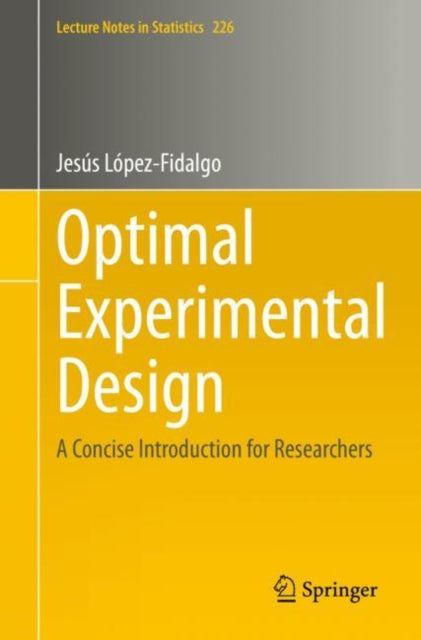
Jesus Lopez-Fidalgo
Optimal Experimental Design: A Concise Introduction for Researchers
Optimal Experimental Design: A Concise Introduction for Researchers
We can order this item for you. Delivery usually takes about 4 to 6 weeks.
This item is not held in our immediate stock. We will order it for you after checkout.
Estimated delivery: About 4 to 6 weeks
YOU SAVE £16.16
- Condition: Brand new
- UK Delivery times: Usually arrives within 2 - 3 working days
- UK Shipping: Fee starts at £3.89. Subject to product weight & dimension
Bulk ordering. Want 15 or more copies? Get a personalised quote and bigger discounts. Learn more about bulk orders.
Couldn't load pickup availability
- More about Optimal Experimental Design: A Concise Introduction for Researchers
This textbook covers optimal experimental design, presenting common concepts and techniques for linear and nonlinear models, Bayesian optimal designs, and real-world applications. It is intended for graduate students and young researchers in statistics and applied mathematics, with examples and exercises.
Format: Paperback / softback
Length: 216 pages
Publication date: 04 September 2023
Publisher: Springer International Publishing AG
This comprehensive textbook offers a concise yet thorough introduction to optimal experimental design, equipping readers with the essential knowledge and skills to embark on research in this field. It delves into the common concepts and techniques applicable to linear and nonlinear models, as well as Bayesian optimal designs, providing a solid foundation for understanding and applying these methodologies. The book's final two chapters are dedicated to exploring specific themes of interest, including recent advancements and hot topics in optimal experimental design, as well as real-world applications. Numerous examples and exercises are included, accompanied by solutions or hints, and references to existing software for computing designs. Primarily designed for graduate students and young researchers in statistics and applied mathematics who are new to the realm of optimal experimental design, this text also appeals to engineers and other applied researchers due to its applications and the way concepts and results are presented.
Introduction:
Optimal experimental design is a fundamental aspect of scientific research, as it enables researchers to obtain reliable and accurate results from their experiments. This textbook aims to provide a comprehensive and accessible introduction to optimal experimental design, catering to students and researchers across various disciplines.
Chapter 1: Optimal Experimental Design Principles:
In this chapter, the authors introduce the basic concepts and principles of optimal experimental design. They discuss the importance of experimental design in hypothesis testing, parameter estimation, and model validation. The chapter also covers the principles of randomization, blocking, and replication, which are essential for reducing experimental bias and increasing the accuracy of results.
Chapter 2: Linear Model Analysis:
The second chapter focuses on linear model analysis, which is a fundamental tool in statistical analysis. The authors introduce the linear regression model, discuss its assumptions and limitations, and provide methods for estimating model parameters and testing hypotheses. The chapter also covers the concept of residual analysis, which is used to assess the goodness of fit of the linear model.
Chapter 3: Nonlinear Model Analysis:
Nonlinear model analysis is a crucial aspect of many scientific disciplines, including biology, economics, and social sciences. In this chapter, the authors introduce the concept of nonlinear regression models, such as logistic regression and neural networks, and provide methods for estimating model parameters and testing hypotheses. The chapter also covers the concept of regularization, which is used to address the issue of overfitting in nonlinear models.
Chapter 4: Bayesian Optimal Designs:
Bayesian optimal designs are a powerful tool for optimal experimental design, particularly in the field of statistics. In this chapter, the authors introduce the concept of Bayesian inference, discuss the advantages of Bayesian approaches over frequentist approaches, and provide methods for constructing Bayesian optimal designs. The chapter also covers the topic of posterior distribution analysis, which is used to evaluate the uncertainty of model parameters and make informed decisions based on the available data.
Chapter 5: Real-World Applications:
The fifth chapter explores real-world applications of optimal experimental design. The authors discuss various industries and research areas where optimal experimental design is used, such as pharmaceutical research, agriculture, and environmental science. The chapter also includes case studies and examples to illustrate the practical applications of optimal experimental design in these fields.
Chapter 6: Software for Computing Designs:
In the final chapter, the authors discuss the available software for computing optimal experimental designs. They introduce popular software packages, such as R, SAS, and STATA, and provide step-by-step instructions on how to use these software to construct and analyze optimal experimental designs. The chapter also includes examples of real-world datasets and their corresponding optimal experimental designs.
Conclusion:
This textbook provides a comprehensive and up-to-date introduction to optimal experimental design, covering a wide range of topics and applications. It is an essential resource for students, researchers, and practitioners in statistics, applied mathematics, and other fields where experimental design is crucial. By providing a solid foundation in optimal experimental design principles and techniques, this textbook equips readers with the skills and knowledge necessary to conduct effective and efficient research.
Weight: 367g
Dimension: 235 x 155 (mm)
ISBN-13: 9783031359170
Edition number: 1st ed. 2023
UK and International shipping information
UK and International shipping information
We deliver throughout the United Kingdom and to 128 countries and territories worldwide, including the United States, Australia, Canada, Germany, Spain and France.