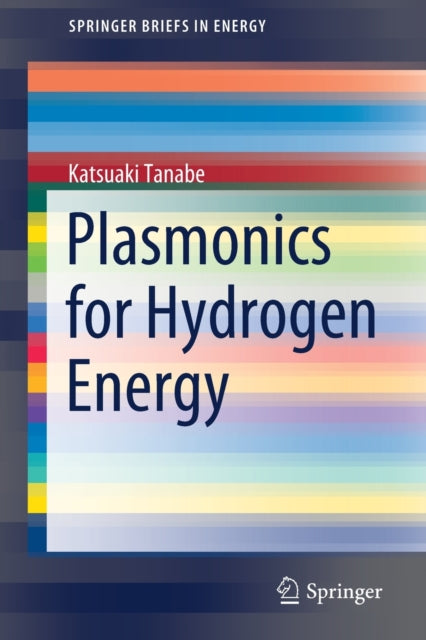
Katsuaki Tanabe
Plasmonics for Hydrogen Energy
Plasmonics for Hydrogen Energy
YOU SAVE £17.92
- Condition: Brand new
- UK Delivery times: Usually arrives within 2 - 3 working days
- UK Shipping: Fee starts at £3.89. Subject to product weight & dimension
Bulk ordering. Want 15 or more copies? Get a personalised quote and bigger discounts. Learn more about bulk orders.
Couldn't load pickup availability
- More about Plasmonics for Hydrogen Energy
This book provides an overview of plasmonic field enhancement phenomena and their applications in hydrogen energy technologies. It highlights the importance of clean and renewable hydrogen production for addressing environmental issues and energy resource depletion. Surface plasmons in metals enable localized field enhancement, which can focus electromagnetic energy and enhance the performance of hydrogen energy systems.
Format: Paperback / softback
Length: 43 pages
Publication date: 14 October 2021
Publisher: Springer Nature Switzerland AG
This comprehensive book delves into the intricate realm of plasmonic field enhancement phenomena and the groundbreaking advancements in the field of hydrogen energy technologies that harness the power of plasmonics for enhanced performance. Hydrogen energy, hailed as a clean and environmentally friendly alternative, holds immense potential for the future. However, the industrial production of hydrogen molecules, or other usable hydrogen-containing compounds, is a crucial prerequisite for its widespread adoption. Moreover, it is imperative to generate hydrogen in clean and renewable ways to address pressing environmental concerns such as atmospheric pollution and global warming, as well as the depletion of energy resources. As the demand for hydrogen energy continues to surge, there is an urgent need for technological developments, particularly in the areas of hydrogen production and storage, to facilitate its widespread utilization.
Free electrons in metals, particularly when they come into close proximity to metal surfaces or interact with dielectric materials, display a remarkable interaction with electromagnetic fields or light in the form of collective oscillations known as surface plasmons. The electromagnetic field intensity surrounding subwavelength-size metal particles can be significantly concentrated due to the interplay between incident photons and the collective oscillation of free electrons at the metal surface, leading to a phenomenon known as local field enhancement. This localized concentration of electromagnetic energy results in a heightened density, effectively enhancing the overall strength of the field.
The study of plasmonic field enhancement has opened up a vast array of applications in various fields, including optics, electronics, and materials science. By manipulating the properties of surface plasmons, scientists and engineers can design and engineer materials with unique optical properties, such as enhanced absorption, emission, or scattering of light. This has significant implications in areas such as solar energy harvesting, optical communication, and medical imaging.
In the realm of hydrogen energy technologies, plasmonics plays a pivotal role in improving the efficiency and sustainability of hydrogen production and storage. One promising approach is to utilize plasmonic nanostructures, such as gold nanoparticles or silver nanowires, to enhance the light-harvesting capabilities of solar cells. By designing these structures with specific shapes and dimensions, scientists can maximize the absorption of solar photons and thus increase the conversion efficiency of solar energy into hydrogen.
Furthermore, plasmonic materials can also be used to enhance the efficiency of hydrogen fuel cells, which are the primary means of converting solar energy into electricity. By incorporating plasmonic components into the fuel cell membrane or catalyst, scientists can improve the electron transfer rates, increase the reaction kinetics, and ultimately enhance the overall performance of the device.
In addition to their applications in hydrogen energy technologies, plasmonic materials have potential implications in other areas such as energy storage, catalysis, and biosensing. For instance, plasmonic nanostructures can be used to enhance the efficiency of lithium-ion batteries, which are widely used in electric vehicles and energy storage systems. By modifying the surface properties of these batteries, scientists can improve their charging and discharging rates, as well as their lifespan.
Similarly, plasmonic materials can be employed as catalysts for various chemical reactions, including the conversion of carbon dioxide into fuels and the degradation of pollutants. By designing plasmonic catalysts with specific properties, scientists can achieve higher reaction rates, selectivity, and stability, leading to more efficient and sustainable chemical processes.
In conclusion, plasmonic field enhancement phenomena and the advancements in hydrogen energy technologies that harness the power of plasmonics offer a promising path toward a sustainable and clean energy future. By leveraging the unique properties of surface plasmons, scientists and engineers can design and engineer materials with enhanced optical, electrical, and catalytic properties, leading to significant improvements in various industries. As we continue to explore the potential of plasmonics, we can expect to see further breakthroughs in hydrogen energy, as well as other fields that rely on the manipulation of light and matter.
Weight: 103g
Dimension: 235 x 155 (mm)
ISBN-13: 9783030882747
Edition number: 1st ed. 2022
UK and International shipping information
UK and International shipping information
We deliver throughout the United Kingdom and to 128 countries and territories worldwide, including the United States, Australia, Canada, Germany, Spain and France.