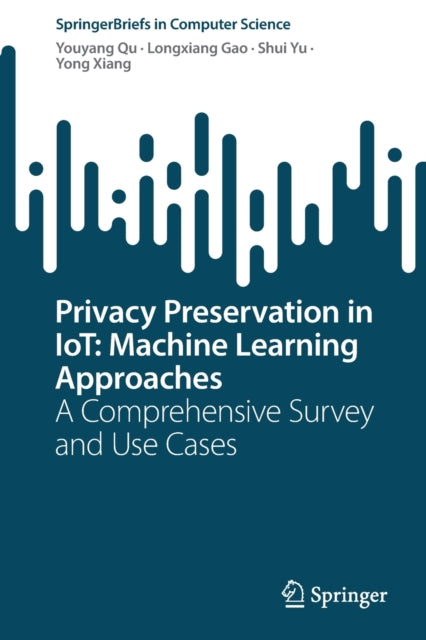
Youyang Qu,Longxiang Gao,Shui Yu,Yong Xiang
Privacy Preservation in IoT: Machine Learning Approaches: A Comprehensive Survey and Use Cases
Privacy Preservation in IoT: Machine Learning Approaches: A Comprehensive Survey and Use Cases
We can order this item for you. Delivery usually takes about 4 to 6 weeks.
This item is not held in our immediate stock. We will order it for you after checkout.
Estimated delivery: About 4 to 6 weeks
YOU SAVE £10.10
- Condition: Brand new
- UK Delivery times: Usually arrives within 2 - 3 working days
- UK Shipping: Fee starts at £3.89. Subject to product weight & dimension
Bulk ordering. Want 15 or more copies? Get a personalised quote and bigger discounts. Learn more about bulk orders.
Couldn't load pickup availability
- More about Privacy Preservation in IoT: Machine Learning Approaches: A Comprehensive Survey and Use Cases
The book aims to provide a comprehensive overview of machine learning-driven privacy preservation in IoTs, discussing the advantages, disadvantages, and future directions of this emerging research topic. It identifies the challenges of existing privacy protection methods and highlights the need for machine learning-driven solutions. The book covers various applications and provides insights into promising research directions in the field.
Format: Paperback / softback
Length: 119 pages
Publication date: 28 April 2022
Publisher: Springer Verlag, Singapore
In the era of big data, the Internet of Things (IoTs) has witnessed an unprecedented surge in the generation and transmission of data, posing significant challenges to privacy protection. Motivated by this, the field of machine learning-driven privacy preservation has emerged as a rapidly growing area of research to address the diverse and evolving demands of IoTs. However, despite the growing importance of this topic, there is a lack of comprehensive literature that systematically explores the challenges and opportunities associated with machine learning-driven privacy preservation in IoTs.
Existing privacy protection methods for IoTs, such as differential privacy, clustering, and anonymity, have limitations that hinder their effectiveness in the big data era. For instance, these methods often result in low data utility, high communication overload, and an unbalanced trade-off between privacy and utility. Recognizing the need for innovative solutions, this book aims to provide a comprehensive discussion on machine learning-driven privacy preservation in IoTs.
The book begins by identifying the issues and challenges associated with existing privacy protection methods in IoTs. It then explores the potential benefits and drawbacks of machine learning-driven privacy preservation techniques, including their ability to handle large datasets, adapt to changing environments, and provide personalized privacy protection. Furthermore, the book discusses the leading and emerging attacks that pose threats to privacy protection in IoTs, such as side-channel attacks, eavesdropping attacks, and identity theft attacks.
To mitigate these threats, the book presents detailed discussions on machine learning-driven privacy preservation methods for IoTs. These methods encompass a wide range of techniques, such as differential privacy, k-anonymity, and secure multi-party computation. Each method is discussed in detail, including its advantages, limitations, and potential applications in different IoT scenarios.
In addition to the theoretical discussions, the book includes case studies and real-world examples to illustrate the practical applications of machine learning-driven privacy preservation in IoTs. These examples cover various applications, including cyber-physical systems, fog computing, and location-based services, highlighting the potential benefits and challenges of these techniques in different contexts.
By providing a comprehensive and up-to-date overview of machine learning-driven privacy preservation in IoTs, this book aims to serve as a valuable resource for forthcoming scientists, policymakers, researchers, and postgraduates. It will help them gain a deeper understanding of the challenges and opportunities associated with privacy preservation in the IoT era, and will provide them with the tools and knowledge necessary to develop innovative solutions that address these challenges.
The book will be of interest to a wide range of readers, including those who are involved in the design, development, and deployment of IoT systems, as well as those who are interested in the ethical and legal implications of privacy preservation in the digital age. It will also be useful for researchers and practitioners in the fields of computer science, data science, and privacy protection, as well as for policymakers and regulators.
In conclusion, the book aims to sort out the clear logic of the development of machine learning-driven privacy preservation in IoTs, including the advantages and disadvantages, as well as the future directions in this under-explored domain. In big data era,an increasingly massive volume of data is generated and transmitted in Internet of Things (IoTs),which poses great threats to privacy protection. Motivated by this,an emerging research topic,machine learning-driven privacy preservation,is fast booming to address various and diverse demands of IoTs. However,there is no existing literature discussion on this topic in a systematically manner. The issues of existing privacy protection methods (differential privacy,clustering,anonymity,etc.) for IoTs,such as low data utility,high communication overload,and unbalanced trade-off,are identified to the necessity of machine learning-driven privacy preservation. Besides,the leading and emerging attacks pose further threats to privacy protection in this scenario. To mitigate the negative impact,machine learning-driven privacy preservation methods for IoTs are discussed in detail on both the advantages and flaws,which is followed by potentially promising research directions. Readers may trace timely contributions on machine learning-driven privacy preservation in IoTs. The advances cover different applications,such as cyber-physical systems,fog computing,and location-based services. This book will be of interest to forthcoming scientists,policymakers,researchers,and postgraduates.
Weight: 215g
Dimension: 235 x 155 (mm)
ISBN-13: 9789811917967
Edition number: 1st ed. 2022
UK and International shipping information
UK and International shipping information
We deliver throughout the United Kingdom and to 128 countries and territories worldwide, including the United States, Australia, Canada, Germany, Spain and France.