Shulph Ink
Problems and Problem Solving in Chemistry Education: Analysing Data, Looking for Patterns and Making Deductions
Problems and Problem Solving in Chemistry Education: Analysing Data, Looking for Patterns and Making Deductions
We can order this item for you. Delivery usually takes about 4 to 6 weeks.
This item is not held in our immediate stock. We will order it for you after checkout.
Estimated delivery: About 4 to 6 weeks
YOU SAVE £9.94
- Condition: Brand new
- UK Delivery times: Usually arrives within 2 - 3 working days
- UK Shipping: Fee starts at £3.89. Subject to product weight & dimension
Bulk ordering. Want 15 or more copies? Get a personalised quote and bigger discounts. Learn more about bulk orders.
Couldn't load pickup availability
- More about Problems and Problem Solving in Chemistry Education: Analysing Data, Looking for Patterns and Making Deductions
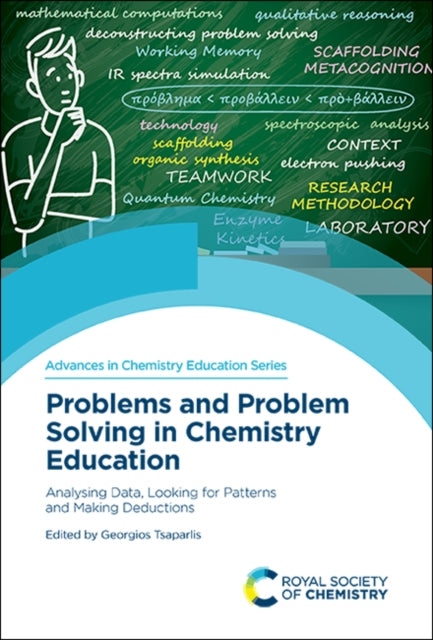
Problem solving is an essential skill for analyzing data and making deductions in chemistry, and is a major research field in science education. Recent developments include quantitative/computational problems, qualitative problem solving, metacognition and resource activation, deconstructing the problem-solving process, working memory hypothesis, electron-pushing formalism, scaffolding organic synthesis skills, spectroscopy for structural characterization, enzyme kinetics, problem solving in the academic chemistry laboratory, chemistry problem-solving in context, team-based/active learning, technology for molecular representations, IR spectra simulation, and computational quantum chemistry tools. The book concludes with methodological and epistemological issues in problem solving research and other perspectives in problem solving in chemistry.
Format: Hardback
Length: 468 pages
Publication date: 19 May 2021
Publisher: Royal Society of Chemistry
Problem solving is a crucial aspect of teaching and learning chemistry at secondary, tertiary, and post-tertiary levels of education. It offers students and professional chemists alike a vast realm to analyze data, identify patterns, and draw conclusions. As a higher-order thinking skill, problem solving also constitutes a significant research field in science education. Ongoing research in this area encompasses both quantitative and qualitative problem-solving approaches, with recent developments focusing on various aspects of chemistry.
Quantitative problems involve mathematical calculations and numerical analysis, while qualitative reasoning involves analyzing and interpreting information without explicit mathematical equations. Metacognition and resource activation involve understanding one's own thinking processes and utilizing available resources effectively. Deconstructing the problem-solving process involves breaking down complex problems into smaller, manageable steps.
An overview of the working memory hypothesis provides insights into how individuals store and retrieve information during problem-solving. Reasoning with the electron-pushing formalism involves applying mathematical concepts to describe chemical reactions and interactions. Scaffolding organic synthesis skills involves teaching students the basic principles and techniques of organic chemistry and gradually building their skills to solve more complex problems.
Spectroscopy for structural characterization in organic chemistry utilizes electromagnetic radiation to identify and analyze the structures of organic compounds. Enzyme kinetics involves studying the rates of chemical reactions catalyzed by enzymes. Problem solving in the academic chemistry laboratory involves applying chemical principles and techniques to solve practical problems.
Chemistry problem-solving in context involves applying chemistry knowledge to real-world situations. Team-based/active learning involves collaborative learning and problem-solving activities. Technology for molecular representations involves using computer-based tools to visualize and manipulate molecular structures. IR spectra simulation involves generating and analyzing infrared spectra of chemical compounds.
Computational quantum chemistry tools utilize computer simulations to study the behavior of molecules and chemical reactions at the quantum level. The book concludes with methodological and epistemological issues in problem solving research and other perspectives on problem solving in chemistry.
George Bodner, a renowned chemist, provides a foreword to this comprehensive resource.
Weight: 865g
Dimension: 156 x 234 (mm)
ISBN-13: 9781839162183
UK and International shipping information
UK and International shipping information
We deliver throughout the United Kingdom and to 128 countries and territories worldwide, including the United States, Australia, Canada, Germany, Spain and France.