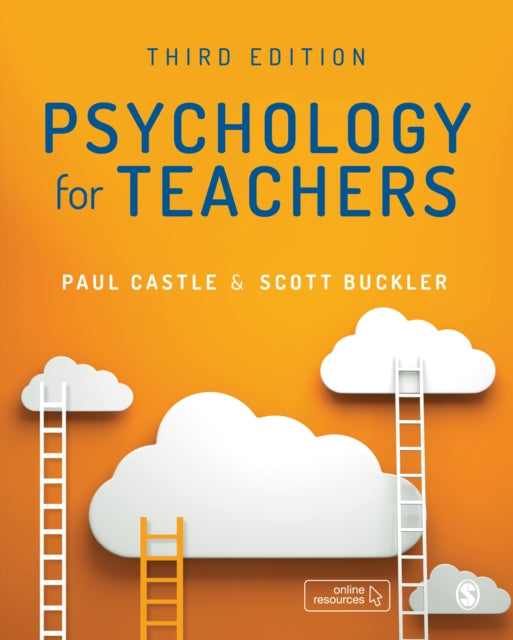
Paul Castle,Scott Buckler
Psychology for Teachers
Psychology for Teachers
YOU SAVE £5.47
- Condition: Brand new
- UK Delivery times: Usually arrives within 2 - 3 working days
- UK Shipping: Fee starts at £3.89. Subject to product weight & dimension
Bulk ordering. Want 15 or more copies? Get a personalised quote and bigger discounts. Learn more about bulk orders.
Couldn't load pickup availability
- More about Psychology for Teachers
Psychology can be applied to the classroom to meet the needs of different learners by examining teaching methods, using evidence-informed practices, and incorporating new technologies.
Format: Paperback / softback
Length: 544 pages
Publication date: 29 April 2021
Publisher: SAGE Publications Ltd
The application of psychological principles to the classroom setting is a topic of great interest and importance, as it has the potential to greatly enhance the learning experience for students of all backgrounds and abilities. By understanding the various cognitive and emotional processes that underpin learning, educators can develop effective strategies and interventions that meet the unique needs of their students.
One of the key ways in which psychology can be applied to the classroom is through the use of instructional design principles. These principles focus on creating learning environments that are engaging, effective, and accessible to all students. For example, educators can use visual aids, interactive activities, and hands-on learning experiences to capture students' attention and promote active engagement.
Another important aspect of applying psychology to the classroom is the recognition of individual differences among students. Every student has unique strengths, weaknesses, and learning styles, and it is essential for educators to tailor their teaching strategies to meet the needs of each individual student. This may involve using different teaching methods, such as visual or auditory learning, or providing additional support and guidance to students who are struggling.
In addition to these practical applications, psychology can also be used to inform the development of classroom policies and practices. For example, research has shown that positive classroom environments, where students feel valued and supported, are associated with higher levels of student engagement and academic achievement. By creating a culture of respect and kindness in the classroom, educators can promote positive social and emotional development in their students, which can have a lasting impact on their overall well-being.
However, it is important to note that the application of psychology to the classroom is not without its challenges. Educators must be aware of the potential biases and limitations of psychological research, and must be careful not to rely solely on stereotypes or generalizations about students. Additionally, the implementation of psychological principles can require significant time and resources, and may require educators to undergo training and professional development.
Despite these challenges, the benefits of applying psychology to the classroom are clear. By creating learning environments that are tailored to the individual needs of students, educators can help to promote greater student engagement, academic achievement, and social and emotional development. As educators continue to explore the intersection of psychology and education, it is likely that we will see even more innovative and effective strategies emerge that can help to improve the learning experience for all students.
In conclusion, the application of psychology to the classroom is a complex and multifaceted topic that requires careful consideration and implementation. By understanding the cognitive and emotional processes that underpin learning, educators can develop effective strategies and interventions that meet the unique needs of their students. Through the use of instructional design principles, individual differences among students, and the development of positive classroom environments, educators can help to promote greater student engagement, academic achievement, and social and emotional development. However, it is important to approach this topic with a critical eye and to be aware of the potential biases and limitations of psychological research. By continuing to explore the intersection of psychology and education, we can work towards the development of even more innovative and effective strategies that can help to improve the learning experience for all students.
Weight: 976g
Dimension: 186 x 230 x 35 (mm)
ISBN-13: 9781529743036
Edition number: 3 Revised edition
UK and International shipping information
UK and International shipping information
We deliver throughout the United Kingdom and to 128 countries and territories worldwide, including the United States, Australia, Canada, Germany, Spain and France.