NicholasLimerick
Recognizing Indigenous Languages: Double Binds of State Policy and Teaching Kichwa in Ecuador
Recognizing Indigenous Languages: Double Binds of State Policy and Teaching Kichwa in Ecuador
💎 Earn 130 Points (£1.30) on this item.
- Condition: Brand new
- UK Delivery times: Usually arrives within 2 - 3 working days
- UK Shipping: Fee starts at £3.89. Subject to product weight & dimension
Bulk ordering. Want 15 or more copies? Get a personalised quote and bigger discounts. Learn more about bulk orders.
Couldn't load pickup availability
- More about Recognizing Indigenous Languages: Double Binds of State Policy and Teaching Kichwa in Ecuador
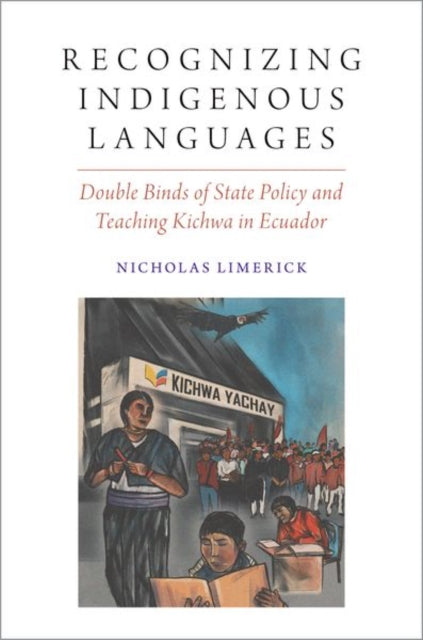
Recognizing Indigenous Languages explores how state agents carry out linguistic and educational politics and policies in eras of greater inclusivity and multiculturalism, showing how institutional advances for bilingual education and Indigenous languages have been premised on affirming the equality-and equivalency-of the linguistic and cultural practices of members of Indigenous pueblos and nationalities with other Ecuadorians.
Format: Paperback / softback
Length: 272 pages
Publication date: 22 November 2023
Publisher: Oxford University Press Inc
The intercultural bilingual school system in Ecuador has been a prominent example of Indigenous education in the Americas since its establishment in 1988. Through the coordination of members of Ecuador's pueblos and nationalities, a second national school system has been developed that includes the teaching of Indigenous languages. Recognizing Indigenous Languages, based on extensive ethnographic research in the Ministry of Education, explores how state agents navigate linguistic and educational politics and policies in eras of greater inclusivity and multiculturalism. This book demonstrates how institutional advancements for bilingual education and Indigenous languages have been built upon affirming the equality and equivalency of the linguistic and cultural practices of Indigenous pueblos and nationalities with other Ecuadorians.
Major responsibilities, such as serving as national state agents, crafting a standardized variety of the Kichwa language family, translating legal documents to Kichwa, and teaching Indigenous languages in schools, have granted these languages vast authority, representation, and visibility. However, the everyday work of directing a school system and making Kichwa a language of the state involves double binds that work against the very goals of autonomous schooling and promoting the use of Kichwa for communication.
One of the key challenges is the lack of resources and support for Indigenous languages. Despite the recognition of their importance, many Indigenous languages face threats of extinction due to lack of exposure and the absence of dedicated teachers and educational materials. This has resulted in limited opportunities for Indigenous students to learn and use their native languages, perpetuating language loss and cultural erasure.
Another challenge is the tension between promoting bilingual education and preserving Indigenous languages. While bilingual education can provide valuable linguistic and cultural skills, it can also contribute to the marginalization of Indigenous languages by prioritizing the dominant language, often Spanish. This can lead to the loss of linguistic diversity and the erosion of Indigenous cultural heritage.
Furthermore, the institutionalization of Indigenous languages can create power dynamics that may work against the interests of Indigenous communities. State agents may have limited understanding of the cultural and linguistic nuances of Indigenous languages, which can lead to misunderstandings and miscommunication. This can further marginalize Indigenous communities and hinder their ability to participate in decision-making processes that affect their lives.
To address these challenges, it is essential to prioritize the preservation and revitalization of Indigenous languages. This can involve investing in language revitalization programs, providing training and support for Indigenous teachers, and developing educational materials that are tailored to the needs of Indigenous students. It is also important to foster intercultural dialogue and understanding to promote respect for linguistic and cultural diversity.
In conclusion, the intercultural bilingual school system in Ecuador has been a significant milestone in Indigenous education in the Americas. However, the challenges of promoting bilingual education and preserving Indigenous languages require a comprehensive and collaborative approach. By prioritizing the preservation and revitalization of Indigenous languages, promoting intercultural dialogue, and ensuring that state agents have a deep understanding of the cultural and linguistic nuances of Indigenous communities, we can work towards a more inclusive and equitable education system that recognizes and values the diversity of languages and cultures in Ecuador.
Weight: 394g
Dimension: 156 x 235 x 19 (mm)
ISBN-13: 9780197559185
UK and International shipping information
UK and International shipping information
We deliver throughout the United Kingdom and to 128 countries and territories worldwide, including the United States, Australia, Canada, Germany, Spain and France.