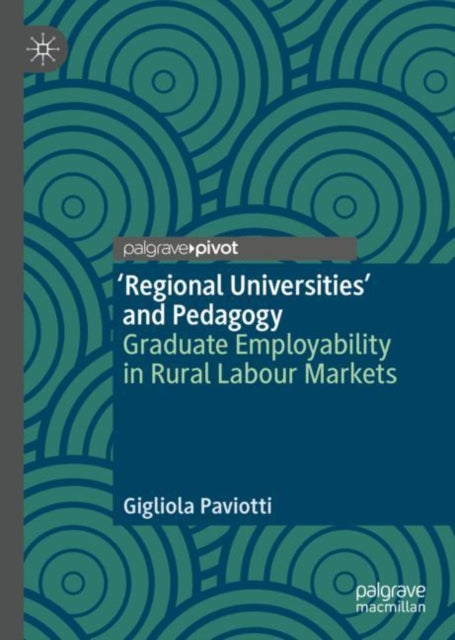
Gigliola Paviotti
'Regional Universities' and Pedagogy: Graduate Employability in Rural Labour Markets
'Regional Universities' and Pedagogy: Graduate Employability in Rural Labour Markets
💎 Earn 185 Points (£1.85) on this item.
We can order this item for you. Delivery usually takes about 4 to 6 weeks.
This item is not held in our immediate stock. We will order it for you after checkout.
Estimated delivery: About 4 to 6 weeks
YOU SAVE £7.83
- Condition: Brand new
- UK Delivery times: Usually arrives within 2 - 3 working days
- UK Shipping: Fee starts at £3.89. Subject to product weight & dimension
Bulk ordering. Want 15 or more copies? Get a personalised quote and bigger discounts. Learn more about bulk orders.
Couldn't load pickup availability
- More about 'Regional Universities' and Pedagogy: Graduate Employability in Rural Labour Markets
This book explores the issue of graduate employability in rural labour markets, examining the roles of higher education in rural centres and offering advice for pedagogies that support the increase of employability potential for rural economies.
Format: Hardback
Length: 129 pages
Publication date: 29 September 2020
Publisher: Springer Nature Switzerland AG
This book delves into the complex issue of graduate employability in rural labor markets, emphasizing the crucial role of European higher education institutions in fostering regional innovation. The author raises a pertinent question: how can these institutions effectively play their role in both urban and rural areas? In rural contexts, educated young individuals often face challenges in contributing to the local economy, leading them to seek better opportunities in urban centers. The author explores the roles of higher education in rural centers, as well as the transitions from education to work, from the perspective of students and graduates. Furthermore, the book provides valuable insights and recommendations for pedagogies aimed at enhancing the employability potential of rural economies.
Introduction:
The book explores the issue of graduate employability in rural labor markets, highlighting the crucial role of European higher education institutions in fostering regional innovation. The author raises a pertinent question: how can these institutions effectively play their role in both urban and rural areas? In rural contexts, educated young individuals often face challenges in contributing to the local economy, leading them to seek better opportunities in urban centers. The author explores the roles of higher education in rural centers, as well as the transitions from education to work, from the perspective of students and graduates. Furthermore, the book provides valuable insights and recommendations for pedagogies aimed at enhancing the employability potential of rural economies.
Roles of Higher Education in Rural Centers:
The author examines the roles of higher education in rural centers, recognizing their potential to contribute to the development and growth of local economies. Higher education institutions can provide specialized knowledge and skills that are in demand in rural industries, such as agriculture, healthcare, and tourism. By offering relevant programs and courses, these institutions can help to train and prepare students for employment in these sectors.
However, the author notes that the implementation of higher education in rural areas faces several challenges. One of the main challenges is the lack of infrastructure and resources, including adequate facilities, libraries, and technology. This can limit the opportunities for students to access quality education and research resources. Additionally, rural areas may have limited job opportunities, which can make it difficult for graduates to find employment locally.
To address these challenges, the author suggests that higher education institutions should work closely with local communities and industries to identify the specific needs and requirements of the local economy. This collaboration can help to develop tailored programs and courses that are relevant to the local job market and promote the employability of graduates.
Furthermore, higher education institutions can play a role in promoting entrepreneurship and innovation in rural areas. By offering entrepreneurship programs and supporting start-up businesses, these institutions can help to create new job opportunities and stimulate economic growth.
Transitions from Education to Work:
The author also examines the transitions from education to work, focusing on the experiences of students and graduates in rural areas. The book highlights the challenges that rural students and graduates face in finding employment and advancing their careers. One of the main challenges is the lack of access to professional networks and opportunities for internships and work experience. This can limit their ability to gain practical skills and make connections with potential employers.
To address these challenges, the author suggests that higher education institutions should work closely with local businesses and organizations to provide internship and work experience opportunities for students. Additionally, institutions can offer career counseling and support services to help students navigate the job market and develop their career plans.
Furthermore, the author emphasizes the importance of promoting lifelong learning and skills development in rural areas. By offering continuing education programs and training opportunities, higher education institutions can help to ensure that graduates have the necessary skills and knowledge to adapt to changing job markets and remain employable throughout their careers.
Advice for Pedagogies:
In conclusion, the book offers valuable advice for pedagogies that support the increase of employability potential for rural economies. The author suggests that higher education institutions should focus on developing practical skills and knowledge that are in demand in rural industries. Additionally, institutions should promote collaboration and partnerships with local communities and industries to ensure that programs and courses are tailored to the local job market.
Furthermore, institutions should prioritize the development of entrepreneurial skills and innovation in rural areas. By offering entrepreneurship programs and supporting start-up businesses, institutions can help to create new job opportunities and stimulate economic growth.
Finally, institutions should promote lifelong learning and skills development in rural areas, ensuring that graduates have the necessary skills and knowledge to adapt to changing job markets and remain employable throughout their careers.
In conclusion, this book provides a comprehensive exploration of the issue of graduate employability in rural labor markets, emphasizing the crucial role of European higher education institutions in fostering regional innovation. The author raises important questions about the roles of higher education in urban and rural areas and offers valuable insights and recommendations for pedagogies that support the increase of employability potential for rural economies. By working closely with local communities and industries, higher education institutions can play a significant role in promoting economic growth and improving the quality of life for rural populations.
Weight: 338g
Dimension: 156 x 218 x 18 (mm)
ISBN-13: 9783030536794
Edition number: 1st ed. 2020
UK and International shipping information
UK and International shipping information
We deliver throughout the United Kingdom and to 128 countries and territories worldwide, including the United States, Australia, Canada, Germany, Spain and France.