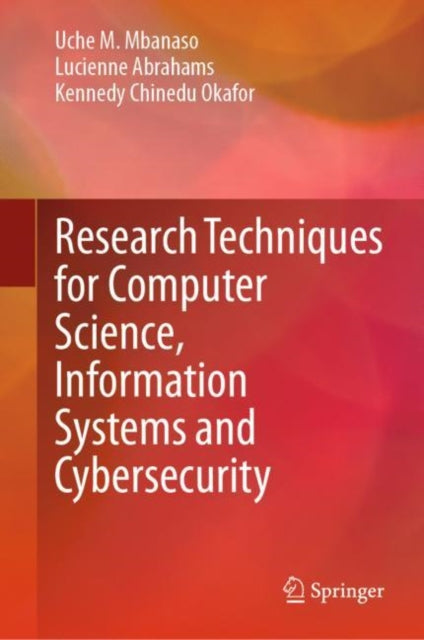
Uche M. Mbanaso,Lucienne Abrahams,Kennedy Chinedu Okafor
Research Techniques for Computer Science, Information Systems and Cybersecurity
Research Techniques for Computer Science, Information Systems and Cybersecurity
💎 Earn 371 Points (£3.71) on this item.
We can order this item for you. Delivery usually takes about 4 to 6 weeks.
This item is not held in our immediate stock. We will order it for you after checkout.
Estimated delivery: About 4 to 6 weeks
YOU SAVE £15.66
- Condition: Brand new
- UK Delivery times: Usually arrives within 2 - 3 working days
- UK Shipping: Fee starts at £3.89. Subject to product weight & dimension
Bulk ordering. Want 15 or more copies? Get a personalised quote and bigger discounts. Learn more about bulk orders.
Couldn't load pickup availability
- More about Research Techniques for Computer Science, Information Systems and Cybersecurity
The book introduces impact-driven research paths in computer science, information systems, and cybersecurity, providing practical insights, effective instructions, and examples. It covers the full cycle of research until submission and evaluation, starting with foundational concepts and techniques. It offers perspectives on deepening research in these fields from computational sciences, engineering sciences, health sciences, social sciences, or interdisciplinary perspectives, benefiting researchers, graduate students, and engineers.
Format: Hardback
Length: 161 pages
Publication date: 25 May 2023
Publisher: Springer International Publishing AG
Impact-driven research paths in computer science, information systems, and cybersecurity are explored in this book, providing practical insights, effective instructions, and examples. It guides postgraduate research students through the entire research cycle, from topic selection to submission and evaluation. The book begins by introducing fundamental concepts and techniques to simplify the complexities of research in these domains. It then offers important perspectives on how to deepen research in CS, IS, and CY, noting that these subjects can be studied from various computational sciences, engineering sciences, health sciences, social sciences, or interdisciplinary perspectives. The book aims to benefit researchers, graduate students, and engineers in these fields, as well as other engineering and technology disciplines.
Impact-Driven Research Paths in Computer Science, Information Systems, and Cybersecurity
This book introduces impact-driven research paths in computer science, information systems, and cybersecurity with practical insights, effective instructions, and examples. The book takes the students through the full cycle of research until the point of submission and evaluation. The book begins by providing postgraduate research students with the foundational concepts and techniques to simplify the complexities associated with choosing topics in the computer science (CS), information systems (IS) and cybersecurity (CY) research domains. The authors furnish readers with fundamentals that facilitate active quantitative, qualitative, and mixed methods research enquiries. The content offers important perspectives on how to think about deepening research in CS, IS and CY, noting that these subjects can be studied from computational sciences, engineering sciences, health sciences, social sciences, or interdisciplinary perspectives.
Introduction to Impact-Driven Research Paths
Impact-driven research paths in computer science, information systems, and cybersecurity are designed to address real-world problems and make a positive impact on society. These paths involve conducting research that is focused on solving specific problems or addressing specific challenges. The research may involve developing new technologies, improving existing technologies, or analyzing data to gain insights into complex systems. The goal of impact-driven research is to create solutions that are practical, effective, and sustainable.
Choosing Topics in Computer Science, Information Systems, and Cybersecurity
Choosing topics in computer science, information systems, and cybersecurity can be a challenging task. There are many different research domains and sub-domains, and it can be difficult to determine which ones are most relevant to your interests and goals. The authors of this book provide a comprehensive overview of the research domains in these fields, and they offer practical advice on how to choose topics that are likely to be successful. They also discuss the importance of selecting topics that are aligned with the goals of your research institution or organization.
Fundamentals of Impact-Driven Research
The fundamentals of impact-driven research include quantitative, qualitative, and mixed methods research. Quantitative research involves the use of statistical methods to analyze data and draw conclusions. Qualitative research involves the use of qualitative methods to gather information and understand the perspectives of individuals or groups. Mixed methods research combines both quantitative and qualitative methods to gain a more comprehensive understanding of a problem or issue.
Active Quantitative, Qualitative, and Mixed Methods Research Enquiries
Active quantitative, qualitative, and mixed methods research enquiries are essential for impact-driven research. These enquiries involve conducting research that is both rigorous and innovative. The authors of this book provide practical advice on how to conduct these enquiries, including how to design research studies, collect data, analyze data, and interpret results. They also discuss the importance of ethical considerations in research and how to ensure that research is conducted in a responsible and ethical manner.
Perspectives on Deepening Research in Computer Science, Information Systems, and Cybersecurity
Perspectives on deepening research in computer science, information systems, and cybersecurity can be varied. Some researchers focus on developing new technologies, while others focus on improving existing technologies. Some researchers focus on analyzing data to gain insights into complex systems, while others focus on developing new algorithms or models. The authors of this book provide a comprehensive overview of the different perspectives on deepening research in these fields, and they offer practical advice on how to pursue these perspectives.
Computational Sciences, Engineering Sciences, Health Sciences, Social Sciences, and Interdisciplinary Perspectives
Impact-driven research paths in computer science, information systems, and cybersecurity can be studied from various computational sciences, engineering sciences, health sciences, social sciences, or interdisciplinary perspectives. Computational sciences involve the use of computers to solve problems and analyze data. Engineering sciences involve the design and development of technologies. Health sciences involve the study of health and disease. Social sciences involve the study of social behavior and institutions. Interdisciplinary perspectives involve the integration of multiple disciplines to address complex problems.
Benefits of Impact-Driven Research
Impact-driven research has many benefits. It can help to improve the quality of life for individuals and communities. It can also help to create new jobs and drive economic growth. It can also help to address social and environmental challenges. However, impact-driven research can also be challenging. It requires a significant amount of time, resources, and expertise. It also requires a commitment to ethical principles and responsible research practices.
Conclusion
In conclusion, impact-driven research paths in computer science, information systems, and cybersecurity are essential for addressing real-world problems and making a positive impact on society. These paths involve conducting research that is focused on solving specific problems or addressing specific challenges. The fundamentals of impact-driven research include quantitative, qualitative, and mixed methods research, and active quantitative, qualitative, and mixed methods research enquiries are essential for success. Perspectives on deepening research in these fields can be varied, and impact-driven research can have many benefits. However, it requires a significant amount of time, resources, and expertise, and it requires a commitment to ethical principles and responsible research practices.
Dimension: 235 x 155 (mm)
ISBN-13: 9783031300301
Edition number: 1st ed. 2023
UK and International shipping information
UK and International shipping information
We deliver throughout the United Kingdom and to 128 countries and territories worldwide, including the United States, Australia, Canada, Germany, Spain and France.