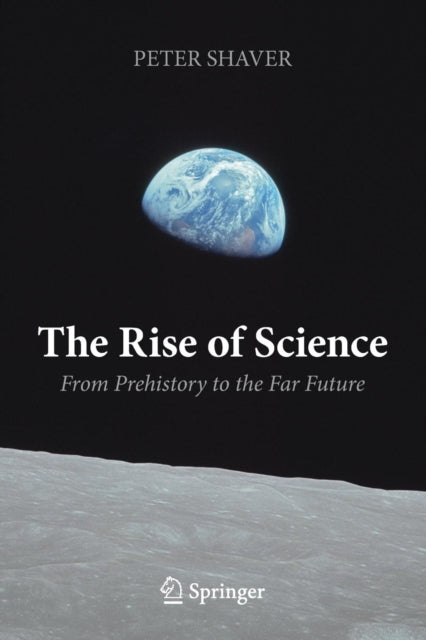
Peter Shaver
Rise of Science: From Prehistory to the Far Future
Rise of Science: From Prehistory to the Far Future
We can order this item for you. Delivery usually takes about 4 to 6 weeks.
This item is not held in our immediate stock. We will order it for you after checkout.
Estimated delivery: About 4 to 6 weeks
YOU SAVE £5.65
- Condition: Brand new
- UK Delivery times: Usually arrives within 2 - 3 working days
- UK Shipping: Fee starts at £3.89. Subject to product weight & dimension
Bulk ordering. Want 15 or more copies? Get a personalised quote and bigger discounts. Learn more about bulk orders.
Couldn't load pickup availability
- More about Rise of Science: From Prehistory to the Far Future
Science has dramatically changed our world and this book offers a unique and broad overview of its rise from the earliest civilizations to the present. It examines how science 'happens, the triumphs, struggles, mistakes, and luck, and explores the current exponential growth, curiosity-driven vs. goal-oriented research, big and small science, support of science, relation to society, philosophy and religion, and benefits and dangers.
Format: Paperback / softback
Length: 279 pages
Publication date: 05 July 2018
Publisher: Springer International Publishing AG
Science has had a profound impact on our world, transforming the way we live, work, and understand the universe. From the earliest civilizations to the present day, science has gone through a series of major phases and turning points, each with its own unique characteristics and achievements. In this book, we will explore the history of science, from its discovery to its modern applications, and assess its current state and future prospects.
The Rise of Science:
Science has a long and complex history, dating back to the earliest civilizations. The earliest forms of science were developed by ancient Egyptians, Greeks, and Indians, who studied the natural world and developed mathematical and astronomical models to explain their observations. These early scientists were primarily interested in understanding the physical world, and their work laid the foundation for the development of modern science.
During the Middle Ages, science was largely neglected in Europe, as religious beliefs and superstitions took precedence over scientific inquiry. However, in the Renaissance, a renewed interest in science began to take hold, with scholars such as Galileo Galilei and Johannes Kepler developing new scientific theories and instruments that challenged traditional religious beliefs. This period marked the beginning of the Scientific Revolution, which saw a shift in scientific thinking from a qualitative to a quantitative approach, and the development of new scientific disciplines such as physics, chemistry, and biology.
In the 18th and 19th centuries, science continued to grow and evolve, with the development of new technologies such as the steam engine, the telegraph, and the microscope. These technologies revolutionized industries and transformed society, and they paved the way for the development of modern science.
In the 20th century, science made even more remarkable advances, with the development of quantum mechanics, relativity, and genetics. These discoveries fundamentally changed our understanding of the universe and our place in it, and they have led to the development of new technologies and therapies that have saved countless lives.
The Impact of Science:
Science has had a profound impact on our world, transforming the way we live, work, and understand the universe. Here are some of the ways in which science has impacted our lives:
Health and Medicine: Science has revolutionized the field of health and medicine, leading to the development of new treatments, therapies, and diagnostic tools. From vaccines and antibiotics to advanced imaging techniques and surgical procedures, science has helped to improve the health and well-being of people around the world.
Technology: Science has led to the development of new technologies that have transformed the way we live and work. From smartphones and laptops to the internet and social media, science has made communication, information access, and entertainment more accessible and convenient.
Environment: Science has played a crucial role in understanding and addressing environmental issues, such as climate change, pollution, and deforestation. Through the development of new technologies and practices, science has helped to mitigate the impact of these issues and protect our planet for future generations.
Economics: Science has had a significant impact on the economy, leading to the development of new industries and the creation of new jobs. From the development of new technologies to the optimization of production processes, science has helped to improve efficiency and productivity in many industries.
Education: Science has played a crucial role in education, leading to the development of new teaching methods and the dissemination of knowledge. From online learning platforms to educational apps and games, science has helped to make education more accessible and engaging for people of all ages.
The Future of Science:
While science has made remarkable progress in recent years, there are still many challenges and opportunities that lie ahead. Here are some of the key questions that will shape the future of science:
Will the current pace of scientific discovery continue? With the rapid development of new technologies and the increasing demand for scientific knowledge, it is difficult to predict whether the pace of scientific discovery will continue to accelerate or slow down in the future.
What will be the next big scientific breakthrough? While it is difficult to predict exactly what the next big scientific breakthrough will be, it is likely to be in the fields of genetics, artificial intelligence, and renewable energy. These fields have the potential to transform our world in profound ways.
How will science impact society in the future? As science continues to advance, it will have a significant impact on society, both positive and negative. For example, the development of new technologies and therapies may have significant benefits for society, while the development of new weapons and technologies may have negative consequences.
What are the ethical implications of scientific progress? As science continues to advance, it will raise new ethical questions and challenges. For example, the use of genetic engineering to modify human genes raises questions about the nature of human identity and the potential for unintended consequences.
Conclusion:
Science has had a profound impact on our world, transforming the way we live, work, and understand the universe. From its earliest origins to its modern applications, science has gone through a series of major phases and turning points, each with its own unique characteristics and achievements. While there are still many challenges and opportunities that lie ahead, it is clear that science will continue to play a crucial role in shaping our world in the years to come.
Weight: 444g
Dimension: 158 x 233 x 17 (mm)
ISBN-13: 9783319918112
Edition number: 1st ed. 2018
UK and International shipping information
UK and International shipping information
We deliver throughout the United Kingdom and to 128 countries and territories worldwide, including the United States, Australia, Canada, Germany, Spain and France.