1
/
of
1
Anurag Krishna Vippala
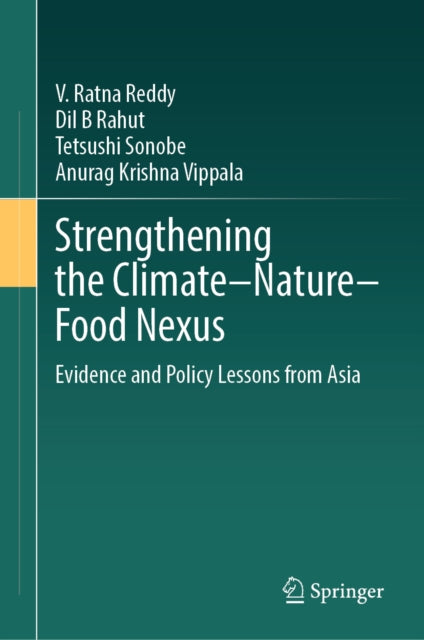
Strengthening the Climate–Nature–Food Nexus: Evidence and Policy Lessons from Asia
Strengthening the Climate–Nature–Food Nexus: Evidence and Policy Lessons from Asia
💎 Earn 552 Points (£5.52) on this item.
ORDERED FOR YOU
We can order this item for you. Delivery usually takes about 4 to 6 weeks.
This item is not held in our immediate stock. We will order it for you after checkout.
Estimated delivery: About 4 to 6 weeks
Regular price
£110.44 GBP
Regular price
£129.99 GBP
Sale price
£110.44 GBP
Unit price
/
per
Taxes included.
Shipping calculated at checkout.
YOU SAVE £19.55
- Condition: Brand new
- UK Delivery times: Usually arrives within 2 - 3 working days
- UK Shipping: Fee starts at £3.89. Subject to product weight & dimension
Bulk ordering. Want 15 or more copies? Get a personalised quote and bigger discounts. Learn more about bulk orders.
Couldn't load pickup availability
- More about Strengthening the Climate–Nature–Food Nexus: Evidence and Policy Lessons from Asia
This book highlights the interdependencies, trade-offs, and competing demands of climate, nature, and food (C-N-F) constitute a nexus. Managing this nexus ensures the integrity of ecosystem services and sustains natural capital. Before elaborating on the process of nexus, it would come in handy to explain how the terms ‘climate’, ‘nature’, and ‘food’ are used in the present context. ‘Climate’ is mainly used in terms of rainfall and temperature. Extreme events of rainfall and temperatures result in floods and droughts. Here, the terms 'climate' and 'climate change' are used interchangeably as synonyms. ‘Nature’ includes both use values (natural resources) and non-use values (biodiversity), which include soil, water, forests, habitat, biodiversity, etc. While natural resources like soil, water, forests, biodiversity, etc. (use values of nature) impact food production directly, non-use values (preference, existence, esoteric, etc.) impact indirectly. However, non-use values are not considered in the present analysis, as assessing non-use values is more complex than evaluating the use values. ‘Food’ production systems primarily include agriculture, forestry, and water-based production systems (such as marine aquaculture). All three production systems are critically linked to nature and are affected by climate change.
- Publication date: 14 August 2026
- Page count: 190
- Dimensions: Height 235 mm; Width 155 mm
- Publisher: Springer Nature Switzerland AG
- Format: Hardback
- ISBN-13: 9783032294227
UK and International shipping information
UK and International shipping information
We deliver throughout the United Kingdom and to 128 countries and territories worldwide, including the United States, Australia, Canada, Germany, Spain and France.