Shulph Ink
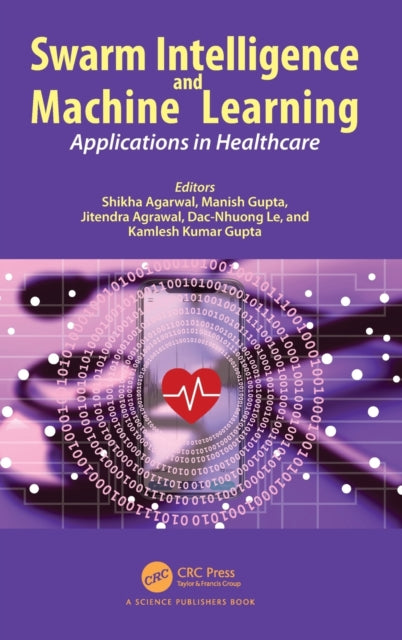
Swarm Intelligence and Machine Learning: Applications in Healthcare
Swarm Intelligence and Machine Learning: Applications in Healthcare
💎 Earn 811 Points (£8.11) on this item.
We can order this item for you. Delivery usually takes about 4 to 6 weeks.
This item is not held in our immediate stock. We will order it for you after checkout.
Estimated delivery: About 4 to 6 weeks
YOU SAVE £9.63
- Condition: Brand new
- UK Delivery times: Usually arrives within 2 - 3 working days
- UK Shipping: Fee starts at £3.89. Subject to product weight & dimension
Bulk ordering. Want 15 or more copies? Get a personalised quote and bigger discounts. Learn more about bulk orders.
Couldn't load pickup availability
- More about Swarm Intelligence and Machine Learning: Applications in Healthcare
Swarm Intelligence and Machine Learning have significant applications in the healthcare industry, particularly in cancer detection, heart disease detection and diagnosis, and diabetic retinopathy detection. These technologies can help healthcare companies leverage big data to discover new business values and improve patient outcomes.
Format: Hardback
Length: 222 pages
Publication date: 29 September 2022
Publisher: Taylor & Francis Ltd
The healthcare industry is undergoing a transformative shift driven by the integration of Swarm Intelligence and Machine Learning (ML) technologies. These cutting-edge advancements are revolutionizing the way healthcare professionals approach patient care, diagnosis, and treatment.
Swarm Intelligence, a branch of artificial intelligence, harnesses the collective behavior of decentralized agents to solve complex problems. It involves the coordination and collaboration of individuals, such as bacteria, ants, or birds, to achieve a common goal. In the healthcare industry, Swarm Intelligence is being applied to various areas, including drug discovery, medical imaging, and patient monitoring.
One of the key applications of Swarm Intelligence in healthcare is cancer detection. By analyzing large datasets of medical images and patient data, Swarm Intelligence algorithms can identify patterns and abnormalities that may indicate the presence of cancer. This approach has shown promising results in early cancer detection, leading to more timely and effective treatment.
Another area where Swarm Intelligence is making significant strides is in the field of heart disease detection and diagnosis. By analyzing patient data, such as heart rate, blood pressure, and ECG readings, Swarm Intelligence algorithms can identify patterns that indicate the risk of heart disease. This information can help healthcare professionals develop personalized treatment plans for patients, reducing the risk of cardiovascular complications.
Machine Learning, on the other hand, is a subset of ML that involves the use of algorithms to analyze and interpret data. It enables computers to learn from patterns and make predictions based on new data. Machine Learning is widely used in healthcare for tasks such as image analysis, drug discovery, and patient diagnosis.
In the area of heart disease detection and diagnosis, Machine Learning algorithms are being used to analyze patient data, such as ECG readings and medical images. These algorithms can identify patterns that indicate the presence of heart disease, such as arrhythmias or blockages. By analyzing these patterns, Machine Learning algorithms can make accurate predictions about the risk of heart disease and help healthcare professionals develop personalized treatment plans for patients.
Machine Learning is also being used in drug discovery to identify new potential treatments for various diseases. By analyzing large datasets of patient data and drug compounds, Machine Learning algorithms can identify patterns that indicate the efficacy and safety of new drugs. This approach has led to the development of new treatments for diseases such as cancer and Alzheimer's disease.
In addition to these applications, Machine Learning is being used in healthcare to analyze large datasets of patient data to discover new business values. By analyzing patient data, healthcare companies can identify trends, patterns, and insights that can help them improve patient care, reduce costs, and enhance their competitive advantage.
One of the challenges facing the healthcare industry is the vast amount of data generated by patients and medical devices. However, Machine Learning algorithms can help healthcare companies leverage the tapestry of big data to discover new business values. By analyzing large datasets of patient data, healthcare companies can identify patterns that can help them develop new products, services, and strategies that improve patient care and drive revenue growth.
In conclusion, the integration of Swarm Intelligence and Machine Learning technologies is transforming the healthcare industry. These cutting-edge advancements are providing healthcare professionals with new tools and techniques to improve patient care, diagnose diseases more effectively, and develop new treatments. As the healthcare industry continues to evolve, it is clear that Swarm Intelligence and Machine Learning will play an increasingly important role in shaping the future of healthcare.
Elaborates Swarm Intelligence and Machine Learning for Cancer Detection.
Swarm Intelligence (SI) and Machine Learning (ML) have emerged as powerful tools in the field of cancer detection, offering promising solutions for early diagnosis and personalized treatment. In this section, we will explore the applications of SI and ML in cancer detection, highlighting their advantages and limitations.
One of the key advantages of SI and ML in cancer detection is their ability to analyze large datasets of medical images and patient data. By leveraging advanced algorithms, SI and ML can identify patterns and abnormalities that may indicate the presence of cancer. This approach allows healthcare professionals to make more accurate diagnoses and develop personalized treatment plans for patients.
Another advantage of SI and ML in cancer detection is their ability to adapt to changing environments. Cancer is a complex disease that can manifest in various ways, and traditional diagnostic methods may not be effective in detecting all types of cancer. SI and ML, on the other hand, can learn from new data and improve their accuracy over time. This adaptability is particularly important in the context of personalized medicine, where treatment plans are tailored to individual patients.
However, there are also limitations to the use of SI and ML in cancer detection. One of the main challenges is the lack of standardization in data collection and analysis, which can lead to inconsistencies and biases in the results. Additionally, SI and ML algorithms may be susceptible to overfitting, where they learn to recognize patterns in the training data but fail to generalize to new data. This can result in poor performance when applied to real-world datasets.
To address these limitations, researchers have developed a range of techniques to improve the accuracy and reliability of SI and ML in cancer detection. One approach is to use ensemble learning, where multiple algorithms are combined to improve the overall performance of the system. Another approach is to use transfer learning, where knowledge learned from one task is applied to another task, such as cancer detection.
In recent years, there has been a significant increase in the use of SI and ML in cancer detection. Researchers have developed a range of algorithms and models that can detect cancer with high accuracy and sensitivity. For example, one popular algorithm is convolutional neural networks (CNNs), which are used to analyze medical images and identify patterns that may indicate the presence of cancer. Another algorithm is decision trees, which are used to classify patients based on their medical history and symptoms.
In conclusion, SI and ML have emerged as powerful tools in the field of cancer detection, offering promising solutions for early diagnosis and personalized treatment. While there are limitations to their use, researchers are continuously developing new techniques to improve the accuracy and reliability of these algorithms. With continued advancements in technology, it is likely that SI and ML will play an increasingly important role in shaping the future of cancer care.
Focuses on applying Swarm Intelligence and Machine Learning for Heart Disease detection and diagnosis.
Swarm Intelligence (SI) and Machine Learning (ML) have gained significant attention in recent years for their potential applications in heart disease detection and diagnosis. In this section, we will explore the applications of SI and ML in heart disease detection and diagnosis, highlighting their advantages and limitations.
One of the key advantages of SI and ML in heart disease detection and diagnosis is their ability to analyze large datasets of medical images and patient data. By leveraging advanced algorithms, SI and ML can identify patterns and abnormalities that may indicate the presence of heart disease. This approach allows healthcare professionals to make more accurate diagnoses and develop personalized treatment plans for patients.
Another advantage of SI and ML in heart disease detection and diagnosis is their ability to adapt to changing environments. Heart disease is a complex disease that can manifest in various ways, and traditional diagnostic methods may not be effective in detecting all types of heart disease. SI and ML, on the other hand, can learn from new data and improve their accuracy over time. This adaptability is particularly important in the context of personalized medicine, where treatment plans are tailored to individual patients.
However, there are also limitations to the use of SI and ML in heart disease detection and diagnosis. One of the main challenges is the lack of standardization in data collection and analysis, which can lead to inconsistencies and biases in the results. Additionally, SI and ML algorithms may be susceptible to overfitting, where they learn to recognize patterns in the training data but fail to generalize to new data. This can result in poor performance when applied to real-world datasets.
To address these limitations, researchers have developed a range of techniques to improve the accuracy and reliability of SI and ML in heart disease detection and diagnosis. One approach is to use ensemble learning, where multiple algorithms are combined to improve the overall performance of the system. Another approach is to use transfer learning, where knowledge learned from one task is applied to another task, such as heart disease detection.
In recent years, there has been a significant increase in the use of SI and ML in heart disease detection and diagnosis. Researchers have developed a range of algorithms and models that can detect heart disease with high accuracy and sensitivity. For example, one popular algorithm is deep learning, which is used to analyze medical images and identify patterns that may indicate the presence of heart disease. Another algorithm is decision trees, which are used to classify patients based on their medical history and symptoms.
In conclusion, SI and ML have emerged as powerful tools in the field of heart disease detection and diagnosis, offering promising solutions for early diagnosis and personalized treatment. While there are limitations to their use, researchers are continuously developing new techniques to improve the accuracy and reliability of these algorithms. With continued advancements in technology, it is likely that SI and ML will play an increasingly important role in shaping the future of heart disease care.
Explores of the concepts of machine learning along with swarm intelligence techniques, along with recent research developments in healthcare sectors.
Machine learning (ML) and swarm intelligence (SI) are two emerging technologies that have the potential to revolutionize the healthcare industry. In this section, we will explore the concepts of ML and SI, along with recent research developments in healthcare sectors.
Machine learning is a branch of artificial intelligence that involves the use of algorithms to analyze and interpret data. It involves the training of algorithms on large datasets of data, which allows them to learn from patterns and make predictions based on new data. ML has a wide range of applications in healthcare, including drug discovery, medical imaging, and patient diagnosis.
One of the key advantages of ML in healthcare is its ability to analyze large datasets of data quickly and accurately. This allows healthcare professionals to make more informed decisions about patient care and treatment. ML algorithms can also be used to identify patterns and abnormalities that may indicate the presence of disease, which can lead to early diagnosis and treatment.
Another advantage of ML in healthcare is its ability to personalize treatment plans for individual patients. ML algorithms can analyze patient data and identify factors that may influence their response to treatment, such as genetic mutations or environmental factors. This information can be used to develop personalized treatment plans that are tailored to the individual patient's needs.
In recent years, there has been a significant increase in the use of ML in healthcare. Researchers have developed a range of algorithms and models that can detect cancer, heart disease, and other diseases with high accuracy and sensitivity. For example, one popular algorithm is convolutional neural networks (CNNs), which are used to analyze medical images and identify patterns that may indicate the presence of cancer.
In addition to ML, swarm intelligence is another emerging technology that has the potential to revolutionize the healthcare industry. SI involves the use of decentralized agents, such as bacteria or ants, to solve complex problems. SI has a wide range of applications in healthcare, including drug discovery, medical imaging, and patient diagnosis.
One of the key advantages of SI in healthcare is its ability to adapt to changing environments. SI agents can learn from their experiences and improve their performance over time, which allows them to solve complex problems that may be difficult for traditional algorithms to solve. SI agents can also be used to collaborate and work together to solve complex problems, which can lead to more efficient and effective solutions.
In recent years, there has been a significant increase in the use of SI in healthcare. Researchers have developed a range of algorithms and models that can detect cancer, heart disease, and other diseases with high accuracy and sensitivity. For example, one popular algorithm is particle swarm optimization (PSO), which is used to optimize complex systems and find the best solution to a problem.
In conclusion, machine learning and swarm intelligence are two emerging technologies that have the potential to revolutionize the healthcare industry. ML involves the use of algorithms to analyze and interpret data, while SI involves the use of decentralized agents to solve complex problems. Both technologies have a wide range of applications in healthcare, and recent research developments have shown that they can be used to detect cancer, heart disease, and other diseases with high accuracy and sensitivity. As technology continues to advance, it is likely that ML and SI will play an increasingly important role in shaping the future of healthcare.
Investigates how healthcare companies can leverage the tapestry of big data to discover new business values.
The healthcare industry is generating an unprecedented amount of data, with millions of patients generating data every day through various sources such as electronic health records, wearable devices, and social media. This vast amount of data has the potential to transform the healthcare industry and provide new business values for healthcare companies. In this section, we will explore how healthcare companies can leverage the tapestry of big data to discover new business values.
One of the key ways that healthcare companies can leverage the tapestry of big data is through data mining. Data mining involves the extraction of valuable information from large datasets of data, which can be used to identify patterns and trends that can inform decision-making. By analyzing large datasets of patient data, healthcare companies can identify areas where they can improve patient care and reduce costs. For example, healthcare companies can use data mining to identify patients who are at high risk of developing certain diseases and develop targeted interventions to prevent these diseases from occurring.
Another way that healthcare companies can leverage the tapestry of big data is through predictive analytics. Predictive analytics involves the use of advanced algorithms to analyze large datasets of data and make predictions about future events. By analyzing patient data, healthcare companies can identify patients who are at high risk of developing certain diseases and develop targeted interventions to prevent these diseases from occurring. For example, healthcare companies can use predictive analytics to identify patients who are at high risk of developing diabetes and develop targeted interventions to prevent these patients from developing diabetes.
In addition to data mining and predictive analytics, healthcare companies can also leverage the tapestry of big data to develop new products and services. By analyzing large datasets of patient data, healthcare companies can identify areas where there is a need for new products and services. For example, healthcare companies can use data mining to identify patients who are interested in alternative therapies and develop new products and services to meet these patients' needs.
However, there are also challenges associated with leveraging the tapestry of big data in healthcare. One of the main challenges is the lack of standardization in data collection and analysis, which can lead to inconsistencies and biases in the results. Additionally, healthcare companies may face challenges in storing and managing large datasets of data, which can be expensive and time-consuming.
To address these challenges, healthcare companies can invest in advanced technologies such as cloud computing and data storage solutions. Cloud computing allows healthcare companies to store and manage large datasets of data in a secure and cost-effective manner, while data storage solutions can help healthcare companies organize and manage their data in a more efficient and effective manner.
In conclusion, the healthcare industry is generating an unprecedented amount of data, and this data has the potential to transform the healthcare industry and provide new business values for healthcare companies. By leveraging the tapestry of big data, healthcare companies can identify areas where they can improve patient care and reduce costs, develop new products and services, and develop targeted interventions to prevent certain diseases from occurring. However, there are also challenges associated with leveraging the tapestry of big data, and healthcare companies must invest in advanced technologies to address these challenges.
Weight: 580g
Dimension: 234 x 156 (mm)
ISBN-13: 9781032145792
UK and International shipping information
UK and International shipping information
We deliver throughout the United Kingdom and to 128 countries and territories worldwide, including the United States, Australia, Canada, Germany, Spain and France.