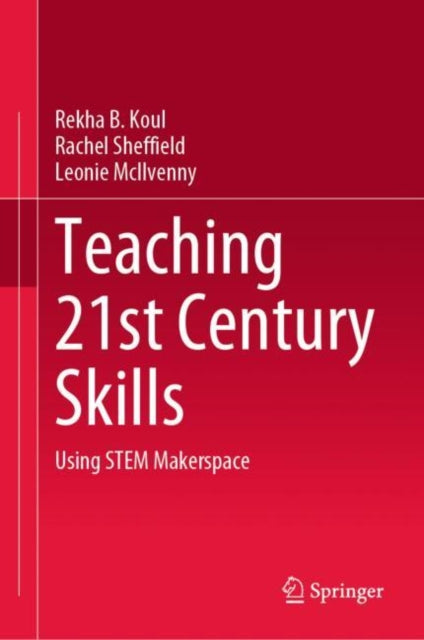
Rekha B. Koul,Rachel Sheffield,Leonie McIlvenny
Teaching 21st Century Skills: Using STEM Makerspaces
Teaching 21st Century Skills: Using STEM Makerspaces
We can order this item for you. Delivery usually takes about 4 to 6 weeks.
This item is not held in our immediate stock. We will order it for you after checkout.
Estimated delivery: About 4 to 6 weeks
YOU SAVE £22.22
- Condition: Brand new
- UK Delivery times: Usually arrives within 2 - 3 working days
- UK Shipping: Fee starts at £3.89. Subject to product weight & dimension
Bulk ordering. Want 15 or more copies? Get a personalised quote and bigger discounts. Learn more about bulk orders.
Couldn't load pickup availability
- More about Teaching 21st Century Skills: Using STEM Makerspaces
This book provides educators with opportunities to engage students in creative and collaborative projects, promoting problem-finding and problem-solving skills. It offers a global perspective on makerspaces through an Indian and Australian lens, highlighting the universal nature of these essential 21st-century skills. It is particularly useful for science, technology, and mathematics teachers, and is an indispensable resource for teacher educators, school administrators, curriculum designers, policymakers, and researchers in science education.
\n Format: Hardback
\n Length: 215 pages
\n Publication date: 11 November 2021
\n Publisher: Springer Verlag, Singapore
\n
This book is a valuable resource for educators looking to provide their students with opportunities for creative and collaborative projects that transcend traditional subject boundaries and promote problem-finding and problem-solving activities. Through an Indian and Australian lens, it offers a comprehensive global perspective on makerspaces, highlighting the commonalities between the approach and pedagogy to emphasize their universal relevance in the 21st century. The book is particularly useful for science, technology, and mathematics teachers, as it demonstrates the potential of integrating a more interdisciplinary curriculum approach to their respective disciplines. It holds significant interest for scholars engaged in research on understanding 21st-century skills and their effective teaching and assessment in school settings. It serves as an essential resource for teacher educators, school administrators, curriculum designers, policymakers, and researchers in the field of science education.
Introduction:
The book explores the concept of makerspaces, which are spaces designed to foster creativity, collaboration, and innovation. It provides a comprehensive overview of makerspaces, including their history, evolution, and potential benefits for students. The authors argue that makerspaces can help students develop essential 21st-century skills such as problem-solving, critical thinking, and creativity, which are crucial for success in today's rapidly changing world.
Chapter 1:
In Chapter 1, the authors introduce the concept of makerspaces and provide an overview of their history and evolution. They discuss the rise of DIY culture and the increasing importance of hands-on learning in education. They also explore the role of technology in shaping the makerspace movement and the emergence of makerfairs and hackathons as popular platforms for showcasing student work.
Chapter 2:
Chapter 2 delves into the benefits of makerspaces for students. The authors argue that makerspaces provide students with a unique learning environment that encourages creativity, collaboration, and innovation. They highlight the importance of hands-on learning in developing practical skills and problem-solving abilities. The chapter also discusses the role of makerspaces in promoting interdisciplinary learning and the development of soft skills such as communication and teamwork.
Chapter 3:
Chapter 3 explores the global perspective on makerspaces. The authors introduce the concept of makerspaces from an Indian and Australian lens, highlighting the commonalities between the approach and pedagogy in these two countries. They discuss the role of government policies and initiatives in promoting makerspaces and the impact of these spaces on education and society. The chapter also illustrates the universal nature of makerspaces and their potential to empower students from diverse backgrounds.
Chapter 4:
Chapter 4 focuses on the practical aspects of setting up and managing a makerspace. The authors provide step-by-step guidance on designing and configuring a makerspace, including selecting appropriate equipment and materials, organizing events and activities, and promoting student engagement. They also discuss the importance of teacher educators and teacher training in supporting the effective use of makerspaces.
Chapter 5:
Chapter 5 explores the assessment of makerspaces. The authors discuss the challenges of assessing student work in a makerspace environment and provide strategies for evaluating student learning and progress. They highlight the importance of authentic assessments and the integration of technology in measuring student outcomes. The chapter also discusses the role.
Conclusion:
In conclusion, this book is a valuable resource for educators looking to provide their students with opportunities for creative and collaborative projects that transcend traditional subject boundaries and promote problem-finding and problem-solving activities. Through an Indian and Australian lens, it offers a comprehensive global perspective on makerspaces, highlighting the commonalities between the approach and pedagogy to emphasize their universal relevance in the 21st century. The book is particularly useful for science, technology, and mathematics teachers, as it demonstrates the potential of integrating a more interdisciplinary curriculum approach to their respective disciplines. It holds significant interest for scholars engaged in research on understanding 21st-century skills and their effective teaching and assessment in school. It serves as an essential resource for teacher educators, school administrators, curriculum designers, policymakers, and researchers in the field of science education.
\n Weight: 526g\n
Dimension: 159 x 241 x 19 (mm)\n
ISBN-13: 9789811643606\n
Edition number: 1st ed. 2021\n
UK and International shipping information
UK and International shipping information
We deliver throughout the United Kingdom and to 128 countries and territories worldwide, including the United States, Australia, Canada, Germany, Spain and France.