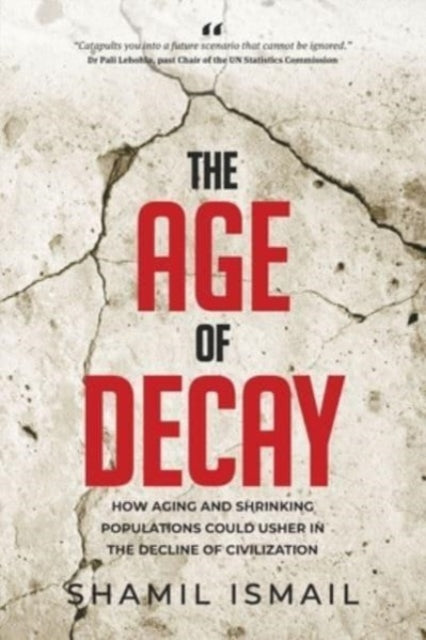
Shamil Ismail
The Age Of Decay
The Age Of Decay
YOU SAVE £5.18
- Condition: Brand new
- UK Delivery times: Usually arrives within 2 - 3 working days
- UK Shipping: Fee starts at £3.89. Subject to product weight & dimension
Bulk ordering. Want 15 or more copies? Get a personalised quote and bigger discounts. Learn more about bulk orders.
Couldn't load pickup availability
- More about The Age Of Decay
Shamil Ismail's book "The Age of Decay" explores the impact of aging and declining birth rates on the global workforce, highlighting the potential for widespread disruptions and societal unraveling. It raises questions about the future of essential jobs, AI, geopolitical tensions, and climate change, and suggests that we are approaching a tipping point where societies will start to unravel. The book aims to prepare readers for the incredible transformation that lies ahead, including the "African Century."
Format: Paperback / softback
Length: 272 pages
Publication date: 01 October 2023
Publisher: Shamil Ismail
Aging and declining birth rates are leading to a shrinking workforce of essential workers that will massively disrupt our everyday lives, according to investment analyst Shamil Ismail. He argues that there is a tipping point of a minimum proportion of essential workers needed to maintain societies, and when countries pass that tipping point, societies will start to unravel and a cycle of decay will set in. These unfolding trends will make most of the topical issues of today—the rise of AI, geopolitical tensions, and climate change—pale in comparison. When are we likely to see the first major signs of this new reality? Which countries will be first impacted, and by when? What can we expect the world to look like in the decades to come? And what will this mean for the future of our children and grandchildren? The Age of Decay attempts to answer these intriguing questions and will, hopefully, allow us to prepare for the incredible transformation that lies ahead, including what Ismail foresees as the "African Century".
Ismail begins by examining the current state of the global workforce. He notes that the number of essential workers—those who work in healthcare, education, transportation, and other critical sectors—is declining, while the number of non-essential workers—those who work in industries such as retail, hospitality, and entertainment—is increasing. This trend is driven by a number of factors, including the aging of the population, the decline in birth rates, and the increasing automation of jobs.
One of the most significant consequences of this trend is the impact on healthcare. As the population ages, the demand for healthcare services is increasing, but the number of healthcare workers is not keeping up. This has led to long wait times, overcrowded hospitals, and a shortage of medical equipment and supplies. In some cases, patients have died because they could not receive the care they needed.
Education is also being affected by the aging and declining birth rates. As the number of students increases, the number of teachers and other educational professionals is not keeping up. This has led to overcrowded classrooms, reduced learning opportunities, and a decline in academic performance. In some cases, students have dropped out of school because they could not afford the tuition.
Transportation is also being affected by the aging and declining birth rates. As the number of drivers increases, the number of vehicles on the road is increasing, which has led to traffic congestion, air pollution, and accidents. In some cases, drivers have been unable to get to work because of traffic.
The increasing automation of jobs is also having a significant impact on the workforce. As machines become more advanced, they are able to perform tasks that were once done by humans. This has led to job losses for many workers, particularly in industries such as manufacturing and logistics.
Ismail argues that these trends are not just a problem for developed countries, but for developing countries as well. Developing countries are often more dependent on essential workers than developed countries, and they are less able to adapt to the changing workforce. This has led to a number of social and economic problems, including poverty, inequality, and political instability.
To address these trends, Ismail suggests a number of policies. He argues that governments should invest in education and training programs to ensure that there is a sufficient supply of essential workers. He also argues that governments should implement policies to encourage women to enter the workforce and to reduce the gender pay gap.
Ismail also argues that governments should implement policies to address the impact of automation on jobs. He suggests that governments should provide training programs to help workers transition to new jobs, and that they should implement policies to reduce the number of jobs that are automated.
In addition to these policies, Ismail suggests that individuals should take steps to prepare for the changing workforce. He suggests that individuals should invest in their education and training, and that they should be flexible and adaptable in their work. He also suggests that individuals should be aware of the risks associated with automation and should take steps to mitigate those risks.
Ismail's book, The Age of Decay, has received widespread acclaim. It has been praised for its well-researched narrative and its compelling arguments. It has been translated into several languages, and it has been used as a teaching tool in schools and universities around the world.
Despite the challenges that the changing workforce presents, Ismail remains optimistic about the future. He believes that there are many opportunities for innovation and growth, and that we can create a better world for ourselves and for future generations. He suggests that we should focus on building a more sustainable and equitable society, and that we should work together to address the challenges that we face.
In conclusion, aging and declining birth rates are leading to a shrinking workforce of essential workers that will massively disrupt our everyday lives. Shamil Ismail argues that there is a tipping point of a minimum proportion of essential workers needed to maintain societies, and that when countries pass that tipping point, societies will start to unravel and a cycle of decay will set in. These unfolding trends will make most of the topical issues of today—the rise of AI, geopolitical tensions, and climate change—pale in comparison. Ismail suggests a number of policies and steps that individuals can take to prepare for the changing workforce, and he remains optimistic about the future.
Weight: 356g
Dimension: 227 x 153 x 22 (mm)
ISBN-13: 9780639791371
UK and International shipping information
UK and International shipping information
We deliver throughout the United Kingdom and to 128 countries and territories worldwide, including the United States, Australia, Canada, Germany, Spain and France.