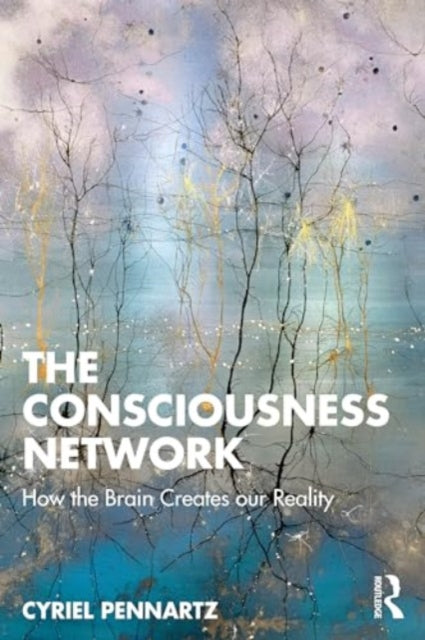
Cyriel Pennartz
The Consciousness Network: How the Brain Creates our Reality
The Consciousness Network: How the Brain Creates our Reality
YOU SAVE £2.20
- Condition: Brand new
- UK Delivery times: Usually arrives within 2 - 3 working days
- UK Shipping: Fee starts at £3.89. Subject to product weight & dimension
Bulk ordering. Want 15 or more copies? Get a personalised quote and bigger discounts. Learn more about bulk orders.
Couldn't load pickup availability
- More about The Consciousness Network: How the Brain Creates our Reality
The Consciousness Network explores the relationship between brain and mind, presenting an original theory of brain and mind based on brain research in patients and healthy people. It is essential reading for students working at the interface of neuroscience, cognitive psychology, philosophy of mind, and cognitive science.
Format: Paperback / softback
Length: 306 pages
Publication date: 06 June 2024
Publisher: Taylor & Francis Ltd
The relationship between consciousness and the brain is a complex and multifaceted subject that has been the subject of much scientific inquiry and debate. While there is still much to be learned about this relationship, researchers have made significant progress in understanding how the brain contributes to consciousness.
One of the key concepts in understanding the relationship between brain and consciousness is the idea of "brain-based consciousness." This concept suggests that consciousness is not a separate entity from the brain, but rather that it is a product of the brain's activity. The brain is a complex organ that is responsible for processing information, generating thoughts, and creating sensations.
According to brain-based consciousness theory, consciousness arises from the interaction between different brain regions, including the prefrontal cortex, the temporal lobe, and the parietal lobe. These regions are responsible for different aspects of consciousness, such as attention, memory, and perception. When these regions are active in a certain way, it can result in the experience of consciousness.
Another important concept in understanding the relationship between brain and consciousness is the idea of "mind-brain duality." This concept suggests that the mind and the brain are two separate entities, but that they are interconnected in a way that allows for the experience of consciousness. The mind is the subjective experience of consciousness, while the brain is the physical entity that is responsible for generating consciousness.
There are several different theories about how the mind and the brain are interconnected. One of the most popular theories is the "interactive activation theory," which suggests that the mind and the brain are constantly interacting with each other, and that this interaction is what gives rise to consciousness.
Another theory is the "global workspace theory," which suggests that the brain is a network of interconnected regions that work together to generate consciousness. This theory suggests that consciousness is a product of the brain's ability to integrate information from different regions of the brain and to generate a coherent perception of the world.
Despite the progress that has been made in understanding the relationship between brain and consciousness, there are still many questions that remain unanswered. For example, how does the brain generate the experience of consciousness? What is the role of the prefrontal cortex in consciousness? And how does the brain leave room for free will?
Researchers are continuing to study these questions and to develop new theories and models that can help to shed light on the relationship between brain and consciousness. In the meantime, it is important to continue to engage in scientific inquiry and to have an open mind about the possibilities of what we can learn about this fascinating subject.
In conclusion, the relationship between consciousness and the brain is a complex and multifaceted subject that has been the subject of much scientific inquiry and debate. While there is still much to be learned about this relationship, researchers have made significant progress in understanding how the brain contributes to consciousness. The brain-based consciousness theory suggests that consciousness arises from the interaction between different brain regions, while the mind-brain duality theory suggests that the mind and the brain are two separate entities that are interconnected in a way that allows for the experience of consciousness. There are several different theories about how the mind and the brain are interconnected, and researchers are continuing to study these questions and to develop new theories and models that can help to shed light on the relationship between brain and consciousness. In the meantime, it is important to continue to engage in scientific inquiry and to have an open mind about the possibilities of what we can learn about this fascinating subject.
Weight: 536g
Dimension: 233 x 156 x 21 (mm)
ISBN-13: 9781032552125
UK and International shipping information
UK and International shipping information
We deliver throughout the United Kingdom and to 128 countries and territories worldwide, including the United States, Australia, Canada, Germany, Spain and France.