Rebecca A. Campbell-Montalvo
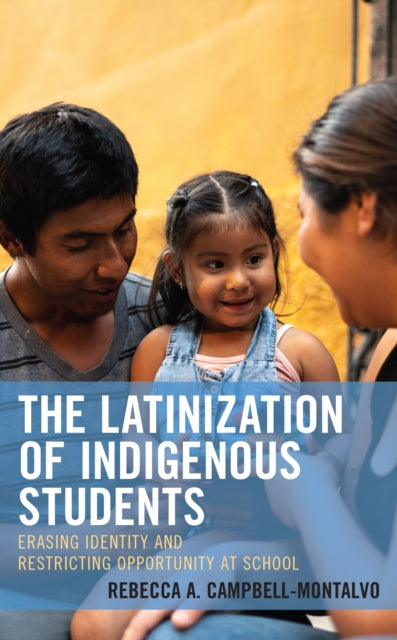
The Latinization of Indigenous Students: Erasing Identity and Restricting Opportunity at School
The Latinization of Indigenous Students: Erasing Identity and Restricting Opportunity at School
We can order this item for you. Delivery usually takes about 4 to 6 weeks.
This item is not held in our immediate stock. We will order it for you after checkout.
Estimated delivery: About 4 to 6 weeks
- Condition: Brand new
- UK Delivery times: Usually arrives within 2 - 3 working days
- UK Shipping: Fee starts at £3.89. Subject to product weight & dimension
Bulk ordering. Want 15 or more copies? Get a personalised quote and bigger discounts. Learn more about bulk orders.
Couldn't load pickup availability
- More about The Latinization of Indigenous Students: Erasing Identity and Restricting Opportunity at School
The Latinization of Indigenous Students explores how schools perceive and process demographic information, potentially erasing Indigeneity and impacting resource access. Programs like the Migrant Education Program can foster equitable access by positioning teachers as cultural insiders or learners, advancing our understanding of pedagogical phenomena and their role in rectifying or reproducing colonialism.
Format: Hardback
Length: 264 pages
Publication date: 15 May 2023
Publisher: Bloomsbury Publishing Plc
The Latinization of Indigenous Students: An Exploration of Perceptions and Processes in Rural Central Florida
Introduction:
The Latinization of Indigenous Students examines how schools perceive and process demographic information, including how those perceptions may erase Indigeneity and impact resource access. Based on multiyear fieldwork, Campbell-Montalvo argues that languages and racial identities of Indigenous Latinx students and families may be re-formed by schools, erasing Indigeneity. However, programs such as the federally funded Migrant Education Program can foster equitable access by encouraging pedagogies that position teachers as cultural insiders or learners. Anchored by pertinent anthropological theories, this work advances our ability to name and explain pedagogical phenomena and their role in rectifying or reproducing colonialism among marginalized and minoritized groups.
Methodology:
The study was conducted in rural central Florida, where the author has conducted fieldwork for several years. The research involved interviews with school administrators, teachers, and students, as well as observations of classroom practices. The data were analyzed using a critical discourse analysis approach, which focused on the ways in which language and racial identities were constructed and reproduced in the school context.
Findings:
The findings of the study revealed that schools in rural central Florida often perceive and process demographic information in a way that erases Indigeneity and impacts resource access. Campbell-Montalvo argues that this erasure is often achieved through the use of standardized testing, which measures students' language and academic skills in a way that does not take into account their cultural and linguistic backgrounds. Additionally, schools may use language policies that prioritize English-only instruction, which can exclude students who speak other languages.
One of the most significant findings of the study was that schools may re-form the languages and racial identities of Indigenous Latinx students and families through their practices. Campbell-Montalvo argues that this re-formation can occur through the use of language policies that promote bilingualism and multilingualism, as well as through the use of culturally responsive teaching practices. However, she also notes that these practices can be challenging to implement in schools that are already struggling to meet academic standards.
Programs such as the Migrant Education Program can help to foster equitable access by encouraging pedagogies that position teachers as cultural insiders or learners. These programs provide resources and support to teachers who work with students from diverse backgrounds, and they can help to create a more inclusive and supportive learning environment.
Conclusion:
The Latinization of Indigenous Students is a critical issue that requires attention from policymakers, educators, and community members. By understanding how schools perceive and process demographic information, we can work to create more equitable and inclusive learning environments for all students. Programs such as the Migrant Education Program can play a vital role in this effort by providing resources and support to teachers who work with students from diverse backgrounds. However, it is important to recognize that this work is complex and requires a sustained commitment from all stakeholders.
Weight: 544g
Dimension: 235 x 485 x 24 (mm)
ISBN-13: 9781793640994
UK and International shipping information
UK and International shipping information
We deliver throughout the United Kingdom and to 128 countries and territories worldwide, including the United States, Australia, Canada, Germany, Spain and France.