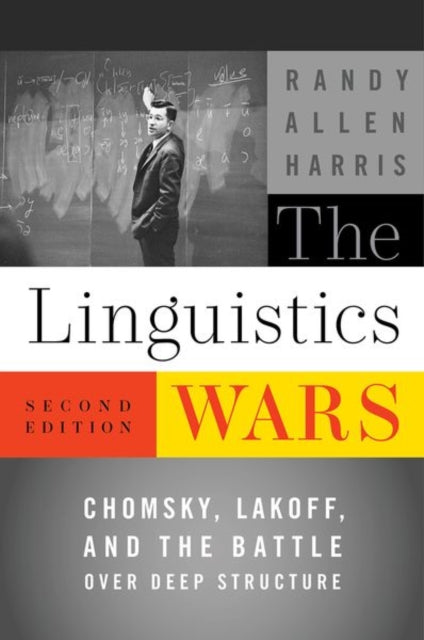
Randy AllenHarris
The Linguistics Wars: Chomsky, Lakoff, and the Battle over Deep Structure
The Linguistics Wars: Chomsky, Lakoff, and the Battle over Deep Structure
We can order this item for you. Delivery usually takes about 4 to 6 weeks.
This item is not held in our immediate stock. We will order it for you after checkout.
Estimated delivery: About 4 to 6 weeks
- Condition: Brand new
- UK Delivery times: Usually arrives within 2 - 3 working days
- UK Shipping: Fee starts at £3.89. Subject to product weight & dimension
Bulk ordering. Want 15 or more copies? Get a personalised quote and bigger discounts. Learn more about bulk orders.
Couldn't load pickup availability
- More about The Linguistics Wars: Chomsky, Lakoff, and the Battle over Deep Structure
The Linguistics Wars is a revised and expanded history of the field of linguistics from the 1950s to the present, focusing on the rupture between Chomsky's structuralist vision and Lakoff's meaning-driven theories. It is essential reading for anyone interested in language, knowledge, and the brilliant minds of our era.
Format: Paperback / softback
Length: 568 pages
Publication date: 24 March 2022
Publisher: Oxford University Press Inc
The Linguistics Wars is a comprehensive and detailed account of the evolution of the field of linguistics from the 1950s to the present day. It delves into the tumultuous history of language and cognition studies, highlighting the significant divide between the structuralist vision proposed by Noam Chomsky and the meaning-driven theories advanced by George Lakoff. Through the lens of Randy Allen Harris, the book explores the personalities, data, technical developments, and social currents that fueled this schism and its lasting impact on the field.
The rise of Noam Chomsky and Transformational Grammar in the 1950s marked a significant turning point in linguistics. Chomsky's theory proposed that the structure of language was innate and universal, governed by a set of grammatical rules that applied to all languages. This approach gained widespread acceptance and influenced the development of many linguistic theories and methodologies.
However, George Lakoff's meaning-driven theories emerged in the 1980s as a challenge to Chomsky's structuralist perspective. Lakoff argued that language was not just a system of rules but also a tool for expressing and understanding meaning. He proposed that the brain was equipped with a set of cognitive mechanisms that were specialized for processing meaning, and that these mechanisms shaped the structure of language.
The clash between Chomsky's structuralist vision and Lakoff's meaning-driven theories led to a heated debate within the field. The debate was characterized by intense intellectual exchanges, philosophical arguments, and social tensions. Many linguists were divided into two camps, with Chomsky's supporters arguing that his theories were more scientific and rigorous, while Lakoff's supporters argued that they were more empirically grounded and better able to explain human language.
The Linguistics Wars also sheds light on the extraordinary personalities who were central to this dispute. Harris profiles key figures such as Noam Chomsky, George Lakoff, and Paul Grice, who were influential in shaping the direction of linguistic research. He also discusses the contributions of other scholars, such as Ronald Langacker, John Haiman, and David Crystal, who played important roles in developing and refining different linguistic theories.
In addition to the historical narrative, The Linguistics Wars provides a wealth of data and technical developments that fueled the schism. Harris discusses the evolution of linguistic theory, from the early stages of generative grammar to the more recent developments in cognitive linguistics and neurolinguistics. He also explores the use of computational models and statistical analysis in linguistic research, which have become increasingly important in understanding the structure and function of language.
The book also examines the social currents that influenced the development of linguistic theory. Harris discusses the impact of postmodernism, feminism, and cultural studies on the field, highlighting how these movements challenged traditional linguistic assumptions and opened up new avenues for research. He also explores the relationship between language and power, discussing how language can be used to perpetuate social inequality and oppression, as well as how it can be used to promote social change and justice.
The Linguistics Wars is an essential reading for anyone interested in the study of language, the making of knowledge, and some of the most brilliant minds of our era. It provides a comprehensive and detailed account of the evolution of the field, highlighting the significant divide between structuralist and meaning-driven theories and the personalities, data, technical developments, and social currents that fueled this schism. The book offers valuable insights into the complex and dynamic nature of language and cognition, and its impact on our understanding of the world.
In conclusion, The Linguistics Wars is a groundbreaking work that provides a comprehensive and detailed account of the evolution of the field of linguistics from the 1950s to the present day. It delves into the tumultuous history of language and cognition studies, highlighting the significant divide between structuralist and meaning-driven theories and the personalities, data, technical developments, and social currents that fueled this schism. The book offers valuable insights into the complex and dynamic nature of language and cognition, and its impact on our understanding of the world. Whether you are a linguist, a student of language, or simply someone interested in the study of human communication, this book is a must-read.
Dimension: 235 x 156 (mm)
ISBN-13: 9780199740338
Edition number: 2 Revised edition
UK and International shipping information
UK and International shipping information
We deliver throughout the United Kingdom and to 128 countries and territories worldwide, including the United States, Australia, Canada, Germany, Spain and France.