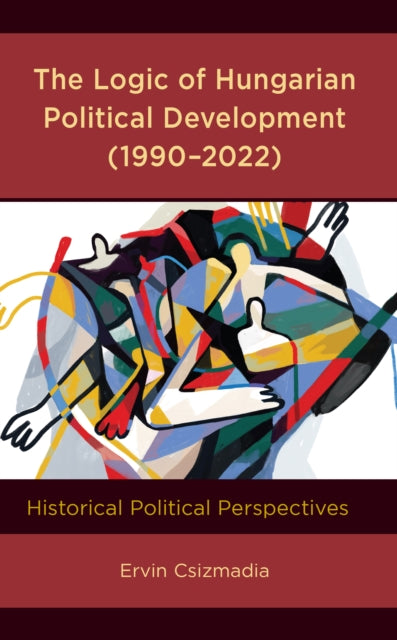
Ervin Csizmadia
The Logic of Hungarian Political Development (1990–2022): Historical Political Perspectives
The Logic of Hungarian Political Development (1990–2022): Historical Political Perspectives
We can order this item for you. Delivery usually takes about 4 to 6 weeks.
This item is not held in our immediate stock. We will order it for you after checkout.
Estimated delivery: About 4 to 6 weeks
- Condition: Brand new
- UK Delivery times: Usually arrives within 2 - 3 working days
- UK Shipping: Fee starts at £3.89. Subject to product weight & dimension
Bulk ordering. Want 15 or more copies? Get a personalised quote and bigger discounts. Learn more about bulk orders.
Couldn't load pickup availability
- More about The Logic of Hungarian Political Development (1990–2022): Historical Political Perspectives
The Logic of Hungarian Political Development, 1990-2022 offers a historical and political perspective on contemporary Hungarian politics, challenging the dominant narrative of transition from democracy to autocracy. Ervin Csizmadia argues that patterns of the old Hungarian development have emerged in our time, which are intriguing and require further exploration.
Format: Hardback
Length: 246 pages
Publication date: 02 February 2024
Publisher: Bloomsbury Publishing Plc
The Logic of Hungarian Political Development, 1990-2022: Historical and Political Perspectives is a significant departure from the majority of works that have focused on contemporary Hungarian politics. While most of these works tend to focus on describing the transition from democracy to autocracy, with a particular emphasis on Viktor Orbán and the construction of an illiberal regime, Ervin Csizmadia's book offers a unique perspective. It seeks to understand the underlying factors that led to the current situation in Hungary and how it could have happened in the first place. To achieve this, Csizmadia argues that patterns of the old Hungarian development have emerged in our time, which cannot be dismissed as archaic. These patterns are intriguing and we know very little about them.
One of the key aspects of Csizmadia's book is his analysis of the political and economic conditions that have shaped Hungary's development over the past three decades. He argues that Hungary's transition from communism to democracy was characterized by a series of reforms that aimed to transform the country into a market-oriented economy. However, these reforms were not implemented effectively, and the country's economy remained stagnant. This, in turn, led to a rise in social inequality and political instability.
Csizmadia also highlights the role of the media in shaping public opinion in Hungary. He argues that the media has been used to promote a conservative and nationalist agenda, which has contributed to the rise of Orbán's Fidesz party. The media has been accused of spreading misinformation and propaganda, and has been criticized for its lack of transparency and accountability.
Another important aspect of Csizmadia's book is his analysis of the political elite in Hungary. He argues that the political elite has been dominated by a small group of individuals who have been able to control the country's political and economic institutions. These individuals have been able to use their power to enrich themselves and their allies, while marginalizing the rest of the population.
Csizmadia's book also provides a detailed analysis of the political and economic policies that have been implemented in Hungary over the past three decades. He argues that these policies have been designed to benefit a small group of individuals at the expense of the rest of the population. For example, the government has implemented a series of tax cuts that have benefited the wealthy, while the public services have been cut back.
Csizmadia's book also provides a critical analysis of the role of the European Union in Hungary's development. He argues that the European Union has been a positive force in Hungary's development, but that it has also been a source of tension. The European Union has been criticized for its strict immigration policies, which have led to a rise in xenophobia and racism in Hungary.
In conclusion, The Logic of Hungarian Political Development, 1990-2022: Historical and Political Perspectives is a significant departure from the majority of works that have focused on contemporary Hungarian politics. Ervin Csizmadia's book offers a unique perspective on the underlying factors that have led to the current situation in Hungary and how it could have happened in the first place. By analyzing the political and economic conditions, the media, the political elite, and the political and economic policies that have been implemented in Hungary over the past three decades, Csizmadia provides a comprehensive understanding of the country's development. His book is a must-read for anyone interested in Hungarian politics and society.
Weight: 522g
Dimension: 236 x 159 x 23 (mm)
ISBN-13: 9781666906929
UK and International shipping information
UK and International shipping information
We deliver throughout the United Kingdom and to 128 countries and territories worldwide, including the United States, Australia, Canada, Germany, Spain and France.