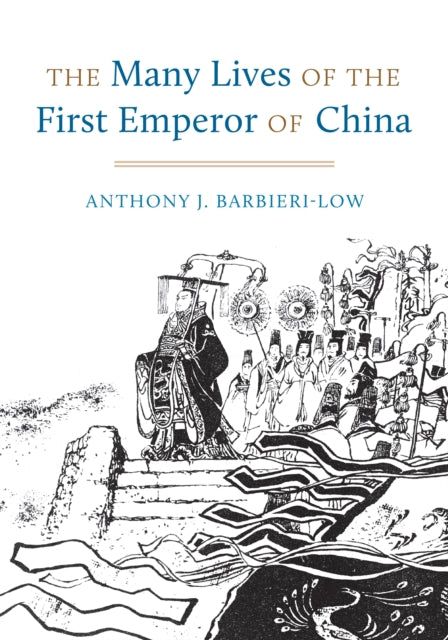
Anthony J. Barbieri-Low
The Many Lives of the First Emperor of China
The Many Lives of the First Emperor of China
💎 Earn 358 Points (£3.58) on this item.
- Condition: Brand new
- UK Delivery times: Usually arrives within 2 - 3 working days
- UK Shipping: Fee starts at £3.89. Subject to product weight & dimension
Bulk ordering. Want 15 or more copies? Get a personalised quote and bigger discounts. Learn more about bulk orders.
Couldn't load pickup availability
- More about The Many Lives of the First Emperor of China
Ying Zheng, the Qin emperor, is a pivotal figure in world history who conquered the warring states of ancient China, created an imperial system that endured for two millennia, and unified Chinese culture through the promotion of a single writing system. His biography is narrated in a biased historical account, but archaeologists have revealed the lavish pits associated with his tomb and documents that demonstrate how his dynasty functioned. This book looks historically at interpretations of the First Emperor in history, literature, archaeology, and popular culture to understand the interpreters as much as the subject of their interpretation.
Format: Hardback
Length: 360 pages
Publication date: 13 September 2022
Publisher: University of Washington Press
Ying Zheng, the founder of the Qin empire, stands as a pivotal figure in world history, alongside renowned conquerors like Alexander the Great, Genghis Khan, and Julius Caesar. His remarkable achievements encompass the conquest of the warring states of ancient China, the establishment of an imperial system that endured for over two millennia, and the unification of Chinese culture through the promotion of a single writing system.
Despite the limited and biased historical account written a century after his death in 210 BCE, recent archaeological discoveries have shed light on the lavish pits associated with his tomb, providing valuable insights into the functioning of his dynasty. The debates surrounding the First Emperor have continued since his demise, making him an ideological slate upon which politicians, revolutionaries, poets, painters, archaeologists, and movie directors have projected their own biases, fears, and fantasies.
This book aims to transcend the traditional boundaries of biography and dynastic history. Instead, it takes a historical approach to examining interpretations of the First Emperor across history, literature, archaeology, and popular culture. By delving into these diverse sources, the book seeks to understand the interpreters as much as the subject of their interpretation.
The Qin empire, founded by Ying Zheng, marked a significant turning point in Chinese history. Its conquest of the warring states brought stability and unity to the region, laying the foundation for the subsequent Han dynasty. Ying Zheng's imperial system, characterized by centralized governance and standardized legal codes, endured for centuries and had a profound impact on Chinese society.
One of Ying Zheng's most enduring legacies is the promotion of a single writing system, known as Qin script. This system was designed to facilitate communication and administration across the empire, and it played a crucial role in unifying Chinese culture. Prior to the Qin dynasty, different regions had their own writing systems, which made it difficult for people to communicate and share knowledge.
The Qin script, on the other hand, was a standardized system that was easy to learn and use. It was based on the characters used by the Shang dynasty, which had ruled over China for centuries before the Qin conquest. By adopting the Qin script, Ying Zheng aimed to create a sense of unity and identity among the people of China, and he succeeded in doing so.
The unification of Chinese culture under the Qin dynasty also had significant implications for the development of literature and art. Prior to the empire's establishment, different regions had their own literary traditions and artistic styles. However, under the Qin, a standardized writing system and a common cultural language were established, which allowed for the development of a unified literary canon and the emergence of a distinct Chinese artistic style.
The Qin dynasty's emphasis on centralized governance and the promotion of a single writing system also had a profound impact on the empire's military capabilities. The empire was able to expand its territory and consolidate its power through the use of efficient administrative systems and a well-trained military force. This military strength was later used by the Han dynasty to conquer the rest of China and establish the Han empire.
Despite the empire's achievements, the Qin dynasty was also marked by its authoritarianism and the repression of dissent. Ying Zheng's rule was characterized by strict laws and regulations, and he employed harsh tactics to maintain control over his subjects. This led to the persecution of intellectuals and the suppression of certain religious and cultural practices.
The legacy of the Qin dynasty continues to be debated and studied by historians, archaeologists, and scholars around the world. While some view the empire as a symbol of tyranny and oppression, others recognize its significance in shaping Chinese history and culture. The debates surrounding the First Emperor and the Qin dynasty serve as a reminder of the complex and multifaceted nature of history and the importance of approaching it with an open mind and a critical eye.
In conclusion, Ying Zheng, the founder of the Qin empire, is recognized as a pivotal figure in world history, alongside other notable conquerors like Alexander the Great, Genghis Khan, and Julius Caesar. His accomplishments include the conquest of the warring states of ancient China, the establishment of an imperial system that endured for over two millennia, and the unification of Chinese culture through the promotion of a single writing system. Despite the limited and biased historical account written a century after his death, recent archaeological discoveries have shed light on the lavish pits associated with his tomb, providing valuable insights into the functioning of his dynasty. The debates surrounding the First Emperor and the Qin dynasty serve as a reminder of the complex and multifaceted nature of history and the importance of approaching it with an open mind and a critical eye.
Weight: 839g
Dimension: 254 x 178 (mm)
ISBN-13: 9780295750224
UK and International shipping information
UK and International shipping information
We deliver throughout the United Kingdom and to 128 countries and territories worldwide, including the United States, Australia, Canada, Germany, Spain and France.