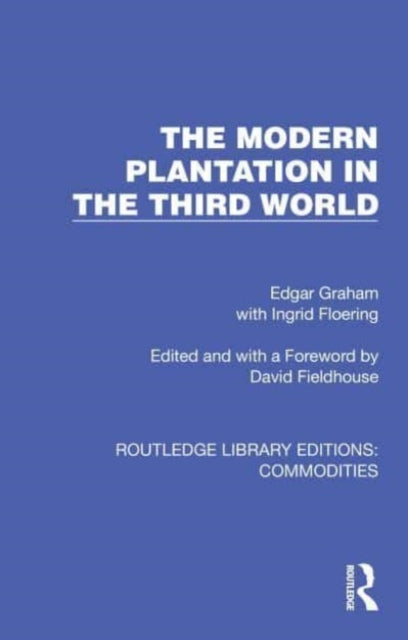
Edgar Graham,Ingrid Floering
The Modern Plantation in the Third World
The Modern Plantation in the Third World
💎 Earn 552 Points (£5.52) on this item.
We can order this item for you. Delivery usually takes about 4 to 6 weeks.
This item is not held in our immediate stock. We will order it for you after checkout.
Estimated delivery: About 4 to 6 weeks
- Condition: Brand new
- UK Delivery times: Usually arrives within 2 - 3 working days
- UK Shipping: Fee starts at £3.89. Subject to product weight & dimension
Bulk ordering. Want 15 or more copies? Get a personalised quote and bigger discounts. Learn more about bulk orders.
Couldn't load pickup availability
- More about The Modern Plantation in the Third World
The first study to define and rationalize the character and functions of the plantation in the contemporary world was published in 1984 by Edgar Graham. He argued that the modern plantation offers host governments the option of using it as the most efficient way of utilizing available factors of production to provide a maximum social return, exemplified by case studies.
Format: Hardback
Length: 246 pages
Publication date: 01 February 2024
Publisher: Taylor & Francis Ltd
Originally published in 1984, this groundbreaking study was the first to define and rationalize the character and functions of plantations in the contemporary world. The author, Edgar Graham, possessed a unique perspective due to his extensive experience managing Unilever plantations across various regions, including West Africa, Zaire, Malaysia, and the Pacific. Writing from a pragmatic standpoint, based on observed facts, Graham's starting point was the realization that the modern plantation bears little resemblance to the historical plantations upon which most hostile accounts are still based. Two significant changes altered the nature of the plantation issue: Firstly, the 20th-century plantation operated within an economic framework controlled by independent governments. Secondly, the rapid advancements in technology revolutionized most aspects of plantation production. The result, as argued, is that the modern plantation offers host governments the opportunity to utilize this system as the most efficient way to maximize the utilization of available factors of production, ultimately providing a maximum social return.
This study is exemplified through case studies, presenting a compelling argument for the continued use of the plantation system when applied appropriately to a diverse range of tropical crops. By examining the historical, economic, and technological aspects of plantations, Graham offers a comprehensive analysis that sheds light on the evolving nature of this agricultural system. He highlights the potential benefits and challenges associated with plantations, emphasizing the need for proper management and sustainable practices to ensure their long-term viability.
Graham's study is particularly relevant in today's global context, where the demand for agricultural products is increasing and the need for efficient production methods is paramount. The plantation system, with its ability to maximize resource utilization and provide a stable source of income, has the potential to contribute to food security and economic development in many regions. However, it is important to note that the success of plantations depends on a range of factors, including the choice of crops, soil quality, management practices, and market conditions.
In conclusion, Edgar Graham's study, published in 1984, was a pioneering effort to define and rationalize the character and functions of plantations in the contemporary world. Through his extensive experience and pragmatic approach, Graham offers a valuable insight into the evolution of the plantation system and its potential for sustainable development. His study serves as a reminder of the importance of proper management and sustainable practices in agricultural production, and its potential to contribute to food security and economic growth in many regions.
Weight: 620g
Dimension: 216 x 138 (mm)
ISBN-13: 9781032693132
UK and International shipping information
UK and International shipping information
We deliver throughout the United Kingdom and to 128 countries and territories worldwide, including the United States, Australia, Canada, Germany, Spain and France.