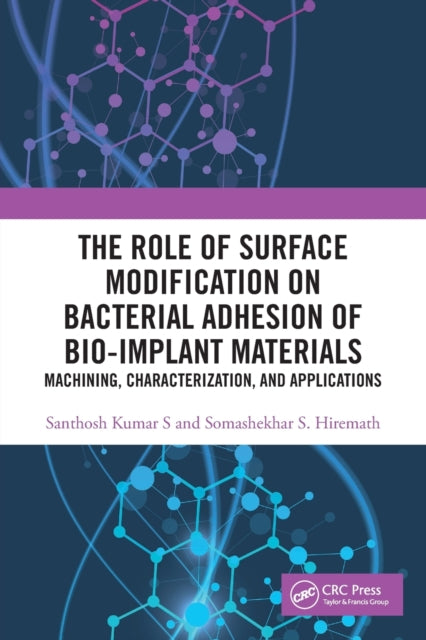
S Santhosh Kumar,Somashekhar S. Hiremath
The Role of Surface Modification on Bacterial Adhesion of Bio-implant Materials: Machining, Characterization, and Applications
The Role of Surface Modification on Bacterial Adhesion of Bio-implant Materials: Machining, Characterization, and Applications
We can order this item for you. Delivery usually takes about 4 to 6 weeks.
This item is not held in our immediate stock. We will order it for you after checkout.
Estimated delivery: About 4 to 6 weeks
YOU SAVE £6.07
- Condition: Brand new
- UK Delivery times: Usually arrives within 2 - 3 working days
- UK Shipping: Fee starts at £3.89. Subject to product weight & dimension
Bulk ordering. Want 15 or more copies? Get a personalised quote and bigger discounts. Learn more about bulk orders.
Couldn't load pickup availability
- More about The Role of Surface Modification on Bacterial Adhesion of Bio-implant Materials: Machining, Characterization, and Applications
The Role of Surface Modification on Bacterial Adhesion of Bio-implant Materials: Machining, Characterization, and Applications explores the relationship between the surface roughness of artificial implants and their bacterial adhesion, failure of implants, mechanisms of bacterial formation, and methods of surface modification. It also explores the use of developed unidirectional abrasive flow finishing processes to finish biomaterials at the nano-level.
Format: Paperback / softback
Length: 172 pages
Publication date: 06 May 2022
Publisher: Taylor & Francis Ltd
The Role of Surface Modification on Bacterial Adhesion of Bio-implant Materials: Machining, Characterization, and Applications delves into the intricate relationship between the surface roughness of artificial implants used for hard tissue replacement and their susceptibility to bacterial adhesion. It serves as a comprehensive summary, outlining the primary reasons behind implant failures, the mechanisms by which bacteria form on implant surfaces, and the established methods employed for implant surface modification techniques. This text offers readers a well-organized and logical framework regarding implant manufacturing and mechanical surface modification. Furthermore, it explores the utilization of advanced unidirectional abrasive flow finishing processes to achieve nanoscale surface finishes in biomaterials. As a valuable resource for academics, graduate students, biomaterial scientists, and manufacturing engineers engaged in research on implants, related infections, and implant manufacturing, this book provides essential insights and guidance.
Implant failures often result from the complex interplay between various factors, including surface roughness. The surface topography of an implant can influence bacterial adhesion, proliferation, and biofilm formation, ultimately leading to implant-related infections. Understanding these mechanisms is crucial for developing effective surface modification techniques to enhance implant biocompatibility and durability.
Bacteria adhere to implant surfaces through a variety of mechanisms, including physical interactions, chemical bonds, and biological factors. The roughness of the implant surface, characterized by its surface texture, micro- and macro-features, can play a significant role in determining bacterial adhesion. For example, rougher surfaces with higher surface energy and more crevices can provide a favorable environment for bacterial attachment and growth.
Several methods have been developed to modify the surface roughness of implants, including machining, chemical etching, and surface coatings. Machining techniques such as grinding, milling, and turning can be used to create precise surface profiles and improve the surface roughness of implants. These methods can be used to create a range of surface textures, from smooth and polished to rough and textured, which can influence bacterial adhesion differently.
Chemical etching, such as acid etching or sandblasting, can also be used to modify the surface roughness of implants. These methods involve removing material from the implant surface to create a rougher texture. However, chemical etching can also alter the chemical composition of the implant material, which may have implications for its biocompatibility and durability.
Surface coatings, such as biocompatible polymers or ceramics, can also be used to modify the surface roughness of implants. These coatings can provide a barrier against bacterial adhesion, reduce friction, and improve the overall biocompatibility of the implant. However, the selection of appropriate surface coatings and their deposition methods must be carefully considered to ensure their effectiveness and durability.
In addition to machining and chemical etching, advanced unidirectional abrasive flow finishing processes have been developed to achieve nanoscale surface finishes in biomaterials. These processes involve the use of high-speed fluid streams to abrade the surface of the biomaterial, creating a nanoscale surface texture. This type of surface modification can enhance the biocompatibility and durability of implants by reducing the surface area available for bacterial attachment and growth.
The Role of Surface Modification on Bacterial Adhesion of Bio-implant Materials: Machining, Characterization, and Applications provides a comprehensive overview of the relationship between surface roughness and bacterial adhesion in bio-implant materials. It discusses the reasons for implant failures, the mechanisms of bacterial formation on implant surfaces, and the established methods of implant surface modification techniques. The book also explores the use of advanced unidirectional abrasive flow finishing processes to achieve nanoscale surface finishes in biomaterials, which can have significant implications for the biocompatibility and durability of implants.
This book is an invaluable resource for academics, graduate students, biomaterial scientists, and manufacturing engineers researching implants, related infections, and implant manufacturing. It offers a well-organized and logical framework for understanding the complexities of implant surface modification and provides essential insights and guidance for developing effective surface modification techniques to enhance implant biocompatibility and durability.
Weight: 317g
Dimension: 234 x 156 (mm)
ISBN-13: 9780367531324
UK and International shipping information
UK and International shipping information
We deliver throughout the United Kingdom and to 128 countries and territories worldwide, including the United States, Australia, Canada, Germany, Spain and France.