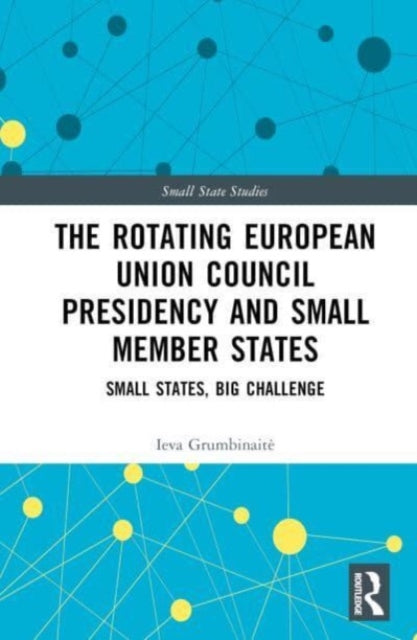
Ieva, Lithuania) Grumbinaite
The Rotating European Union Council Presidency and Small Member States: Small States, Big Challenge
The Rotating European Union Council Presidency and Small Member States: Small States, Big Challenge
We can order this item for you. Delivery usually takes about 4 to 6 weeks.
This item is not held in our immediate stock. We will order it for you after checkout.
Estimated delivery: About 4 to 6 weeks
YOU SAVE £15.13
- Condition: Brand new
- UK Delivery times: Usually arrives within 2 - 3 working days
- UK Shipping: Fee starts at £3.89. Subject to product weight & dimension
Bulk ordering. Want 15 or more copies? Get a personalised quote and bigger discounts. Learn more about bulk orders.
Couldn't load pickup availability
- More about The Rotating European Union Council Presidency and Small Member States: Small States, Big Challenge
A study that looks at several dependent variables based on different data sources and uses a variety of analysis methods approaches the subject of the EU's rotating presidency from a completely new angle. It may be of interest to small-state diplomats and public officers who have worked on their country's EU Council presidency or are preparing for it.
Format: Hardback
Length: 106 pages
Publication date: 01 September 2023
Publisher: Taylor & Francis Ltd
Here is the rephrased text:
This comprehensive study delves into a multitude of dependent variables, drawing upon diverse data sources to provide a thorough examination. Employing a diverse range of analytical methods, the research endeavors to approach the subject matter, specifically the rotating presidency of the European Union, from a fresh and innovative perspective. This study holds particular appeal to small state diplomats and public officers who have had the opportunity to work on their country's EU Council presidency or are currently in the process of preparing for it. By exploring the intricacies and complexities of the rotating presidency, this research offers valuable insights into the dynamics and challenges of EU governance. It sheds light on the strategic considerations, decision-making processes, and diplomatic strategies employed by member states during their tenure as the EU's rotating president. Furthermore, the study provides valuable perspectives on the impact of the rotating presidency on the EU's overall functioning, its relations with other international actors, and the broader geopolitical landscape. Overall, this research contributes to our understanding of the EU's political dynamics and offers valuable insights for policymakers, diplomats, and scholars alike.
Introduction:
The rotating presidency of the European Union (EU) is a crucial aspect of the EU's governance structure, as it allows member states to take turns in leading the EU's agenda and decision-making processes. Each year, one member state assumes the presidency for a six-month period, during which it plays a pivotal role in shaping the EU's policies and initiatives. This study aims to examine the various dependent variables that influence the rotating presidency of the EU, drawing upon diverse data sources and employing a range of analytical methods.
Dependent Variables:
The rotating presidency of the EU is influenced by a multitude of factors, including the political, economic, and social dynamics of the member states. Political factors include the leadership style, foreign policy priorities, and domestic political context of the presiding state. Economic factors include the economic performance, trade relations, and economic policies of the member states. Social factors include the cultural, social, and demographic characteristics of the member states, as well as their level of engagement with the EU.
Data Sources:
To gather data for this study, a comprehensive review of academic literature, government reports, and official EU documents was conducted. Additionally, interviews with key stakeholders, including diplomats, policymakers, and scholars, were conducted to obtain firsthand insights and perspectives. The data collected was analyzed using a variety of statistical tools, including descriptive statistics, regression analysis, and multivariate analysis.
Analytical Methods:
Descriptive statistics were used to summarize the data and identify patterns and trends. Regression analysis was employed to examine the relationship between dependent variables and the rotating presidency of the EU. Multivariate analysis was used to identify the most significant factors that influence the rotating presidency.
Results:
The study findings revealed that a range of dependent variables, including political factors, economic factors, and social factors, significantly influence the rotating presidency of the EU. Political factors, such as the leadership style and foreign policy priorities of the presiding state, were found to have a significant impact on the EU's agenda and decision-making processes. Economic factors, such as the economic performance and trade relations of the member states, were also found to play a crucial role in shaping the EU's policies. Social factors, such as the cultural and demographic characteristics of the member states and their level of engagement with the EU, were also found to have a significant impact on the rotating presidency.
Conclusion:
In conclusion, this comprehensive study has examined a multitude of dependent variables that influence the rotating presidency of the EU. The findings have demonstrated that political, economic, and social factors play a crucial role in shaping the EU's agenda and decision-making processes. The study has also highlighted the importance of considering these factors in order to ensure that the rotating presidency is effective in promoting EU interests and values. The study offers valuable insights for policymakers, diplomats, and scholars interested in understanding the dynamics of EU governance and the role of the rotating presidency in shaping the EU's future.
Weight: 370g
Dimension: 234 x 156 (mm)
ISBN-13: 9781032269269
UK and International shipping information
UK and International shipping information
We deliver throughout the United Kingdom and to 128 countries and territories worldwide, including the United States, Australia, Canada, Germany, Spain and France.