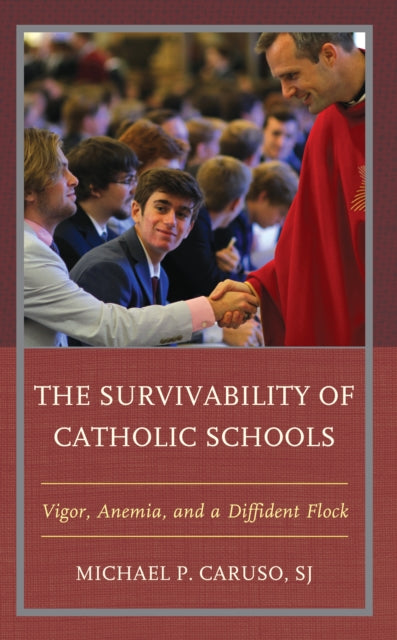
Michael P. Caruso
The Survivability of Catholic Schools: Vigor, Anemia, and a Diffident Flock
The Survivability of Catholic Schools: Vigor, Anemia, and a Diffident Flock
We can order this item for you. Delivery usually takes about 4 to 6 weeks.
This item is not held in our immediate stock. We will order it for you after checkout.
Estimated delivery: About 4 to 6 weeks
YOU SAVE £7.25
- Condition: Brand new
- UK Delivery times: Usually arrives within 2 - 3 working days
- UK Shipping: Fee starts at £3.89. Subject to product weight & dimension
Bulk ordering. Want 15 or more copies? Get a personalised quote and bigger discounts. Learn more about bulk orders.
Couldn't load pickup availability
- More about The Survivability of Catholic Schools: Vigor, Anemia, and a Diffident Flock
Catholic elementary and secondary schools in the US face numerous challenges, including escalating costs, limited funding, rising expectations, divisive culture battles, conflicting beliefs, and growing secularism. The book "The Survivability of Catholic Schools: Vigor, Anemia, and a Diffident Flock" guides readers through these trials and joys and encourages reinvigoration of this valuable institution.
Format: Hardback
Length: 120 pages
Publication date: 15 December 2022
Publisher: Bloomsbury Publishing Plc
Catholic elementary and secondary schools in the United States are renowned for their academic excellence, safety, discipline, good communication, and a Christ-centered focus that permeates the school culture. However, there are numerous unseen challenges that school leaders face daily. These challenges include escalating costs and limited funding streams, rising expectations of families, divisive culture battles, conflicting and sometimes mutually exclusive views of Church teachings and beliefs, and a growing and hostile secularism.
One of the most significant challenges facing Catholic schools is the increasing cost of education. With the rising cost of tuition, fees, and other expenses, many families are finding it difficult to afford a Catholic education for their children. This has led to a decline in enrollment and a financial crisis for many schools.
Another challenge is the limited funding streams available to Catholic schools. While some schools receive government funding, many others rely on donations and fundraising. However, the economic downturn has made it difficult for many donors to give, and this has led to a decrease in funding.
Rising expectations of families are also a challenge for Catholic schools. Families want their children to receive a high-quality education that will prepare them for success in college and the workforce. However, this can be difficult to achieve with limited resources.
Divisive culture battles are also a challenge for Catholic schools. With the increasing diversity of the United States, there are many different cultural perspectives and beliefs that can conflict with the teachings of the Catholic Church. This can lead to tensions and conflicts within the school community.
Conflicting and sometimes mutually exclusive views of Church teachings and beliefs are also a challenge for Catholic schools. While the Church has a clear set of teachings and beliefs, there are many different interpretations of these teachings and beliefs. This can lead to confusion and disagreement within the school community.
A growing and hostile secularism is also a challenge for Catholic schools. With the increasing secularization of society, many people are becoming less religious and less supportive of Catholic schools. This can lead to a decline in enrollment and a financial crisis for many schools.
Despite these challenges, Catholic schools remain a vital part of the American education system. They provide a high-quality education that is rooted in the teachings of the Catholic Church and that prepares students for success in college and the workforce. However, to maintain these hard-won benchmarks, school leaders must face these challenges head-on.
One way to address these challenges is to increase funding for Catholic schools. This can be done through government funding, donations, and fundraising. However, it is important to ensure that the funding is used effectively and that it is not used to promote a particular political or religious agenda.
Another way to address these challenges is to promote a culture of collaboration and communication within the school community. This can be done by creating opportunities for parents, alumni, and stakeholders to engage with the school and by providing training and support for teachers and staff.
In addition, Catholic schools can work to address the divisive culture battles that are occurring within the school community. This can be done by promoting diversity and inclusion and by providing education and training on cultural sensitivity and awareness.
Finally, Catholic schools can work to address the growing and hostile secularism that is occurring within society. This can be done by promoting a strong sense of Catholic identity and by providing education and training on the Catholic faith.
In conclusion, Catholic elementary and secondary schools in the United States are known for their academic excellence, safety, discipline, good communication, and a Christ-centered focus that permeates the school culture. However, there are numerous unseen challenges that school leaders face daily. These challenges include escalating costs and limited funding streams, rising expectations of families, divisive culture battles, conflicting and sometimes mutually exclusive views of Church teachings and beliefs, and a growing and hostile secularism. To maintain these hard-won benchmarks, school leaders must face these challenges head-on and work to promote a culture of collaboration and communication, address the divisive culture battles, and address the growing and hostile secularism. By doing so, Catholic schools can continue to be a vital part of the American education system for generations to come.
Weight: 362g
Dimension: 158 x 237 x 19 (mm)
ISBN-13: 9781475867923
UK and International shipping information
UK and International shipping information
We deliver throughout the United Kingdom and to 128 countries and territories worldwide, including the United States, Australia, Canada, Germany, Spain and France.