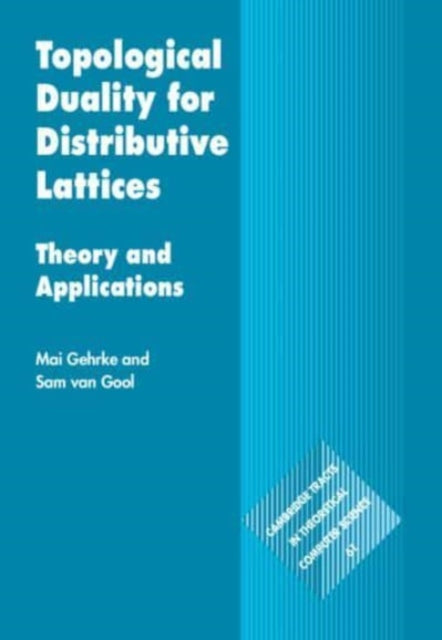
MaiGehrke,Samvan Gool
Topological Duality for Distributive Lattices: Theory and Applications
Topological Duality for Distributive Lattices: Theory and Applications
💎 Earn 320 Points (£3.20) on this item.
We can order this item for you. Delivery usually takes about 4 to 6 weeks.
This item is not held in our immediate stock. We will order it for you after checkout.
Estimated delivery: About 4 to 6 weeks
YOU SAVE £3.81
- Condition: Brand new
- UK Delivery times: Usually arrives within 2 - 3 working days
- UK Shipping: Fee starts at £3.89. Subject to product weight & dimension
Bulk ordering. Want 15 or more copies? Get a personalised quote and bigger discounts. Learn more about bulk orders.
Couldn't load pickup availability
- More about Topological Duality for Distributive Lattices: Theory and Applications
Stone–Priestley duality theory is a theoretical framework that unifies algebraic, topological, logical, and categorical aspects of computer science, providing a foundation for advanced research in domain theory and automata theory.
Format: Hardback
Length: 367 pages
Publication date: 07 March 2024
Publisher: Cambridge University Press
Stone-Priestley duality theory is a fundamental concept in logic and theoretical computer science that provides a framework for understanding the relationship between different types of mathematical structures. It was first introduced by the British mathematician Alan Stone and the American mathematician Leslie Priestley in the 1960s and has since played a crucial role in advancing our understanding of computability and complexity theory.
The theory revolves around the idea of dualizing structures, which means taking a structure and transforming it into another structure that is closely related but has a different perspective. This transformation is achieved through a series of operations called dualization, which involve taking elements of the original structure and mapping them to elements of the dual structure.
One of the key applications of Stone-Priestley duality theory is in the area of logic. Logic is the study of formal systems that allow us to reason and prove statements. Stone-Priestley duality theory provides a way to formalize the relationship between different types of logical systems, such as propositional logic, first-order logic, and higher-order logic. By dualizing logical systems, we can prove theorems that are valid in one system but not in another, and we can also develop new logical systems that are more powerful than existing ones.
Another application of Stone-Priestley duality theory is in the area of theoretical computer science. Theoretical computer science is the study of the design and analysis of algorithms and data structures. Stone-Priestley duality theory provides a way to formalize the relationship between different types of algorithms and data structures, such as sorting algorithms, search algorithms, and graph algorithms. By dualizing algorithms and data structures, we can develop new algorithms that are more efficient and scalable than existing ones, and we can also develop new insights into the complexity of algorithms and data structures.
In addition to its applications in logic and theoretical computer science, Stone-Priestley duality theory has also been used in other areas of mathematics and computer science. For example, it has been used to develop new methods for solving optimization problems, such as linear programming and convex optimization. It has also been used to develop new methods for analyzing complex systems, such as networks and social systems.
Overall, Stone-Priestley duality theory is a powerful tool that has had a significant impact on the field of logic and theoretical computer science. It provides a framework for understanding the relationship between different types of mathematical structures and has been used to develop new methods for reasoning, proving, and analyzing complex systems. While the theory is complex and requires careful study, it is a valuable resource for anyone interested in advancing their understanding of these fields.
Stone-Priestley duality theory is a fundamental concept in logic and theoretical computer science that provides a framework for understanding the relationship between different types of mathematical structures. It was first introduced by the British mathematician Alan Stone and the American mathematician Leslie Priestley in the 1960s and has since played a crucial role in advancing our understanding of computability and complexity theory.
The theory revolves around the idea of dualizing structures, which means taking a structure and transforming it into another structure that is closely related but has a different perspective. This transformation is achieved through a series of operations called dualization, which involve taking elements of the original structure and mapping them to elements of the dual structure.
One of the key applications of Stone-Priestley duality theory is in the area of logic. Logic is the study of formal systems that allow us to reason and prove statements. Stone-Priestley duality theory provides a way to formalize the relationship between different types of logical systems, such as propositional logic, first-order logic, and higher-order logic. By dualizing logical systems, we can prove theorems that are valid in one system but not in another, and we can also develop new logical systems that are more powerful than existing ones.
Another application of Stone-Priestley duality theory is in the area of theoretical computer science. Theoretical computer science is the study of the design and analysis of algorithms and data structures. Stone-Priestley duality theory provides a way to formalize the relationship between different types of algorithms and data structures, such as sorting algorithms, search algorithms, and graph algorithms. By dualizing algorithms and data structures, we can develop new algorithms that are more efficient and scalable than existing ones, and we can also develop new insights into the complexity of algorithms and data structures.
In addition to its applications in logic and theoretical computer science, Stone-Priestley duality theory has also been used in other areas of mathematics and computer science. For example, it has been used to develop new methods for solving optimization problems, such as linear programming and convex optimization. It has also been used to develop new methods for analyzing complex systems, such as networks and social systems.
Overall, Stone-Priestley duality theory is a powerful tool that has had a significant impact on the field of logic and theoretical computer science. It provides a framework for understanding the relationship between different types of mathematical structures and has been used to develop new methods for reasoning, proving, and analyzing complex systems. While the theory is complex and requires careful study, it is a valuable resource for anyone interested in advancing their understanding of these fields.
Stone-Priestley duality theory is a fundamental concept in logic and theoretical computer science that provides a framework for understanding the relationship between different types of mathematical structures. It was first introduced by the British mathematician Alan Stone and the American mathematician Leslie Priestley in the 1960s and has since played a crucial role in advancing our understanding of computability and complexity theory.
The theory revolves around the idea of dualizing structures, which means taking a structure and transforming it into another structure that is closely related but has a different perspective. This transformation is achieved through a series of operations called dualization, which involve taking elements of the original structure and mapping them to elements of the dual structure.
One of the key applications of Stone-Priestley duality theory is in the area of logic. Logic is the study of formal systems that allow us to reason and prove statements. Stone-Priestley duality theory provides a way to formalize the relationship between different types of logical systems, such as propositional logic, first-order logic, and higher-order logic. By dualizing logical systems, we can prove theorems that are valid in one system but not in another, and we can also develop new logical systems that are more powerful than existing ones.
Another application of Stone-Priestley duality theory is in the area of theoretical computer science. Theoretical computer science is the study of the design and analysis of algorithms and data structures. Stone-Priestley duality theory provides a way to formalize the relationship between different types of algorithms and data structures, such as sorting algorithms, search algorithms, and graph algorithms. By dualizing algorithms and data structures, we can develop new algorithms that are more efficient and scalable than existing ones, and we can also develop new insights into the complexity of algorithms and data structures.
In addition to its applications in logic and theoretical computer science, Stone-Priestley duality theory has also been used in other areas of mathematics and computer science. For example, it has been used to develop new methods for solving optimization problems, such as linear programming and convex optimization. It has also been used to develop new methods for analyzing complex systems, such as networks and social systems.
Overall, Stone-Priestley duality theory is a powerful tool that has had a significant impact on the field of logic and theoretical computer science. It provides a framework for understanding the relationship between different types of mathematical structures and has been used to develop new methods for reasoning, proving, and analyzing complex systems. While the theory is complex and requires careful study, it is a valuable resource for anyone interested in advancing their understanding of these fields.
Stone-Priestley duality theory is a fundamental concept in logic and theoretical computer science that provides a framework for understanding the relationship between different types of mathematical structures. It was first introduced by the British mathematician Alan Stone and the American mathematician Leslie Priestley in the 1960s and has since played a crucial role in advancing our understanding of computability and complexity theory.
The theory revolves around the idea of dualizing structures, which means taking a structure and transforming it into another structure that is closely related but has a different perspective. This transformation is achieved through a series of operations called dualization, which involve taking elements of the original structure and mapping them to elements of the dual structure.
One of the key applications of Stone-Priestley duality theory is in the area of logic. Logic is the study of formal systems that allow us to reason and prove statements. Stone-Priestley duality theory provides a way to formalize the relationship between different types of logical systems, such as propositional logic, first-order logic, and higher-order logic. By dualizing logical systems, we can prove theorems that are valid in one system but not in another, and we can also develop new logical systems that are more powerful than existing ones.
Another application of Stone-Priestley duality theory is in the area of theoretical computer science. Theoretical computer science is the study of the design and analysis of algorithms and data structures. Stone-Priestley duality theory provides a way to formalize the relationship between different types of algorithms and data structures, such as sorting algorithms, search algorithms, and graph algorithms. By dualizing algorithms and data structures, we can develop new algorithms that are more efficient and scalable than existing ones, and we can also develop new insights into the complexity of algorithms and data structures.
In addition to its applications in logic and theoretical computer science, Stone-Priestley duality theory has also been used in other areas of mathematics and computer science. For example, it has been used to develop new methods for solving optimization problems, such as linear programming and convex optimization. It has also been used to develop new methods for analyzing complex systems, such as networks and social systems.
Overall, Stone-Priestley duality theory is a powerful tool that has had a significant impact on the field of logic and theoretical computer science. It provides a framework for understanding the relationship between different types of mathematical structures and has been used to develop new methods for reasoning, proving, and analyzing complex systems. While the theory is complex and requires careful study, it is a valuable resource for anyone interested in advancing their understanding of these fields.
Stone-Priestley duality theory is a fundamental concept in logic and theoretical computer science that provides a framework for understanding the relationship between different types of mathematical structures. It was first introduced by the British mathematician Alan Stone and the American mathematician Leslie Priestley in the 1960s and has since played a crucial role in advancing our understanding of computability and complexity theory.
The theory revolves around the idea of dualizing structures, which means taking a structure and transforming it into another structure that is closely related but has a different perspective. This transformation is achieved through a series of operations called dualization, which involve taking elements of the original structure and mapping them to elements of the dual structure.
One of the key applications of Stone-Priestley duality theory is in the area of logic. Logic is the study of formal systems that allow us to reason and prove statements. Stone-Priestley duality theory provides a way to formalize the relationship between different types of logical systems, such as propositional logic, first-order logic, and higher-order logic. By dualizing logical systems, we can prove theorems that are valid in one system but not in another, and we can also develop new logical systems that are more powerful than existing ones.
Another application of Stone-Priestley duality theory is in the area of theoretical computer science. Theoretical computer science is the study of the design and analysis of algorithms and data structures. Stone-Priestley duality theory provides a way to formalize the relationship between different types of algorithms and data structures, such as sorting algorithms, search algorithms, and graph algorithms. By dualizing algorithms and data structures, we can develop new algorithms that are more efficient and scalable than existing ones, and we can also develop new insights into the complexity of algorithms and data structures.
In addition to its applications in logic and theoretical computer science, Stone-Priestley duality theory has also been used in other areas of mathematics and computer science. For example, it has been used to develop new methods for solving optimization problems, such as linear programming and convex optimization. It has also been used to develop new methods for analyzing complex systems, such as networks and social systems.
Overall, Stone-Priestley duality theory is a powerful tool that has had a significant impact on the field of logic and theoretical computer science. It provides a framework for understanding the relationship between different types of mathematical structures and has been used to develop new methods for reasoning, proving, and analyzing complex systems. While the theory is complex and requires careful study, it is a valuable resource for anyone interested in advancing their understanding of these fields.
Weight: 802g
Dimension: 175 x 251 x 27 (mm)
ISBN-13: 9781009349697
UK and International shipping information
UK and International shipping information
We deliver throughout the United Kingdom and to 128 countries and territories worldwide, including the United States, Australia, Canada, Germany, Spain and France.