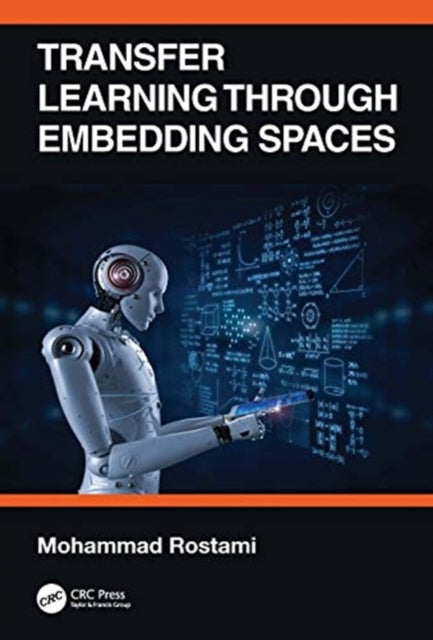
Mohammad Rostami
Transfer Learning through Embedding Spaces
Transfer Learning through Embedding Spaces
💎 Earn 589 Points (£5.89) on this item.
We can order this item for you. Delivery usually takes about 4 to 6 weeks.
This item is not held in our immediate stock. We will order it for you after checkout.
Estimated delivery: About 4 to 6 weeks
YOU SAVE £7.00
- Condition: Brand new
- UK Delivery times: Usually arrives within 2 - 3 working days
- UK Shipping: Fee starts at £3.89. Subject to product weight & dimension
Bulk ordering. Want 15 or more copies? Get a personalised quote and bigger discounts. Learn more about bulk orders.
Couldn't load pickup availability
- More about Transfer Learning through Embedding Spaces
Recent progress in AI has revolutionized our everyday life, but data annotation is a time-consuming and expensive task. Transfer learning is a remedy to relax the need for data annotation by transferring knowledge across similar tasks and using similarities and previously learned knowledge to learn more efficiently. This book provides a brief background on transfer learning and focuses on the idea of transferring knowledge through intermediate embedding spaces.
Format: Hardback
Length: 198 pages
Publication date: 29 June 2021
Publisher: Taylor & Francis Ltd
The recent advancements in artificial intelligence (AI) have brought about a transformative impact on our daily lives. Numerous AI algorithms have achieved remarkable levels of performance, rivaling human capabilities, and are increasingly replacing human labor in various professions. According to predictions, this trend is expected to continue, with approximately 30% of work activities in approximately 60% of current occupations projected to be automated.
While this success is noteworthy, it is crucial to acknowledge that the widespread adoption of AI relies heavily on the availability of vast annotated datasets for training AI models. Data annotation, a time-consuming and expensive process, is currently performed predominantly by human workers. However, there is a pressing need to develop more efficient methods for learning from limited data, as this will further enhance the similarity between AI and natural intelligence.
Transfer learning has emerged as a promising approach to address this challenge. The core concept of transfer learning involves transferring knowledge across similar tasks and leveraging similarities and previously learned knowledge to learn more efficiently. In this book, we provide a comprehensive overview of transfer learning, including its historical background and fundamental principles. We then delve into the idea of transferring knowledge through intermediate embedding spaces, which aim to couple and relate different learning tasks based on task-level relations and similarities.
Throughout the book, we explore a wide range of machine learning scenarios where this approach has been successfully applied. We demonstrate how intermediate embedding spaces can be used to overcome challenges such as zero-shot learning, few-shot learning, domain adaptation, continual learning, lifelong learning, and collaborative learning. By leveraging the power of transfer learning, we aim to empower AI systems to adapt and learn in diverse environments, ultimately improving their performance and capabilities.
In conclusion, the recent progress in AI has opened up exciting opportunities for innovation and growth. Transfer learning plays a pivotal role in this journey, enabling AI systems to learn from limited data and adapt to new environments. By embracing the principles of transfer learning, we can further enhance the capabilities of AI and pave the way for a more intelligent and autonomous future.
Weight: 588g
Dimension: 183 x 260 x 21 (mm)
ISBN-13: 9780367699055
UK and International shipping information
UK and International shipping information
We deliver throughout the United Kingdom and to 128 countries and territories worldwide, including the United States, Australia, Canada, Germany, Spain and France.