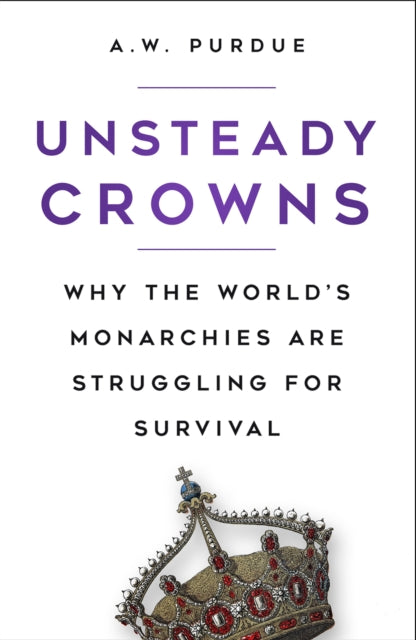
A.W. Purdue
Unsteady Crowns: Why the World's Monarchies are Struggling for Survival
Unsteady Crowns: Why the World's Monarchies are Struggling for Survival
💎 Earn 53 Points (£0.53) on this item.
YOU SAVE £4.38
- Condition: Brand new
- UK Delivery times: Usually arrives within 2 - 3 working days
- UK Shipping: Fee starts at £3.89. Subject to product weight & dimension
Bulk ordering. Want 15 or more copies? Get a personalised quote and bigger discounts. Learn more about bulk orders.
Couldn't load pickup availability
- More about Unsteady Crowns: Why the World's Monarchies are Struggling for Survival
Throughout the 20th century, monarchies were the predominant form of government, but their numbers have decreased. They still have charisma and play a role in continuity.
Format: Paperback / softback
Length: 368 pages
Publication date: 10 February 2022
Publisher: The History Press Ltd
The reign of the monarch was the dominant form of government during the early 20th century. Although their numbers have dwindled over time, their influence remains strong. This essay explores the factors that have contributed to the survival of monarchies in certain countries and argues that they play a crucial role in preserving cultural heritage and promoting stability.
The concept of monarchy has been prevalent throughout history, with various countries adopting this form of government. In the early 20th century, monarchy was by far the most common form of government, with many nations across the world adopting this system. However, with the passage of time, the number of monarchies has diminished, and today, only a handful of countries continue to have a monarch as their head of state.
Despite the decline in the number of monarchies, these institutions continue to hold a significant place in the hearts and minds of people around the world. They are often associated with tradition, grandeur, and stability, and their presence can evoke a sense of nostalgia and pride. Monarchies are also seen as a symbol of continuity, as they have been in place for centuries and often play a role in preserving cultural heritage and traditions.
One of the common denominators in those countries that have retained their monarchies is a strong sense of national identity. Monarchies are often seen as a link to the country's past and a symbol of its cultural heritage. They are often associated with the history, traditions, and values of a nation, and their presence can help to promote a sense of unity and belonging among the people.
Another factor that has contributed to the survival of monarchies is the role that they play in promoting stability. Monarchies are often seen as a stable and predictable form of government, as they are not subject to the fluctuations and political instability that can be seen in other forms of government. This stability can be particularly important in regions that are facing political or social unrest, as it can help to provide a sense of security and reassurance to the people.
In addition to their role in promoting stability, monarchies can also play a role in promoting economic development. Monarchies are often associated with wealth and prosperity, and their presence can attract investment and tourism. This can lead to economic growth and job creation, which can benefit the people of a country.
Despite the benefits that monarchies can bring, there are also criticisms of these institutions. Some argue that monarchies are outdated and undemocratic, as they do not allow for the direct participation of the people in the decision-making process. Others argue that monarchies are a source of corruption and abuse of power, as the power of the monarch is often unchecked and unaccountable.
Despite these criticisms, it is important to recognize that monarchies are a unique form of government that has a rich history and cultural significance. They can play a valuable role in promoting stability, preserving cultural heritage, and promoting economic development. As such, it is important to consider the factors that have contributed to the survival of monarchies in certain countries and to work towards preserving these institutions for future generations.
In conclusion, while the number of monarchies has diminished over time, these institutions continue to hold a significant place in the hearts and minds of people around the world. They are often associated with tradition, grandeur, and stability, and their presence can evoke a sense of nostalgia and pride. Monarchies are also seen as a symbol of continuity, as they have been in place for centuries and often play a role in preserving cultural heritage and traditions. Despite the criticisms that these institutions face, it is important to recognize the benefits that they can bring and to work towards preserving them for future generations.
Weight: 396g
Dimension: 130 x 199 x 32 (mm)
ISBN-13: 9780750999328
Edition number: 2 New edition
UK and International shipping information
UK and International shipping information
We deliver throughout the United Kingdom and to 128 countries and territories worldwide, including the United States, Australia, Canada, Germany, Spain and France.