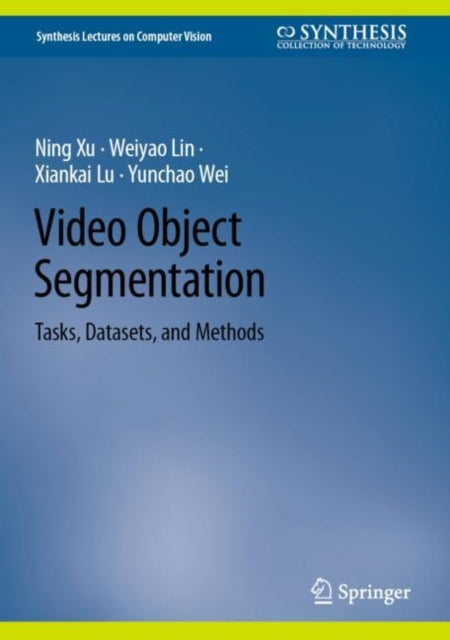

Ning Xu,Weiyao Lin,Xiankai Lu,Yunchao Wei
Video Object Segmentation: Tasks, Datasets, and Methods
Video Object Segmentation: Tasks, Datasets, and Methods
We can order this item for you. Delivery usually takes about 4 to 6 weeks.
This item is not held in our immediate stock. We will order it for you after checkout.
Estimated delivery: About 4 to 6 weeks
YOU SAVE £7.07
- Condition: Brand new
- UK Delivery times: Usually arrives within 2 - 3 working days
- UK Shipping: Fee starts at £3.89. Subject to product weight & dimension
Bulk ordering. Want 15 or more copies? Get a personalised quote and bigger discounts. Learn more about bulk orders.
Couldn't load pickup availability
- More about Video Object Segmentation: Tasks, Datasets, and Methods
The book provides a comprehensive overview of recent progress in video object segmentation, covering deep learning, large-scale video analysis, and benchmarks in complex events. It is useful for researchers and industrial practitioners in the field.
Format: Hardback
Length: 187 pages
Publication date: 16 December 2023
Publisher: Springer International Publishing AG
Video segmentation is a crucial aspect of video understanding in computer vision, as it enables the identification and separation of distinct objects within a given video. This process holds immense potential for various applications, such as video conference, video editing, surveillance, and autonomous driving. With the advent of deep learning in computer vision, there has been a surge in the development of new tasks, datasets, and methods in the field of segmentation. This book comprehensively covers these recent advancements and findings in large-scale video object segmentation, as well as benchmarks in large-scale human-centric video analysis in complex events. The authors aim to provide readers with a comprehensive understanding of the challenges involved in video object segmentation, as well as the most effective methods for addressing them.
The book begins by providing an introduction to the topic of video segmentation, highlighting its significance and potential applications. It then delves into the state-of-the-art techniques and algorithms used in this field, including deep learning-based methods, edge-based methods, and active learning-based methods. The authors discuss the advantages and limitations of each approach and provide examples of their applications in different domains.
In the subsequent chapters, the book presents detailed overviews of recent progress in large-scale video object segmentation. It covers topics such as object detection, instance segmentation, semantic segmentation, and tracking. The authors discuss the challenges associated with these tasks and present innovative solutions that have achieved state-of-the-art performance. They also provide benchmarks and evaluation metrics to assess the performance of different segmentation algorithms.
Furthermore, the book explores the application of video segmentation in complex events analysis. It discusses the challenges of analyzing large-scale videos with multiple objects and humans, and presents methods for extracting meaningful information from these videos. The authors discuss the use of deep learning-based models for human pose estimation, activity recognition, and scene understanding, and provide examples of their applications in surveillance, sports analytics, and healthcare.
Throughout the book, the authors emphasize the importance of interdisciplinary research in video segmentation. They discuss the collaboration between computer vision researchers, machine learning experts, and domain experts from various fields, and highlight the need for open-source datasets and tools to facilitate research and development in this area.
In conclusion, this book provides a comprehensive and up-to-date overview of recent progress in video object segmentation. It is an invaluable resource for researchers, industrial practitioners, and students interested in this field. By presenting the latest techniques, algorithms, and applications, the book enables readers to gain a deep understanding of the challenges involved in video object segmentation and develop effective solutions for their applications.
Weight: 514g
Dimension: 240 x 168 (mm)
ISBN-13: 9783031446559
Edition number: 1st ed. 2024
UK and International shipping information
UK and International shipping information
We deliver throughout the United Kingdom and to 128 countries and territories worldwide, including the United States, Australia, Canada, Germany, Spain and France.