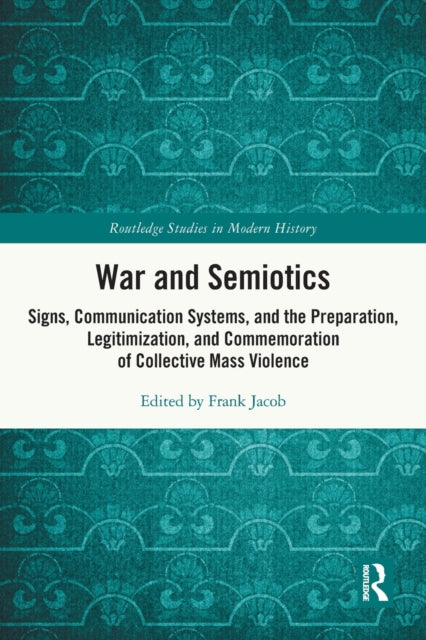
Frank Jacob
War and Semiotics: Signs, Communication Systems, and the Preparation, Legitimization, and Commemoration of Collective Mass Violence
War and Semiotics: Signs, Communication Systems, and the Preparation, Legitimization, and Commemoration of Collective Mass Violence
💎 Earn 226 Points (£2.26) on this item.
We can order this item for you. Delivery usually takes about 4 to 6 weeks.
This item is not held in our immediate stock. We will order it for you after checkout.
Estimated delivery: About 4 to 6 weeks
YOU SAVE £2.69
- Condition: Brand new
- UK Delivery times: Usually arrives within 2 - 3 working days
- UK Shipping: Fee starts at £3.89. Subject to product weight & dimension
Bulk ordering. Want 15 or more copies? Get a personalised quote and bigger discounts. Learn more about bulk orders.
Couldn't load pickup availability
- More about War and Semiotics: Signs, Communication Systems, and the Preparation, Legitimization, and Commemoration of Collective Mass Violence
Wars redefine semiotic and semantic codes to create enemy images and post-event definitions of just or reasonable outcomes. This volume discusses the interrelationship of semiotic systems and their constructions during wars in different periods of history.
Format: Paperback / softback
Length: 324 pages
Publication date: 01 August 2022
Publisher: Taylor & Francis Ltd
Wars have a unique dynamic that is particularly evident in the realm of images and language. The semiotic and semantic codes undergo redefinition, driven by the necessity to construct an enemy image or in response to the post-event perceptions of a war as just or reasonable. The semiotic systems of wars play a crucial role in the exploration of the contributions presented in this volume, which shed light on the interconnectedness of semiotic systems and their construction during various historical periods of warfare.
The media plays a significant role in shaping public opinion during times of war. Through the use of images, videos, and narratives, the media can influence how people perceive the conflict and its participants. For example, during the Gulf War, the media heavily portrayed Saddam Hussein as a cruel and despotic leader, which contributed to the widespread public support for the US-led invasion. Similarly, during the Vietnam War, the media showed images of Vietnamese civilians fleeing from American troops, which helped to generate opposition to the war.
The language used in war reporting can also have a significant impact on public perception. For example, the use of euphemisms and sanitization can downplay the severity of the conflict and the human cost. This can be seen in the media's coverage of the Iraq War, where terms such as "collateral damage" were used to describe the deaths of innocent civilians.
In addition to the media, social media has become an increasingly important tool for shaping public opinion during times of war. Social media platforms such as Twitter and Facebook allow individuals to share information and opinions quickly and widely, and can have a significant impact on the public's perception of the conflict. For example, during the Syrian Civil War, social media was used to share videos and images of the conflict, which helped to raise awareness of the human rights abuses and the plight of the Syrian people.
However, the use of images and language in war can also be problematic. The use of stereotypes and caricatures can perpetuate harmful biases and prejudices, and can contribute to the dehumanization of the enemy. This can be seen in the media's coverage of the Israeli-Palestinian conflict, where images of Palestinians are often portrayed as violent and terrorist, while Israelis are portrayed as innocent and victimized.
Similarly, the use of language can be used to justify military actions and downplay the human cost of war. For example, the phrase "collateral damage" was coined by the US military to describe the deaths of innocent civilians in the Iraq War, which helped to normalize the use of military force and reduce the moral consequences of war.
In conclusion, the use of images and language in war is a complex and multifaceted issue that can have a significant impact on public perception and the course of the conflict. The media, social media, and the language used in war reporting can all shape public opinion and contribute to the dehumanization of the enemy. It is important for journalists and media organizations to be mindful of the impact that their reporting can have on public perception and to strive for accuracy, fairness, and empathy in their coverage of war.
Weight: 620g
Dimension: 234 x 156 (mm)
ISBN-13: 9780367681012
UK and International shipping information
UK and International shipping information
We deliver throughout the United Kingdom and to 128 countries and territories worldwide, including the United States, Australia, Canada, Germany, Spain and France.