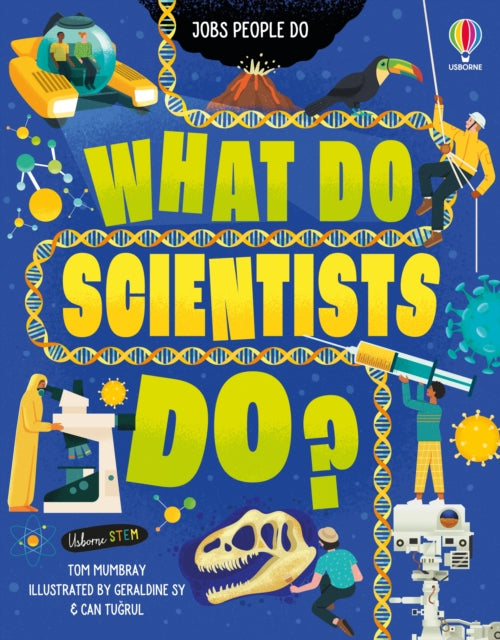
Tom Mumbray
What Do Scientists Do?
What Do Scientists Do?
YOU SAVE £3.16
- Condition: Brand new
- UK Delivery times: Usually arrives within 2 - 3 working days
- UK Shipping: Fee starts at £3.89. Subject to product weight & dimension
Bulk ordering. Want 15 or more copies? Get a personalised quote and bigger discounts. Learn more about bulk orders.
Couldn't load pickup availability
- More about What Do Scientists Do?
Explore science careers, meet scientists, and discover how to become a scientist yourself.
Format: Hardback
Length: 80 pages
Publication date: 06 July 2023
Publisher: Usborne Publishing Ltd
Are you ready to embark on an exciting journey into the world of science? Prepare to meet a diverse range of scientists who are engaged in a wide array of fascinating jobs, spanning from astronomy to zoology. Get a glimpse into their daily routines and witness their groundbreaking discoveries firsthand. But that's not all—learn how you can become a scientist yourself and unlock your potential to make incredible contributions to the field.
Science is a vast and captivating field that offers endless opportunities for exploration and discovery. Whether you are interested in the mysteries of the universe, the intricacies of animal behavior, or the wonders of modern technology, there is a career in science that can suit your interests and passions.
One of the most exciting aspects of science is the wide range of jobs that are available. From astrophysicists who study the behavior of stars and galaxies to microbiologists who study the tiny organisms that inhabit our environment, scientists are involved in a diverse array of research and experimentation.
Astrophysicists, for example, use advanced telescopes and computers to study the properties of stars, planets, and galaxies. They work to understand the formation and evolution of the universe, as well as the laws of physics that govern the behavior of matter and energy. Astrophysicists may also be involved in the development of new telescopes and instruments that will allow us to explore the cosmos in greater detail.
Microbiologists, on the other hand, study the microscopic organisms that inhabit our environment, including bacteria, viruses, and fungi. They work to understand how these organisms function and interact with each other, as well as with their host organisms. Microbiologists may also be involved in the development of new antibiotics, vaccines, and other medical treatments.
In addition to research and experimentation, science also involves a variety of other jobs, such as engineering, mathematics, and computer science. Engineers design and develop new technologies and products that have the potential to improve our lives and solve complex problems. Mathematicians use their skills to solve complex mathematical problems and develop new theories and models that can help us understand the world around us. Computer scientists use their skills to develop new software and hardware that can improve the efficiency and accuracy of scientific research and experimentation.
Another exciting aspect of science is the opportunity to make groundbreaking discoveries that can have a significant impact on society. Scientists are constantly pushing the boundaries of what is possible and are making discoveries that have the potential to change the way we live and work. For example, the discovery of the Higgs boson by scientists at CERN in 2012 was a major breakthrough in our understanding of the fundamental structure of the universe. This discovery has the potential to lead to new insights into the origins of the universe and the laws of physics that govern it.
In addition to making groundbreaking discoveries, science also plays a critical role in addressing important social and environmental challenges. Scientists are working to develop new technologies and solutions that can help us mitigate the effects of climate change, improve our energy efficiency, and protect our natural resources. They are also working to develop new medical treatments and therapies that can help us improve the health and well-being of people around the world.
If you are interested in becoming a scientist, there are several steps you can take to achieve your goal. First, you will need to obtain a strong foundation in science, including biology, chemistry, physics, and mathematics. You may also need to pursue advanced degrees, such as a Ph.D. or a Master's degree, in your chosen field. In addition to academic qualifications, you will also need to develop strong research skills, problem-solving skills, and communication skills.
One of the best ways to gain experience and develop your skills as a scientist is to participate in research projects and internships. Many universities and research institutions offer research opportunities for students and recent graduates, and these experiences can provide you with valuable hands-on experience and help you build your network of colleagues and mentors.
In addition to research, you can also pursue careers in science education and outreach. Science educators work to promote scientific literacy and understanding among the public and teach students about the exciting discoveries and innovations in science. Outreach programs, such as science fairs and museum exhibits, can also help to promote scientific awareness and inspire young people to pursue careers in science.
Another exciting aspect of science is the opportunity to work in a variety of different environments, from academic institutions to government agencies to private companies. Scientists can work in a wide range of fields, including research, development, management, and marketing.
In conclusion, science is a fascinating and dynamic field that offers endless opportunities for exploration and discovery. Whether you are interested in the mysteries of the universe, the intricacies of animal behavior, or the wonders of modern technology, there is a career in science that can suit your interests and passions. By obtaining a strong foundation in science, developing your research skills, and pursuing advanced degrees, you can become a scientist and make incredible contributions to the field. So why not embark on an exciting journey into the world of science and unlock your potential to make a difference?
Weight: 652g
Dimension: 282 x 224 x 14 (mm)
ISBN-13: 9781474969024
UK and International shipping information
UK and International shipping information
We deliver throughout the United Kingdom and to 128 countries and territories worldwide, including the United States, Australia, Canada, Germany, Spain and France.