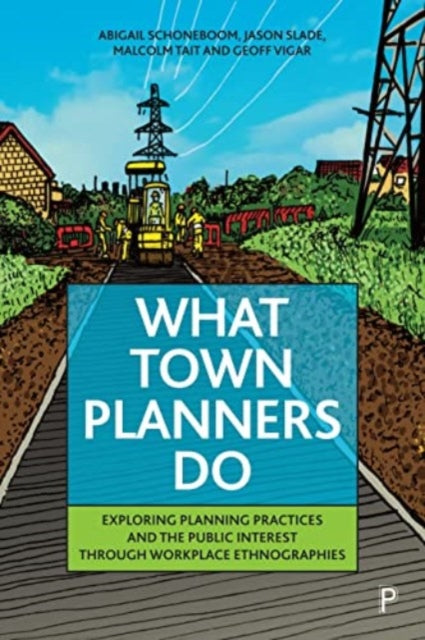
AbigailSchoneboom,JasonSlade,MalcolmTait,GeoffVigar
What Town Planners Do: Exploring Planning Practices and the Public Interest through Workplace Ethnographies
What Town Planners Do: Exploring Planning Practices and the Public Interest through Workplace Ethnographies
YOU SAVE £6.26
- Condition: Brand new
- UK Delivery times: Usually arrives within 2 - 3 working days
- UK Shipping: Fee starts at £3.89. Subject to product weight & dimension
Bulk ordering. Want 15 or more copies? Get a personalised quote and bigger discounts. Learn more about bulk orders.
Couldn't load pickup availability
- More about What Town Planners Do: Exploring Planning Practices and the Public Interest through Workplace Ethnographies
The book explores the complexities of planning work and its moral and practical dilemmas, providing a unique insight into the lives of planners and associated built environment occupations. It uses team ethnography to advance organisational ethnography into new areas.
Format: Paperback / softback
Length: 228 pages
Publication date: 21 May 2024
Publisher: Bristol University Press
Planning work is a complex and multifaceted endeavor that involves making decisions about the use of land, resources, and infrastructure to create and shape public and private spaces. It is a profession that requires a deep understanding of the social, economic, and environmental factors that influence the development of these spaces and the people who use them. This rich ethnographic study analyses how places are made through stories of four diverse public and private sector working environments. The book provides a unique insight for educators, students, and researchers into the everyday lives of planners and those in associated built environment occupations. It offers a comprehensive overview of the planning process, from initial site analysis to final implementation, and explores the various challenges and dilemmas that planners face in their work. The authors use team ethnography to push the methodological frontiers of planning research and to advance organisational ethnography into new areas.
One of the key themes of the book is the role of storytelling in planning. Stories are powerful tools that can help planners communicate their ideas and values to others and can help to shape public opinion and policy. The authors argue that stories can be used to create a sense of place, to promote social cohesion, and to address social and environmental issues. However, they also note that stories can be used to manipulate and control people and that planners must be aware of the ethical implications of their use of storytelling.
Another theme of the book is the impact of globalization on planning. Globalization has led to the growth of cities and the development of new infrastructure, but it has also led to the displacement of people and the degradation of natural resources. Planners must work to address these issues and to create sustainable and equitable communities. The authors argue that this can be done by promoting sustainable development, by reducing the impact of climate change, and by promoting social justice.
The book also explores the role of technology in planning. Technology has revolutionized the planning process, making it more efficient and effective. However, it has also led to the loss of human touch and the dehumanization of planning. Planners must work to balance the use of technology with the need for human interaction and to ensure that technology is used in a way that is ethical and sustainable.
The book also provides a number of case studies that illustrate the various challenges and dilemmas that planners face in their work. These case studies include the development of a new urban park, the redevelopment of a historic neighborhood, and the planning of a new transportation system. Each case study provides a detailed analysis of the planning process and the ethical and practical dilemmas that were faced by the planners.
In conclusion, this rich ethnographic study provides a unique insight into the everyday lives of planners and those in associated built environment occupations. It explores the role of storytelling in planning, the impact of globalization on planning, the role of technology in planning, and the various challenges and dilemmas that planners face in their work. The book offers a comprehensive overview of the planning process and provides a number of case studies that illustrate the various challenges and dilemmas that planners face. It is a valuable resource for educators, students, and researchers in the field of planning and related fields.
Dimension: 234 x 156 (mm)
ISBN-13: 9781447365983
UK and International shipping information
UK and International shipping information
We deliver throughout the United Kingdom and to 128 countries and territories worldwide, including the United States, Australia, Canada, Germany, Spain and France.