Naomi S. Baron
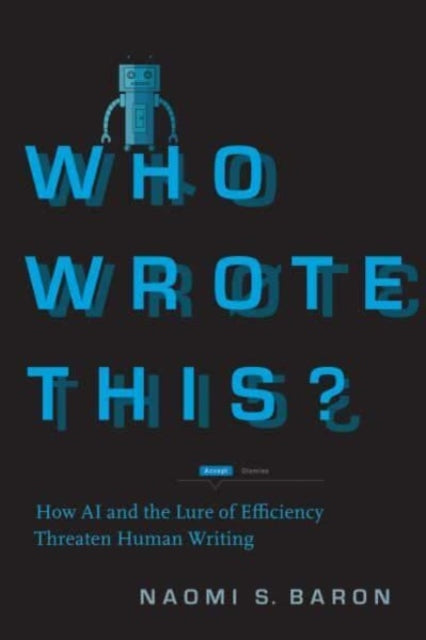
Who Wrote This?: How AI and the Lure of Efficiency Threaten Human Writing
Who Wrote This?: How AI and the Lure of Efficiency Threaten Human Writing
💎 Earn 115 Points (£1.15) on this item.
YOU SAVE £2.99
- Condition: Brand new
- UK Delivery times: Usually arrives within 2 - 3 working days
- UK Shipping: Fee starts at £3.89. Subject to product weight & dimension
Bulk ordering. Want 15 or more copies? Get a personalised quote and bigger discounts. Learn more about bulk orders.
Couldn't load pickup availability
- More about Who Wrote This?: How AI and the Lure of Efficiency Threaten Human Writing
The book "Who Wrote This?" explores how AI is redefining writing and thinking, and cautions that we should make conscious choices about the extent to which we collaborate with AI. It urges us to weigh what we gain and lose when heeding its siren call, and shows how to work with AI and spot where it risks diminishing the valuable cognitive and social benefits of being literate.
Format: Hardback
Length: 344 pages
Publication date: 12 September 2023
Publisher: Stanford University Press
Would you read this book if a computer wrote it?
Today's eerily impressive artificial intelligence writing tools present us with a crucial challenge: As writers, do we unthinkingly adopt AI's time-saving advantages or do we stop to weigh what we gain and lose when heeding its siren call? To understand how AI is redefining what it means to write and think, linguist and educator Naomi S. Baron leads us on a journey connecting the dots between human literacy and today's technology. From nineteenth-century lessons in composition, to mathematician Alan Turing's work creating a machine for deciphering war-time messages, to contemporary engines like ChatGPT, Baron gives readers a spirited overview of the emergence of both literacy and AI, and a glimpse of their possible future. As the technology becomes increasingly sophisticated and fluent, it's tempting to take the easy way out and let AI do the work for us. Baron cautions that such efficiency isn't always in our interest. As AI plies us with suggestions or full-blown text, we risk losing not just our technical skills but the power of writing as a springboard for personal reflection and unique expression.
Would you read this book if a computer wrote it?
Today's eerily impressive artificial intelligence writing tools present us with a crucial challenge: As writers, do we unthinkingly adopt AI's time-saving advantages or do we stop to weigh what we gain and lose when heeding its siren call? To understand how AI is redefining what it means to write and think, linguist and educator Naomi S. Baron leads us on a journey connecting the dots between human literacy and today's technology. From nineteenth-century lessons in composition, to mathematician Alan Turing's work creating a machine for deciphering war-time messages, to contemporary engines like ChatGPT, Baron gives readers a spirited overview of the emergence of both literacy and AI, and a glimpse of their possible future. As the technology becomes increasingly sophisticated and fluent, it's tempting to take the easy way out and let AI do the work for us. Baron cautions that such efficiency isn't always in our interest. As AI plies us with suggestions or full-blown text, we risk losing not just our technical skills but the power of writing as a springboard for personal reflection and unique expression.
Would you read this book if a computer wrote it?
Today's eerily impressive artificial intelligence writing tools present us with a crucial challenge: As writers, do we unthinkingly adopt AI's time-saving advantages or do we stop to weigh what we gain and lose when heeding its siren call? To understand how AI is redefining what it means to write and think, linguist and educator Naomi S. Baron leads us on a journey connecting the dots between human literacy and today's technology. From nineteenth-century lessons in composition, to mathematician Alan Turing's work creating a machine for deciphering war-time messages, to contemporary engines like ChatGPT, Baron gives readers a spirited overview of the emergence of both literacy and AI, and a glimpse of their possible future. As the technology becomes increasingly sophisticated and fluent, it's tempting to take the easy way out and let AI do the work for us. Baron cautions that such efficiency isn't always in our interest. As AI plies us with suggestions or full-blown text, we risk losing not just our technical skills but the power of writing as a springboard for personal reflection and unique expression.
Would you read this book if a computer wrote it?
Today's eerily impressive artificial intelligence writing tools present us with a crucial challenge: As writers, do we unthinkingly adopt AI's time-saving advantages or do we stop to weigh what we gain and lose when heeding its siren call? To understand how AI is redefining what it means to write and think, linguist and educator Naomi S. Baron leads us on a journey connecting the dots between human literacy and today's technology. From nineteenth-century lessons in composition, to mathematician Alan Turing's work creating a machine for deciphering war-time messages, to contemporary engines like ChatGPT, Baron gives readers a spirited overview of the emergence of both literacy and AI, and a glimpse of their possible future. As the technology becomes increasingly sophisticated and fluent, it's tempting to take the easy way out and let AI do the work for us. Baron cautions that such efficiency isn't always in our interest. As AI plies us with suggestions or full-blown text, we risk losing not just our technical skills but the power of writing as a springboard for personal reflection and unique expression.
Weight: 634g
Dimension: 161 x 239 x 28 (mm)
ISBN-13: 9781503633223
UK and International shipping information
UK and International shipping information
We deliver throughout the United Kingdom and to 128 countries and territories worldwide, including the United States, Australia, Canada, Germany, Spain and France.