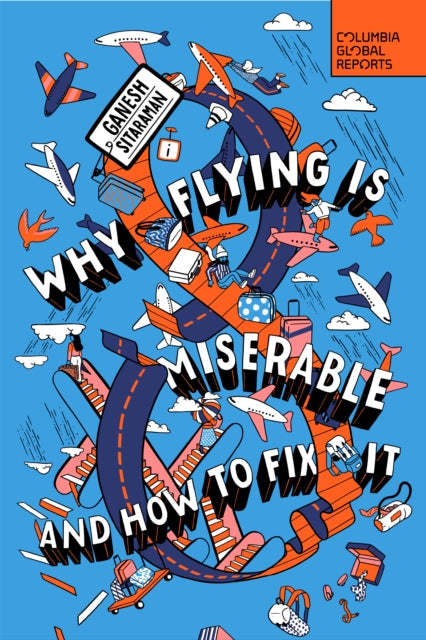
Ganesh Sitaraman
Why Flying Is Miserable: And How to Fix It
Why Flying Is Miserable: And How to Fix It
💎 Earn 49 Points (£0.49) on this item.
YOU SAVE £3.03
- Condition: Brand new
- UK Delivery times: Usually arrives within 2 - 3 working days
- UK Shipping: Fee starts at £3.89. Subject to product weight & dimension
Bulk ordering. Want 15 or more copies? Get a personalised quote and bigger discounts. Learn more about bulk orders.
Couldn't load pickup availability
- More about Why Flying Is Miserable: And How to Fix It
The airlines are in a crisis due to a conscious choice by Washington in the 1970s to roll back regulation in the name of capitalism and competition. This has led to an oligopoly with four too-big-to-fail airlines that have received billions of dollars in taxpayer bailouts and still can't offer reliable service. It is a symbol of the unregulated capitalism that America has unleashed, but there are ways to fix the industry.
Format: Paperback / softback
Length: 172 pages
Publication date: 28 December 2023
Publisher: Columbia Global Reports
Why are the airlines always in a crisis?
Everyone has a horror story about air travel—cancellations, delays, lost baggage, tiny seats, poor service. In this day and age, there is no reason that flying should be this bad.
In Why Flying Is Miserable, Ganesh Sitaraman, a law professor and policy expert, explains how this happened: It was a conscious choice made by Washington in the 1970s to roll back many forms of regulation that began during the New Deal, in the name of unimpeded capitalism and more competition. Today, the industry is an oligopoly, with only four too-big-to-fail airlines that have received billions of dollars in taxpayer bailouts and still can't offer reliable service.
Miserable air travel is the perfect symbol of the type of unregulated capitalism that America has unleashed. But there are ways to fix airlines—and, by extension, many other sectors of industry—because, after a half-century run, people are sick and tired of the turbulence that deregulation has brought to our economy.
The airline industry is a complex and multifaceted sector that has been facing numerous challenges in recent years. One of the primary reasons for the airline industry's crisis is the significant deregulation that occurred in the 1970s and 1980s. This deregulation allowed airlines to operate more freely and efficiently, but it also led to increased competition and lower fares.
As a result, airlines have been forced to cut costs in order to remain competitive, which has led to a reduction in service quality and an increase in complaints from passengers. In addition, the airline industry has been heavily impacted by the COVID-19 pandemic, which has led to a significant decline in air travel demand and a financial crisis for many airlines.
Another factor contributing to the airline industry's crisis is the consolidation of the industry. In recent years, there has been a trend towards consolidation among airlines, with larger airlines acquiring smaller airlines to expand their market share and reduce costs. This consolidation has led to a reduction in competition and has made it difficult for smaller airlines to compete with larger airlines on price and service quality.
In addition, the airline industry has been facing significant environmental and sustainability challenges. Air travel is a major contributor to greenhouse gas emissions, and airlines have been under pressure to reduce their carbon footprint and adopt more sustainable practices. However, the cost of implementing these practices can be significant, and airlines may not be able to afford to invest in them.
Despite these challenges, there are several steps that the airline industry can take to address its crisis and improve its service quality. One of the most important steps is to increase competition in the industry. This can be achieved by encouraging the development of new airlines and by promoting greater competition among existing airlines.
Another important step is to invest in service quality and customer satisfaction. Airlines can improve their service quality by investing in training and development programs for their employees, improving their aircraft and facilities, and providing more comfortable and convenient services for passengers.
In addition, the airline industry can also take steps to address its environmental and sustainability challenges. This can be achieved by investing in sustainable technologies and practices, such as electric and hybrid aircraft, and by reducing the carbon footprint of their operations.
Finally, the government can play a role in addressing the airline industry's crisis by implementing policies that promote competition and investment in the industry. This can include policies that encourage the development of new airports and air routes, policies that promote investment in sustainable technologies and practices, and policies that provide financial support to airlines that are struggling to stay afloat.
In conclusion, the airline industry is facing numerous challenges in recent years, including significant deregulation, increased competition, the COVID-19 pandemic, consolidation, and environmental and sustainability challenges. However, there are steps that the industry can take to address these challenges and improve its service quality and sustainability. By increasing competition, investing in service quality and customer satisfaction, addressing environmental and sustainability challenges, and implementing policies that promote competition and investment, the airline industry can position itself for success in the future.
Weight: 188g
Dimension: 189 x 127 x 15 (mm)
ISBN-13: 9798987053584
UK and International shipping information
UK and International shipping information
We deliver throughout the United Kingdom and to 128 countries and territories worldwide, including the United States, Australia, Canada, Germany, Spain and France.