Shulph Ink
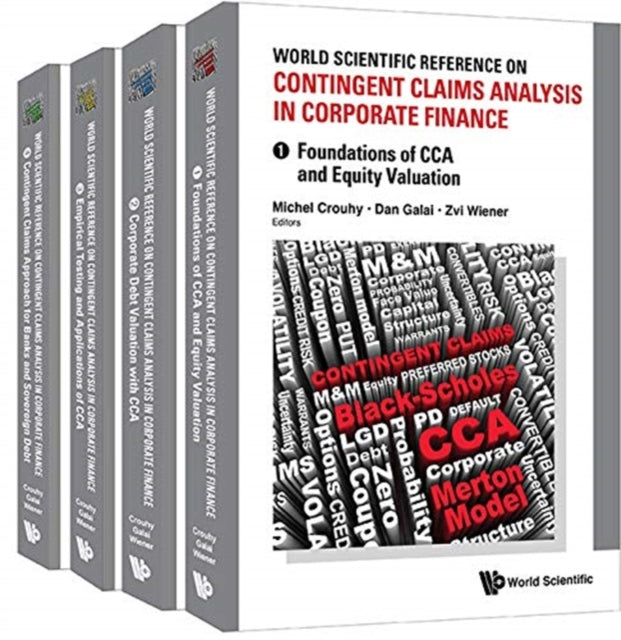
World Scientific Reference On Contingent Claims Analysis In Corporate Finance (In 4 Volumes)
World Scientific Reference On Contingent Claims Analysis In Corporate Finance (In 4 Volumes)
We can order this item for you. Delivery usually takes about 4 to 6 weeks.
This item is not held in our immediate stock. We will order it for you after checkout.
Estimated delivery: About 4 to 6 weeks
YOU SAVE £238.36
- Condition: Brand new
- UK Delivery times: Usually arrives within 2 - 3 working days
- UK Shipping: Fee starts at £3.89. Subject to product weight & dimension
Bulk ordering. Want 15 or more copies? Get a personalised quote and bigger discounts. Learn more about bulk orders.
Couldn't load pickup availability
- More about World Scientific Reference On Contingent Claims Analysis In Corporate Finance (In 4 Volumes)
Black and Scholes (1973) and Merton (1974) (hereafter referred to as BSM) introduced the contingent claim approach (CCA) to the valuation of corporate debt and equity. The BSM modeling framework is also named the "structural" approach to risky debt valuation.
Format: Hardback
Length: 2036 pages
Publication date: 14 March 2019
Publisher: World Scientific Publishing Co Pte Ltd
Black and Scholes (1973) and Merton (1973, 1974) (hereafter referred to as BSM) introduced the contingent claim approach (CCA) to the valuation of corporate debt and equity. The BSM modeling framework is also named the 'structural' approach to risky debt valuation. The CCA considers all stakeholders of the corporation as holding contingent claims on the assets of the corporation. Each claim holder has different priorities, maturities and conditions for payouts. It is based on the principle that all the assets belong to all the liability holders.The BSM modeling framework gives the basic fundamental version of the structural model where default is assumed to occur when the net asset value of the firm at the maturity of the pure-discount debt becomes negative, i.e., market value of the assets of the firm falls below the face value of the firm's liabilities. In a regime of limited liability, the shareholders of the firm have the option to default on the firm's debt. Equity can be viewed as a European call option on the firm's assets with a strike price equal to the face value of the firm's debt. Actually, CCA can be used to value all the components of the firm's liabilities, equity, warrants, debt, contingent convertible debt, guarantees, etc.In the four volumes we present the major academic research on CCA in corporate finance starting from 1973, with seminal papers of Black and Scholes (1973) and Merton (1973, 1974). Volume I covers the foundation of CCA and contributions on equity valuation. Volume II focuses on corporate debt valuation and the capital structure of the firm. Volume III presents empirical evidence on the valuation of debt instruments as well as applications of the CCA to various financial arrangements. The papers in Volume IV show how to apply the CCA to analyze sovereign credit risk, contingent convertible bonds (CoCos), deposit insurance and loan guarantees. Volume 1: Foundations of CCA and Equity ValuationVolume 1 presents the seminal papers of Black and Scholes (1973) and Merton (1973, 1974). This volume also includes papers that specifically price equity as a call option on the corporation. It introduces warrants, convertible bonds and taxation as contingent claims on the corporation. It highlights the strong relationship between the CCA and the Modigliani-Miller (M&M) Theorems, and the relation to the Capital Assets Pricing Model (CAPM). Volume 2: Corporate Debt Valuation with CCAVolume 2 concentrates on corporate bond valuation by introducing various types of bonds with different covenants as well as introducing various conditions that trigger default. While empirical evidence indicates that the simple Merton's model underestimates the credit spreads, additional risk factors like jumps can be used to resolve it. Volume 3: Empirical Testing and Applications of CCAVolume 3 includes papers that look at issues in corporate finance that can be explained with the CCA approach. These issues include the effect of dividend policy on the valuation of debt and equity, the pricing of employee stock options and many other issues of corporate governance. Volume 4: Contingent Claims Approach for Banks and Sovereign DebtVolume 4 focuses on the application of the contingent claim approach to banks and other financial intermediaries. Regulation of the banking industry led to the creation of new financial securities (e.g., CoCos) and new types of stakeholders (e.g., deposit insurers).
Weight: 4092g
Dimension: 263 x 184 x 124 (mm)
ISBN-13: 9789814730723
UK and International shipping information
UK and International shipping information
We deliver throughout the United Kingdom and to 128 countries and territories worldwide, including the United States, Australia, Canada, Germany, Spain and France.